Two new books highlight pioneering female journalists of the 1930s-40s like Martha Gellhorn and Janet Flanner, who overcame gender barriers to report on war and politics with unique perspectives. Their resourcefulness and outsider status led to innovative storytelling that challenged male-dominated journalism.
Key Takeaways
•Female journalists faced systemic exclusion from traditional reporting channels, forcing them to develop creative angles and distinctive voices.
•Women like Janet Flanner and Martha Gellhorn pioneered personal, immersive reporting styles that predated and influenced the 'New Journalism' movement.
•These reporters avoided the insularity and groupthink of male-dominated newsrooms, offering fresh perspectives on major historical events.
•Their work evolved from covering social scenes to confronting fascism and atrocities, demonstrating journalism's capacity for growth and moral witness.
•The legacy of these journalists remains relevant as modern journalism faces new threats and challenges to diverse storytelling.
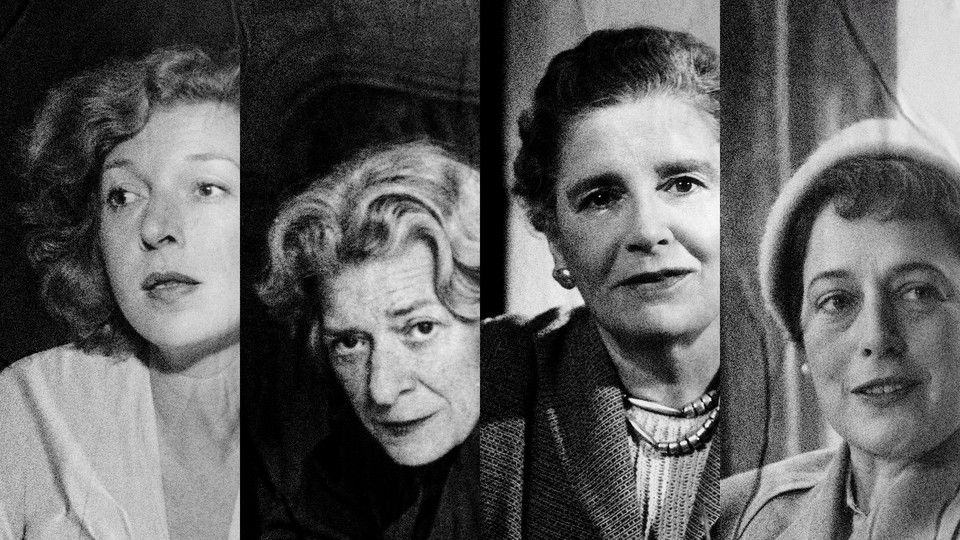
Two new books demonstrate how Martha Gellhorn, Janet Flanner, and other reporters took journalism in directions that men could not. Illustration by The Atlantic* This is a dangerous season for journalism. Legendary newspapers are being gutted by careless owners, foreign correspondents fired while still in war zones, local papers shut down entirely. Into the tumult come two new books that focus on some of the most pathbreaking journalists of the 1930s and ’40s. These reporters, all women, broke social norms to chronicle the seismic years they were living through. When read together, Mark Braude’s The Typewriter and the Guillotine and Julia Cooke’s Starry and Restlessprompt an obvious question: Why women? In other words, what is the value of looking at the history of journalism through this gendered prism?
For starters: Women were handed nothing. In many cases, when they were interested in doing serious, international stories—say, reporting on a war—they had to tell editors that they happened to be going anyway, Cooke writes, and ask: Should they send some articles? These women’s lack of access led to a resourcefulness that animated their subjects as well as their style. They also avoided the insularity of the boys’ club from which they were excluded, an inner circle whose chumminess helped breed dangerous misinformation. From 1917 to 1920, for instance, The New York Times proclaimed the imminent collapse of Communism in the newly formed Soviet Union more than 90 times. “Over drinks as often as in briefing rooms, reporters (mostly men) had taken other men’s word for it,” Cooke writes in Starry and Restless.
And because female reporters were banned from battlefields, they had to get creative in finding an angle that could illuminate the larger conflict. If they couldn’t go to the front lines, they would write about the hospital, or the home front. They had to use their voice, their style, to make the most of those subjects, establishing, Cooke argues, a precedent for the “New Journalism” that men such as Tom Wolfe were credited with having invented in the ’60s and ’70s.
Braude, in his sharply honed new history, singles out one of these writers in particular. Janet Flanner, also known as Genêt, was the subject of a 1989 biography by Brenda Wineapple; here she is seen through a tighter lens, focused on the years leading up to World War II. Braude grounds his narrative in the persistent dilemmas of journalism, especially the question of how to tell the story of a bewildering moment without the benefit of hindsight.
Flanner had escaped from a Midwest upbringing—and her husband. In 1922, she moved to Paris with her lover, Solita Solano. Both women hoped to become novelists. They lived in adjoining rooms at the Hotel Bonaparte, sharing a toilet with everyone else on the hall. Flanner wrote colorful letters about Paris to a friend back home, Jane Grant, who happened to be launching a magazine, called The New Yorker, with her husband, Harold Ross. They encouraged Flanner to keep sending her lively notes from Paris. Ross wanted, his wife wrote to Flanner, “dope on fields of the arts” and “a little on fashion,” all with “a definite personality injected.”
Flanner became The New Yorker’s first Paris correspondent, but she wrestled with insecurities in her new role. She was, after all, a woman from Indianapolis, the daughter of a mortician. Could she rise to this beat and capture this majestic capital that represented, as she put it, “Beauty, with a capital B”? She read 10 French newspapers a day. Some of her best sources were the waiters at the Brasserie Lipp, who saved their stories to whisper in her ear. In the early years of her Letter From Paris, her subjects included masked balls, gallery openings, and new additions to the cocktail menu at the Ritz. She evoked a country that many of her readers back home were hungry to hear about.
But as the mood in Europe began to turn, she struggled with how to match it. On a trip to Germany in 1933 with Solano, they saw Jews not welcome signs at the entrance to towns and “the Hitler salute from every passerby,” as Solano wrote in a dispatch for D.A.C News. The New Yorker in those days did not tend to weigh in on social or political issues. E. B. White joked that even as late as the mid-’30s, the magazine’s only political stance had been to oppose the relocation of the information booth at Penn Station.
Yet Flanner’s pieces began to widen in scope; by 1935, in a Europe rapidly darkening under a cloud of fascism, she wanted to address the largest shadow of all: Adolf Hitler. She struggled with how to approach such a daunting assignment. She was allergic to what we would now call “activism.” Braude writes that she “thought of her public role as that of a mere witness to the fractures of her time, rather than as one who would use her position to contribute to the deepening of those fractures.” She decided to take on Hitler just as she had Queen Mary, and Coco Chanel: He too was a human, and she would write about him as such. She returned to Germany to report, but chose not to pursue a direct interview with him, instead observing him from a distance, amid the enraptured crowds. She herself, Braude suggests, may have been a little too enraptured.
Flanner opened her portrait with a light-hearted observation. “It was odd,” Braude paraphrases, “that a man who didn’t drink, smoke, eat meat, or apparently, sleep with women, should be ‘dictator of a nation devoted to splendid sausages, cigars, beer, and babies.’” She’d worried about being barred from Germany for what she would write. What she didn’t expect was the reaction she received: Hitler, she heard, was pleased with the piece, even as many American readers were aghast at her light tone, her banal details, her minimizing of the Jewish plight. Malcolm Cowley, a prominent writer and editor, called Flanner a “fascist.” To a New Yorker colleague, Flanner recounted that on a trip to Hollywood she took in 1936, “the Jewish film gentlemen candidly said they thought my Hitler article was not unfriendly enough! No pleasing everybody.”
Braude uses the Hitler profile as a case study of Flanner’s complications: her courage—to go, to see, to do—as well as her blind spots. In Braude’s telling, Flanner is not straightforwardly heroic, but she is always evolving. Less rewarding is Braude’s decision to braid into the narrative the story of a German serial killer, Eugen Weidmann, whose 1939 execution by guillotine was covered by Flanner. If writing about Weidmann represented a significant breakthrough in Flanner’s career, we don’t see proof of that here. A few months after Weidmann’s execution, with France now at war, Flanner decided to return to the United States. She ceded her position as The New Yorker’s Paris correspondent to A. J. Liebling, handing over her sources at Ross’s request.
In Starry and Restless, Julia Cooke focuses on the practice of journalism in the same era, but broadens the context with a banquet of detail, alongside a portrait of three women who truly broke with the expectations of their day. Her central protagonists are Rebecca West, Martha Gellhorn, and Emily “Mickey” Hahn, the least well remembered of the trio today, though not for lack of color or talent. All three women were extraordinary in their nonconformism, bravery, and style.
According to Cooke, the number of American women working in journalism nearly quadrupled from 1930 to 1960. And although at the start of the century they had mostly been confined to subjects that helped bring in advertising—cooking, decorating, fashion—during World War II 180 worked abroad, comprising 11 percent of all U.S. foreign correspondents. Through these crucial decades, we follow West in the making of her masterpiece about Yugoslavia, Black Lamb and Grey Falcon, in which she ingeniously combined the personal voice with history and reportage. We follow Gellhorn to Spain during the time of its civil war, when she found her voice while writing about “the contrast of domesticity and war, sociability and war, safety and war.” Afterward, married to Ernest Hemingway and ensconced in domesticity in Cuba, she felt cut off from what drove her; finally, she returned to Europe, wanting to witness the actual fighting. Famously, Hemingway tried to undercut her, claiming the single accreditation offered by Collier’s, the magazine they both wrote for. She went anyway: traveling on a Norwegian freighter, ducking under a fence to escape a nurses’ training camp where authorities had hoped to confine her, persuading a Royal Air Force pilot to fly her to Naples with a made-up story about a missing fiancé. “I do not want to be good. I wish to be hell on wheels, or dead,” Gellhorn once wrote.
All of these women had an infectious “hell on wheels” quality. Hahn, who arrived in Shanghai on a whim in 1935 and stayed for six years, reporting regularly for The New Yorker, wanted her readers to see the China she had come to know and deeply love—based not only on her long tenure in Shanghai but also on her (brief, polygamous) marriage to a prominent Chinese man who introduced her to opium. Having found the reporting of other Americans on China glib, she sent pieces home aiming to deepen American understanding of the layered society she inhabited.
During the Japanese invasion, Hahn was trapped in Hong Kong; a poet there proposed to her, telling her, as she recalled, that “obviously somebody should take care of me.” She was indignant. “I’m sort of a genius myself,” she thought. “I’m entitled to a nurse or mamma too.” She rejected his proposal, and kept writing. (She eventually married someone else.)
These writers got to know one another. They were colleagues in a global endeavor. They sometimes covered the same stories, including the Nuremberg trials, for which both Flanner and West trudged to that freezing, destroyed city where 22 high-ranking Nazi officials stood in the docket—charged, for the first time in history, with crimes against humanity. Each woman would publish her impressions in The New Yorker. Flanner “didn’t flinch when describing the evidence of atrocities presented during the trial,” Braude writes, including “a child who had been decapitated and several adult heads without bodies.” This was a marked evolution from her days of reporting on the cocktail menu at the Ritz. What drove Flanner and West to that ruined place were the same forces that propelled all these women during the war years, when they so decisively honed their craft, and beyond: the need to bear witness, and to do it their own way. Their legacy is still with us, precious and precarious.
*Illustration Sources: FPG / Archive Photos / Getty; Library of Congress / Corbis / VCG / Getty; PA Images / Getty; Kurt Hutton / Picture Post / Hulton Archive / Getty.