The Trump administration dismantled DHS oversight offices, leaving ICE without accountability guardrails. This has led to increased officer shootings and a culture prioritizing aggressive enforcement over safety and proper procedures.
•ICE officers have shot 11 people since Trump returned to office, with no disciplinary actions taken against any officers involved in recent shootings.
•The administration's rhetoric and budget increases for ICE promote aggressive enforcement while removing transparency and oversight requirements.
•Former ICE officials criticize poor training and tactics in incidents like the Minneapolis shooting, warning that reduced training for new recruits makes more such incidents inevitable.
•Investigations into officer misconduct are compromised by controversial leadership and political interference, as seen in the Minneapolis case where Minnesota police were blocked from investigating.
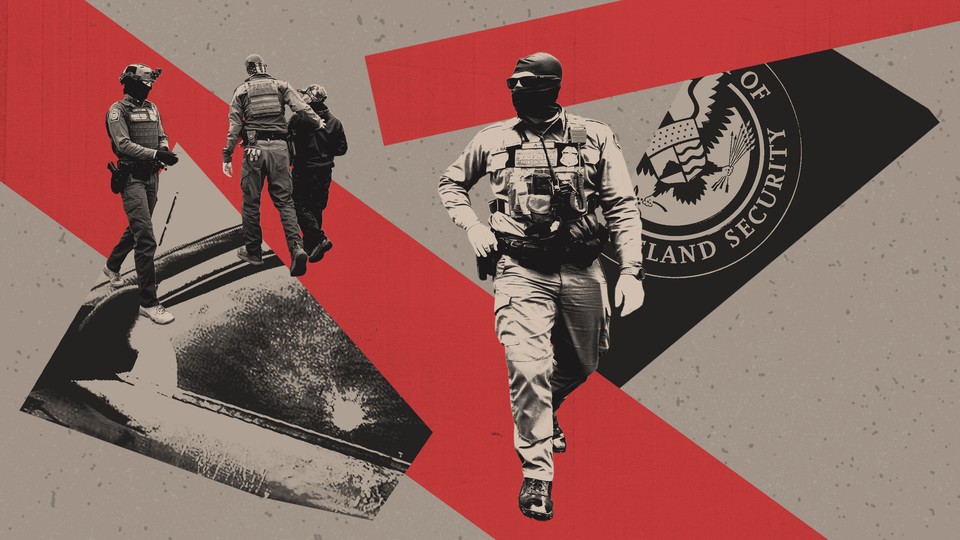
The Minneapolis shooting will get less official scrutiny because of cuts by the Trump administration. Illustration by Ben Kothe / The Atlantic. Sources: Scott Olson / Getty; Chip Somodevilla / Getty; Jamie Kelter Davis / Getty; Adam Gray / AFP / Getty. If the Department of Homeland Security’s Office for Civil Rights and Civil Liberties was still functioning as it did before Donald Trump returned to the presidency, Julie Plavsic and her former colleagues would have spent yesterday opening an investigation into the shooting death of Renee Nicole Good by an ICE officer in Minnesota. Although the DHS inspector general takes the lead on criminal investigations of officers, after an incident like this, CRCL’s job would have been to review policies, training, and oversight procedures to try to prevent anything like it from happening again. But today, the office is effectively dormant.
Plavsic was a senior policy adviser at CRCL. She and her colleagues were put on leave in March and officially dismissed from their positions two months later. The administration also closed two other offices with mandates to protect the public from misconduct—the Citizenship and Immigration Services Ombudsman and the Immigration Detention Ombudsman—saying the cuts were necessary to limit redundancy. Nonprofit groups sued, arguing that a department with more than 250,000 employees that interacts with 3 million to 4 million members of the public each day needed more oversight, not less. The offices reopened with a skeleton staff of inexperienced contractors who, former officials told me, are doing almost nothing. (DHS did not respond to my request for comment.)
Across the department, DHS has experienced considerable turnover since Trump returned to office, as supporters of his mass-deportation plans have replaced people with years of experience. “They have different priorities and they don’t care about safety and they don’t care about doing things right,” Plavsic told me. She retired after she was laid off. Since the Minneapolis shooting, she has been talking with former colleagues who no longer recognize the agency they worked for: “People are just saying, ‘I’m so glad to be unaffiliated with DHS.’”
The changes at DHS are part of a government-wide push by the administration away from transparency and accountability. Trump fired 17 inspectors general soon after he took office. He has neutered civil-rights offices across multiple departments. And he handed ICE the biggest cash infusion it’s ever seen, more than tripling the agency’s budget, without attaching any requirements for oversight. All the while, the president, his top advisers, and his public-affairs offices have pumped out rhetoric and imagery that celebrates the merciless, military-style pursuit of deportations. The overall message to employees, including those who carry weapons, is that anything goes.
The DHS oversight offices that Trump all but scrapped did not have enforcement powers, but their recommendations often led to significant policy changes. All three were created by Congress. CRCL investigated the use of whole-body restraints and sent rapid-response teams to investigate the Border Patrol’s practice of corralling people outdoors under bridges when it ran out of detention space. Staff from the Office of the Immigration Detention Ombudsman made frequent visits to detention centers, identifying violations of the agency’s health and safety standards. The Citizenship and Immigration Services Ombudsman handled more than 20,000 complaints a year from immigrants and their employers about the visa-application process.
Trump’s recent statements suggest that immigration officers are now free to act without fear of accountability. Video recordings of the Minneapolis shooting show Good telling the officer “I’m not mad at you,” then briefly moving her SUV toward him before turning away. The vehicle appears to clip him as he opens fire. But within hours of the incident, before investigators had reached any conclusions, Trump posted online that Good “ran over the ICE Officer.” Kristi Noem, the homeland-security secretary, accused Good of domestic terrorism, a label the administration has used to justify cracking down on political opponents. A DHS spokesperson blamed “rioters,” even though the recordings show no evidence of a riot. “It seems like the message is that the only repercussions are for not going far enough,” Claire Trickler-McNulty, who spent more than a decade in both nonpolitical and politically appointed positions at ICE and U.S. Citizenship and Immigration Services, told me. She departed last January.
At least 11 people have been shot by immigration-enforcement officers since Trump returned to office, two of them just yesterday, in Portland, Oregon. ICE was involved in three shootings in 2023 and five the year before, according to an analysis by The New York Times. None of the officers who shot civilians in the past year has been disciplined, according to CBS News.
The leaders of the agencies that will investigate the shooting face their own controversies. The DHS’s inspector general, Joseph Cuffari, is one of the few IGs who survived Trump’s firings, but he’s been embroiled in scandals for years. Cuffari has been accused of, among other things, retaliating against his employees and failing to disclose during his confirmation hearings that he had been under investigation when he left a previous job at the Department of Justice. (Cuffari has called the accusations “baseless.”) The administration is blocking Minnesota police from the investigation into Good’s death, leaving it in the hands of Kash Patel’s FBI.
Former ICE officers I spoke with said that the Minneapolis shooting never should have happened, and that it seemed to stem, in part, from the overwhelming pressure the agency is working under. Jim Rielly, who spent 23 years at ICE, said the encounter looks problematic from the start. It begins with Good’s car in the path of an ICE vehicle. An officer gets out and rushes toward her, yelling at her to “get out of the fucking car” and trying to force open her car door. “I would have said, ‘Ma’am, please shut your car off and get out of the car,’” he told me, sounding bewildered. “It looks like she just panicked.”
Rielly acknowledged that Good failed to comply with the officer’s demands, but he said there was no reason to fire a weapon. ICE policy allows deadly force only when there is a “reasonable belief” of imminent death or bodily harm. The officer who shot Good, identified in multiple press reports as Jonathan Ross, could have simply stepped to the side to avoid being hit, Rielly said. Ross did so, but at the same time, he shot Good three times in the face. “If she wants to drive off, let her drive off,” Rielly said.
Ross had more than a decade of experience and was part of a unit trained to handle tactical arrests, but not traffic stops. Over the summer, he was dragged by a car and seriously injured while trying to arrest the driver. Rielly and others I interviewed said that law-enforcement officers who conduct traffic stops are trained never to hold on to a moving vehicle, as it appears Ross did in the first incident, or to shoot at one, as he did in this one. Rielly also said Ross should have known better than to stand in front of Good’s car. “That’s common sense and good police work,” one officer who recently retired told me. The agency’s policy dictates that officers “avoid intentionally and unreasonably placing themselves in positions in which they have no alternative to using deadly force.”
Since the Wednesday shooting, Rielly and his former colleagues in the Chicago field office have been discussing how some ICE employees—including those who are great at their desk jobs—aren’t well trained or confident enough to calmly interact with the public. Now that ICE is bringing on new recruits in droves while cutting training time, Rielly said he worries more incidents like the one in Minneapolis are inevitable. One former colleague texted him, “You should see the guys they’re hiring now.”