Iran's weakened regime may retaliate globally through inspired lone-wolf attacks, directed criminal operations, or sleeper cells. Western nations face increased risk as Iran's intent grows despite diminished capabilities. Vigilance is crucial as attacks could target the U.S., Europe, and beyond.
Key Takeaways
•Iran's retaliation could take three forms: inspired lone-wolf attacks, directed attacks using criminal networks, or sleeper cell operations.
•Lone-wolf attacks are most likely but least deadly, while sleeper cells would be deadliest but least probable.
•Iran's proxy network is weakened but its intent for retribution is growing stronger after recent conflicts.
•Western nations must remain vigilant as U.S. counterterrorism resources have shifted to other priorities.
•Historical precedents show Iran and proxies like Hezbollah have successfully executed attacks globally.
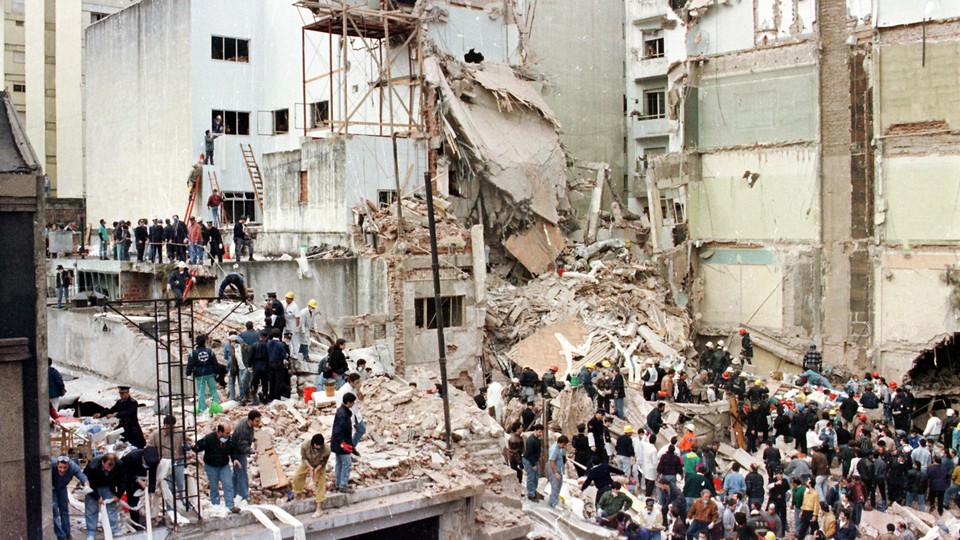
The risk of a retaliatory attack outside the Middle East is growing. Enrique Marcarian / Reuters Ever since the United States and Israel began their war against Iran last weekend, Tehran has fought back with rocket and drone strikes across the Middle East—in Bahrain, Israel, Qatar, Saudi Arabia, and the United Arab Emirates. Iran’s capacity to fight back appears to be diminishing; the number of projectiles it is launching is declining by the day. Still, as the war drags on, the risk of retaliation outside the region will increase—and that risk is already very real.
Even before images of death and destruction in Iran began flooding the internet, Western security officials had expressed concern that Iran or its proxies—Hezbollah in Lebanon, Iraqi Shia militia groups, the Houthis in Yemen—could launch attacks in the United States, Europe, or elsewhere. When Time magazine this week asked President Trump about the threat to the U.S. homeland, he said, “I guess” Americans should be worried. “We plan for it. But yeah, you know, we expect some things. Like I said, some people will die. When you go to war, some people will die.”
Besides seeking revenge, Iran’s goal for engineering high-profile attacks in the West would be to turn populations against their governments so that they push policy makers to bring the conflict to an end. Terrorist attacks in Western cities could become a pressure point, making the U.S. and its allies directly feel the pain of this war. At this stage, Iran has very little to lose, and might be willing to take more extreme actions than it has in the past. The U.S. and its allies must remain vigilant and prepare for the possibility of violence on their shores.
Iran and its proxies have a long history of conducting attacks abroad. In 1992, in response to Israel killing Hezbollah’s secretary general, Abbas Musawi, the group used a truck bomb to kill 29 people and injure 242 more at the Israeli embassy in Buenos Aires. Two years later, Hezbollah struck the city again, targeting a Jewish community center, the Asociación Mutual Israelita Argentina, where it killed 85 people and injured more than 300. Hezbollah has maintained a footprint throughout Latin America for decades and remains capable of conducting terror attacks in the region. In 2012, Hezbollah planned and executed a suicide bombing on a bus in Burgas, Bulgaria, that was carrying Israeli tourists, killing six and injuring dozens more.
Authorities have disrupted suspected Hezbollah plots over the years in Bolivia, Cyprus, Georgia, Kenya, Peru, Thailand, the United Kingdom, and elsewhere, demonstrating Hezbollah’s global reach. An Iranian diplomat was arrested in 2018, and later convicted, for supplying a couple living in Belgium with a powerful bomb that was supposed to be used in a terrorist attack targeting Iranian expatriates in France.
Since the United States assassinated the Islamic Revolutionary Guard Corps’ Quds Force commander Qasem Soleimani in 2020, Iran has attempted even more attacks. Over the past five years, U.S. authorities have disrupted 17 Iranian plots targeting the homeland. Tehran has been implicated in multiple plots to kill U.S. officials, including Trump, former National Security Adviser John Bolton, and former Secretary of State Mike Pompeo. In October 2024, MI5 Director General Ken McCallum said that in a nearly three-year span, U.K. authorities had dealt with 20 distinct Iranian-backed plots targeting British citizens and residents. After the U.S. and Israel struck Iran’s nuclear infrastructure in June, a suspected Iranian-backed terror plot was disrupted in Germany. Days before the most recent war in Iran started, a senior U.S. official told TheNew York Times that government analysts were tracking “a lot” of Iranian activity and planning but didn’t know precisely what would prompt an attack.
The so-called Axis of Resistance, Iran’s informal network of proxies, has been significantly weakened since the October 7, 2023, Hamas terror attacks and the fighting that came afterward. Notably, the June air strikes didn’t elicit a strong response from Iran or its allies. But now, after the assassination of the supreme leader, Ayatollah Ali Khamenei, and with the collapse of the Iranian regime looking more likely, the IRGC and its progeny are in an existential moment.
Iran’s retribution against the West could take three possible forms: inspired attacks, in which individuals who are radicalized by current events or Iranian propaganda decide to act on their own; directed attacks, in which Iran relies on third parties such as transnational criminal organizations; and attacks by sleeper cells, which consist of Iranian operatives or terrorist proxies deployed to Western countries years ago in order to respond in the event of a catastrophic U.S.-Iran war.
In the near future, the most likely of these scenarios is an inspired act by a lone wolf or homegrown violent extremist. During the two decades of the global War on Terror, the primary lone-wolf threat emanated from Sunni jihadists motivated by propaganda produced by al-Qaeda, the Islamic State, and their various affiliates. Now, following the assassination of Khamenei, one of the most revered figures in Shia Islam, Shia extremists could replace Sunni jihadists as the biggest transnational terrorist threat. In August 2022, Hadi Matar, a New Jersey resident, traveled to the Chautauqua Institution in upstate New York, where he stabbed Salman Rushdie, against whom a fatwa had been issued in 1989 by Iran’s former supreme leader, Ayatollah Ruhollah Khomeini. The day after the war with Iran began, a man wearing a sweatshirt that said Property of Allah and a shirt with a design similar to that of the Iranian flag killed three people at a bar in Austin, Texas; the incident is being investigated as a potential act of terrorism, although little is known about the perpetrator’s motive at this point.
Lone-wolf attacks are the most difficult kind to predict because, as the name suggests, the individuals don’t have accomplices and they eschew guidance from both state and non-state actors. When a plot is designed by one person, there is less of a chance for what authorities refer to as “leakage” of the plans. If the assailant is not already on law enforcement’s radar, preventing the plot becomes even more challenging. But even though an inspired attack is perhaps the most likely possibility, these attacks are the least likely to result in high casualty counts, because many lone wolves have little to no training and the plots can be amateurish in nature.
The Iranians would have more control over a directed attack, in which the IRGC would commission gangs, criminals, or Mafia members to carry out their work. In 2011, U.S. authorities charged Manssor Arbabsiar for a foiled plot to assassinate the Saudi ambassador to the United States, Adel al-Jubeir, on directions from the Quds Force. (Arbabsiar pleaded guilty in 2012.) Part of that plot involved working through an individual whom the Iranians believed was a member of the notorious Mexican drug-trafficking gang Los Zetas. Then in 2022, Iran paid two members of an Eastern European criminal syndicate to kill the Iranian dissident and journalist Masih Alinejad at her home in Brooklyn; this attack was also foiled.
Working through criminal groups can be effective, but it also exposes Iran and its supporters to potential undercover operatives. These plots require communication among Iranian handlers and those tasked with gathering weapons, selecting targets, and devising operational plans. The more communication among nodes in the network, the greater the opportunity for U.S. intelligence agencies to interdict such communications, including through signals intelligence.
The most unlikely scenario for Iranian retaliation against the West would be for the regime to rely on sleeper cells. Planning for this approach is challenging because it requires Iranian agents or terror proxies to have established deep cover for years. Still, this approach would also potentially be the deadliest, because those deployed for such an operation would be elite members of the IRGC, Hezbollah, or another Iranian-sponsored group.
In 2017, U.S.-based Hezbollah operatives Ali Kourani and Samer el Debek were arrested for activities allegedly conducted on behalf of Hezbollah’s external-operations wing. Kourani admitted to the FBI that he was part of a sleeper cell and was sentenced to prison. Two years later, in 2019, a New Jersey resident named Alexei Saab was arrested for scouting U.S. landmarks for a potential Hezbollah attack. The sites surveilled by Saab included Times Square, Wall Street, the New York Stock Exchange, Rockefeller Center, and many other soft targets. He was convicted and sentenced to 12 years in prison.
Despite the successful record of U.S. law-enforcement and intelligence agencies in disrupting Iranian-backed plots on American soil, and even with a more feeble Iranian proxy network, there is good reason to be concerned today. Over the past several years, the U.S. government has shifted resources and personnel away from counterterrorism and toward other priorities, including China, Russia, and immigration. Because of this, the U.S. homeland is arguably more vulnerable than it has been in a long time.
And then there’s the question of Iran’s desire for retribution. Terrorists need both capabilities and intent to succeed. Even as the Iranians’ capabilities are being attenuated, their intent to attack, if anything, is growing stronger.