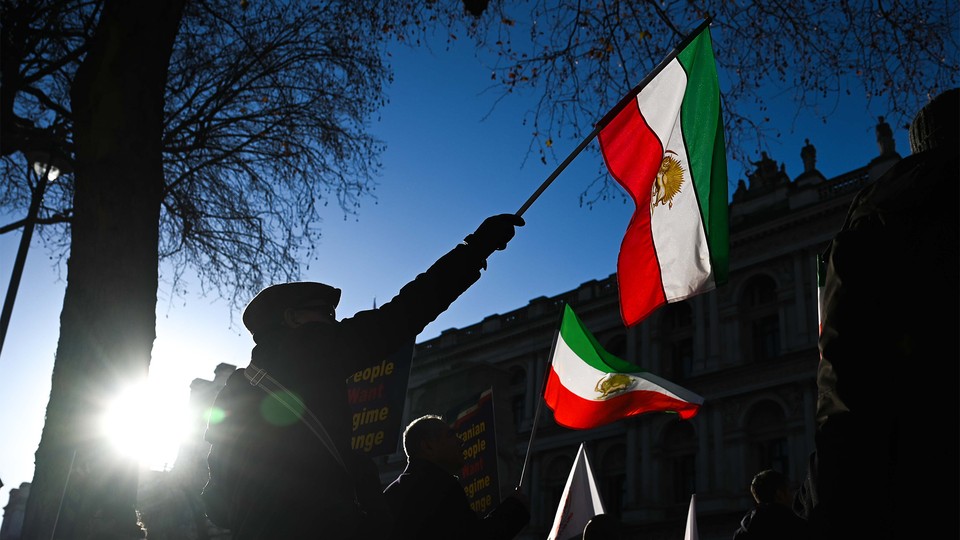
The article criticizes the American left's lack of support for Iranian protesters facing brutal crackdowns, contrasting it with their vocal advocacy for Palestinians. Iranian exiles express feeling abandoned by progressive peers who view the protests through ideological lenses, dismissing them as Western plots rather than genuine struggles for freedom.
Key Takeaways
•Many on the American left view Iranian protests through anti-imperialist ideology, seeing them as CIA/Mossad plots rather than authentic movements for basic rights.
•Iranian exiles feel betrayed by progressive allies who show solidarity with Palestinians but dismiss Iranian protesters with suspicion or conspiracy theories.
•The left's framework often prioritizes ideological consistency over empathy, defending Iran's regime as anti-imperialist despite its oppression of citizens.
•This selective solidarity reflects a broader pattern where non-Western aggressors (like Iran's government) receive muted condemnation compared to Western ones.
•The debate reduces Iranians to pawns in geopolitical games, ignoring their agency and the ordinary people risking their lives for freedom.
As the Islamic Republic massacres protesters, exiles are dismayed by the lack of sympathy from the American left. Rasid Necati Aslim / Anadolu / Getty Whenever I hear the plaintive lyrics of “Baraye,” the song that became an anthem for the 2022 Iranian protests, I still tear up—and I find it hard to imagine anyone having a different reaction. Shervin Hajipour, then 25, wrote it by stringing together a list of young Iranians’ reasons for going to the streets. They want to kiss in public without fear and not be forced to spout empty slogans. They want an economic future and clean air. These are what the Czech dissident Václav Havel called the “aims of life,” which in authoritarian counties, places like Iran, slam right up against the “aims of the system.”
Iranians are out in those streets again, pursuing those aims. And this time they are being slaughtered for it in numbers that have not been seen before—estimates of the death toll are rough (because the internet and most international communication have been cut), but they run anywhere from 2,000 to 12,000.
This is a simple story: People are risking their life to resist tyranny, engaging in a human struggle for basic rights. Its resonance, particularly for those on the left, should be self-evident. It has all the greatest hits—pitting the powerless against power, freedom against repression, unarmed men and women against snipers. But in the most animated corners of the activist ecosystem, so recently energized by their opposition to the death and destruction in Gaza, it has not resonated. The protest has been viewed instead through the thick lens of ideology, producing a reaction that has been dismissive at best and, at worst, degrading to the Iranians themselves. Many thousands of demonstrators, rising up all over the country, are accused of being witless tools of an imperialist agenda, part of a “CIA-Mossad regime change campaign,” or maybe just actual “Mossad agents.”
These might be the most extreme examples—it’s easy enough to find any opinion on social media—but there are clear signs that they represent a pervasive line of thinking on the left. By Wednesday, they had reached a sustained-enough pitch that Cornel West, a high priest of anti-imperialism, was moved to reprimand his own comrades for “playing some ideological games”: “Shame on those on the left who view precious Iranians solely as pawns,” he said in a video posted on X. (For this, he was derided in replies as a “clown,” a “fool,” and “a useful tool of Zionism.”)
But I didn’t need to go online to see evidence of this myopia, or the effect that it is having on those who are distressed by what’s happening in Iran. I spoke this week with a number of Iranian exiles who consider themselves progressive and pro-Palestine—many of them used the word genocide, for instance, to talk about the conflict in Gaza. Overwhelmingly, they told me that they felt abandoned—rejected by peers whom they had believed shared their values. (I felt something like this myself in the days immediately following October 7.)
“I feel isolated and betrayed,” said Fatemeh Shams, a feminist scholar and poet at the University of Pennsylvania, referring to fellow academics. “I have already unfriended a bunch of these idiots who are, unfortunately, my colleagues. I don’t even know how I can bring myself, in the future, to even go to their conferences and give papers.”
In my conversations with these Iranian exiles, I heard deep frustration. Whether they are responding to social media or drawing conclusions from a lack of organizing was sometimes hard to tell, but they confirmed for me that this was not just a problem of the very online: The Iranian protesters stepping fearlessly into the sights of government snipers are being seen by the American left with more suspicion than sympathy. Perhaps I shouldn’t have been so surprised, given the state of American polarization. In many ways this is just the latest example of the epistemic rupture between left and right, a framework that applies settled, simplified templates to anything reality presents us with, including the recent shooting in Minneapolis—discarding what is inconvenient and swallowing what is most palatable.
This framework has ideological, if not factual, consistency. In the (admittedly) simplified version of the hard left’s worldview, the Iranian regime represents an anti-imperialist force that should be defended against America and Israel, two countries they view as agents of oppression. I can’t help but think of the way some intellectuals in the 1950s ignored Stalin’s Gulags because the Soviet Union was the side they wanted to support in the Cold War. From this Manichaean perspective, what is happening in Iran right now as the bodies pile up is possibly exaggerated, possibly the work of the Mossad or the CIA, or at the very least a disruption openly desired by Donald Trump and Benjamin Netanyahu (and therefore evil).
What could be fueling this perception on the left is the fact that the right is indeedviewing the protest through its own interests. Trump said he hopes to “make Iran great again”—though as of this writing, the president seems to have backed off his threat of intervention, convinced that “the killing in Iran is stopping—it’s stopped—it’s stopping,” as he stutteringly put it. To many on the left, agreeing with the premise that regime change would be optimal feels like encouraging the start of another war in the Middle East. And if you ask a college activist why they are willing to protest in support of Palestinians but not Iranians, they might answer, logically, that the United States is complicit in the killing in Gaza because of the money that flows to Israel, whereas it already sanctions the Islamic Republic—so there is no policy change to agitate for. This argument, however, sounds pedantic to me, like a point scored in a debate rather than a real explanation for why some human dramas compel empathy and action and others do not.
The Mossad and CIA conspiracy theories also draw on real facts: A slice of the opposition in Iran is loyal to Reza Pahlavi, a son of the former shah who expanded his power in 1953 with the CIA’s backing. Pahlavi does not seem to represent a democratic, pluralistic vision of the country’s future, and he is openly courting American and Israeli intervention.
This has all led to an orgy of whataboutism, as the left and the right mock each other for caring only about their favored victims. Lost in this pointless food fight is what is actually happening to the Iranian people, who are fighting against a sclerotic regime that has insinuated itself into the most private corners of their life and proved itself incapable of maintaining a standard of living for its citizens.
“We’re between a rock and a hard place,” Ali Abbasi, an Iranian-born film director based in Denmark, told me. “The left doesn’t believe us, because they think we have the wrong supporters. The right wants us to go and, you know, overthrow the Islamic Republic and install a pro-Israeli, pro-right” leader. “And in the middle are millions and millions of Iranian people who just know this system has hit an absolute dead end.”
I am not shocked by the positions held by the right; perhaps because of this, I feel more troubled by the quiet on the left. If you’re someone attuned to suffering, you should be strongly inclined to feel a sense of solidarity with the protesters in Iran. And I’d hoped that somewhere in the leftist body, beneath layers of ideological bloat, the muscle for expressing basic opposition to totalitarianism was intact. I don’t think I’m being self-indulgently nostalgic when I recall that there used to be an international left capable of activating on behalf of people fighting fascism anywhere in the world, simply as a matter of principle.
For the exiles I spoke with, the most disturbing—and telling—thing about the tepid response was the contrast with the impassioned reaction to Gaza. “Why is it that when Palestinians—armed or unarmed—fight for liberation, it is seen as a moral duty to support them, but when Iranians protest, they are labeled ‘armed terrorists’ or ‘agents of Mossad?’” Shams, the feminist scholar, said.
Janet Afary, a religious-studies professor at UC Santa Barbara, helped put this dissonance in context. She described for me a long history that would explain the left’s knee-jerk sympathy for the Islamic Republic, starting with the leftist elements that helped lead the 1979 revolution (alongside the clerics who ended up seizing full control). For those who want to see the end of Israel, the regime’s identity as a defender of Palestinian rights—and a funder of extremist anti-Israel groups such as Hamas and Hezbollah—has given it cachet.
Afary recalled confronting a colleague who was dismissive of the 2022 protests, which were largely driven by feminists; this person wondered why Iranian women can’t just wear hijab like other women in the Middle East. “Are you saying this because you don’t want the government of the Islamic Republic to be overthrown because it supports the Palestinian cause?” Afary asked her. She said yes. “To my face!” Afary said.
The ideological left doesn’t know what to do with violence that doesn’t involve a Western aggressor, according to Kamran Matin, another exile and an international-relations professor at the University of Sussex in England. Matin noted other groups that received only muted support from anti-imperialists, including the Yazidis, persecuted by ISIS, and Rohingya, victims of the Myanmar government—in which case the aggressors were not Western hegemons. If you jump to the barricades against these atrocities, “then the whole edifice of postcolonial anti-imperialism basically collapses. Because for them, it feels like they dilute their case against the West by accepting non-Western cases.”
I also wonder if what distinguishes Gaza from Iran is that Palestinian civilians represented perfect victims, people bombed simply for living in Gaza, especially in places where Hamas was operating. The picture in Iran is more complicated; the protesters are fighting for regime change, and they comprise a melange of opposition groups with various motives and ideas about a post-ayatollah Iran. The opponents of the mullahs are, for now, powerless against them. But they are also, ultimately, jockeying for power, with various international forces behind them. (This is true of Palestinians, of course, but the endgame seems very far off.) Outsiders might think that supporting the protests would amount to support for one or another faction.
This sort of litmus test is exactly what the exiles I spoke with find so disheartening because it doesn’t regard Iranians as people with agency who deserve their own freedom. Some even described as racist the assumption, as Abbasi put it, “that people of a country like Iran are never able to make their own decisions, and they’re always puppets of some government, some power.”
All you have to do, he added, is look at who is getting killed to understand that this is a movement of ordinary people—and he wants the focus to return to them. “Of the few people that are named among the killed, one of them was a costume-design student,” Abbasi said. “The other one was a bodybuilder. The third one was a sculptor. These are not the people who work for anyone. If the CIA was really using a sculptor to do armed operations in Iran, then it’s mismanaged.”
Nearly a week into the communications blackout, and with stories of extreme state violence leaking out, Abbasi and his fellow exiles seemed desperate to have their case taken up by as broad a public as possible, one that bridges partisan politics. But when I spoke with Siamak Aram, the president of the National Solidarity Group for Iran, he didn’t sound particularly hopeful on this point. He told me that a demonstration planned for this weekend, which was meant to bring together multiple factions of Iranian opposition, had almost no participation from non-Iranian activist groups.
This was unfortunate, Aram said, because the argument for supporting his people should be legible to the left. “If a police officer kneels on the neck of a man, we condemn that,” he said. “If a sniper shoots a girl in Tehran, we must condemn that.” Aram also thinks we need to find a way to see the human beings in this story. “The failure of both sides, of left and right, would be that they are letting their political calculator override their moral compass. They are asking, Who benefits if I condemn this?, instead of asking, What is wrong; what is right?”