The Brown University shooting highlights America's failure to protect children from gun violence. Despite repeated tragedies, political inaction and cultural acceptance make meaningful gun legislation seem increasingly unlikely.
Key Takeaways
•The Brown University shooting represents a systemic failure to protect students, with victims like Mia Tretta experiencing multiple school shootings in their youth.
•Political gridlock and cultural factors make 'common sense' gun legislation appear increasingly unrealistic in current America.
•Mass shootings have become normalized to the point where they no longer inspire the same level of public outrage and creative response as earlier incidents like Columbine.
•The incident exposes how even elite educational institutions can no longer guarantee the safety that was once taken for granted on campus.
•Survivors of previous shootings attending Brown demonstrate how gun violence repeatedly traumatizes the same individuals across different stages of life.
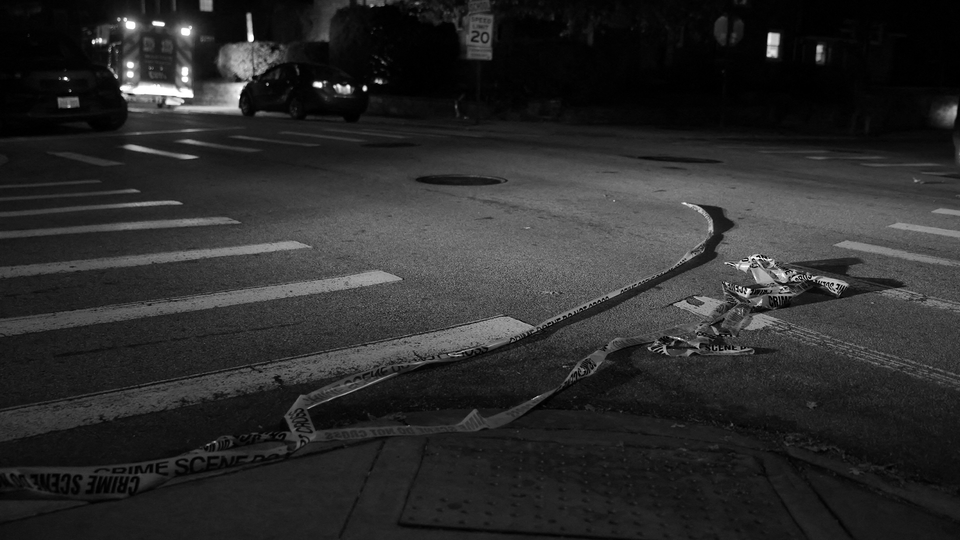
Yesterday’s attack at Brown University is just the latest example. Taylor Coester / ReutersUpdated at 1:20 p.m. ET on December 14, 2025
Nothing encapsulates the failures of our society more than what just happened to Mia Tretta. When she was 15, she was shot in the stomach by a classmate at her high school in California. Yesterday, she survived the second school shooting of her short life: A person opened fire at Brown University, where Tretta is a junior.
Students were studying for finals when a shooter walked into an economics classroom and started firing, killing two students, injuring nine, and inflicting terror on not just a campus but an entire city. No suspect has been named yet, but authorities have detained a “person of interest.”
I left Brooklyn to attend Brown in 1995, when New York City had yet to shake its rough-and-tumble reputation. Of all the amenities that the Ivy League campus provided—bountiful libraries, a full-service gym—the most luxurious to me was a sense of safety. I’d walk around campus at all hours of the night; just the other day, my freshman roommate and I reminisced about keeping our dorm room unlocked so our friends could come and go. Despite how much has changed in the decades since I was there, it was that sense of security that had, after what she’d endured in high school, appealed to Tretta.
I’m a trustee at Brown now. Many of my friends have children there, and I know and care for countless staff members and administrators. When yet another tragedy like this takes place in America, everyone grieves. But it feels different when it happens so close to home. When you hear that your friend’s daughter is hiding in a bathroom in the Sciences Library, you can picture the tiny floor tiles she’s staring at. You can conjure the smell of the heat in the dorm where a student you recently had coffee with is sheltering in place. And you’re able to picture the streets where the shooter is rumored to have been running at large.
I have always believed that the mass shootings that define our nation are preventable. But more and more, I have to wonder if that is not a bit of dated, magical thinking. In Donald Trump’s America, the idea of politicians passing “commonsense” gun legislation feels as removed and naive as hanging up a HOPE poster. It’s possible that the dual ills of creating the violent, misanthropic young men who tend to be the culprits and protecting the guns they arm themselves with are both too endemic to our culture to change.
I was a senior at Brown, sitting in a coffee shop a stone’s throw from where yesterday’s attack occurred, when I read about two boys in Colorado who’d donned black trench coats, walked into their high school, and opened fire with pump-action shotguns. At the time, it was a shocking story. It inspired a documentary, a film, and songs. If each school shooting that’s happened since had inspired such creative output, we could populate an entire streaming service.
Every mass shooting in America fills me with sorrow, but this particular incident has been coupled with a dose of nihilism. Across the nation this week, students will be opening emails announcing their early-decision college acceptances. For many of America’s children, it’s the culmination of the zero-sum game of elite college admissions. They have been trained from their earliest years to pass exams and write essays so that they may one day be lucky enough to study for their finals in an Ivy League classroom where, randomly, at any moment, a shooter might open fire.
Over the past day, I’ve found myself ruminating on Thomas Hobbes’s Leviathan. In Hobbes’s estimation, the natural state of things was chaos: competition, violence, greed, war, self-interest, and economic insecurity. Government was the only solution to provide order and create a functioning society. Even tyranny, according to Hobbes, was better than all of that. Today, we seem to have saddled ourselves with tyranny while being mired in more chaos than ever.
No matter how great our collective amnesia, these mass shootings add up. Tretta is not even the only student at Brown who had already been involved in one. Zoe Weissmann, now 20, was only 12 when gunshots were fired at Marjory Stoneman Douglas High School, in Parkland, Florida. She was in a classroom in the middle school across campus. Yesterday she told The New York Times, “What I’ve been feeling most is just, like, how dare this country allow this to happen to someone like me twice?”
This article originally misstated the number of shooters involved in the Columbine massacre.