The U.S. is building up military forces near Iran, potentially for war. The conflict's nature depends on U.S. goals, which could range from targeted strikes to broader attacks on Iran's nuclear or missile programs. However, military action risks Iranian retaliation and may not achieve long-term objectives.
Key Takeaways
•The U.S. has significantly increased military assets in the Middle East, including aircraft carriers and fighter jets, amid tensions with Iran.
•Potential U.S. military goals include targeted strikes on Iranian leadership, attacks on ballistic missile facilities, or strikes on nuclear sites, each requiring different approaches.
•Iran is likely to retaliate against any U.S. attack, posing risks to U.S. troops and regional stability, even with limited strikes.
•Military action alone may not permanently disable Iran's nuclear or missile programs, as Iran could rebuild capabilities over time.
•The U.S. military buildup could serve as leverage in negotiations, but there is pressure to use the assembled forces if diplomacy fails.
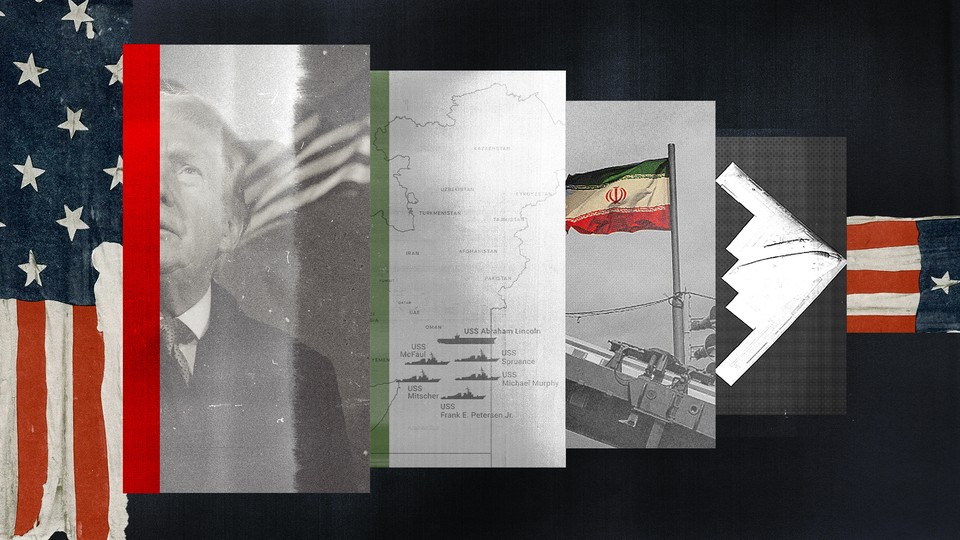
How the U.S. conducts any attack will depend on what goal Trump is trying to achieve. Illustration by Matteo Giuseppe Pani / The Atlantic* During President Trump’s first term, Pentagon officials took a highly unusual step to diminish the likelihood of war: They shared their plans for a large-scale conflict with Iran with top White House officials. They reasoned that if advisers saw the risks that the plan entailed, they would choose another path, people familiar with the matter told me.
The gambit was successful. At least twice, the president weighed ordering an attack on Iran, only to be dissuaded by aides from moving forward. But America now appears to be on the brink of war with Iran again. And this time, instead of acting as a deterrent, the Pentagon’s war plans are being used to draw up options for the president to consider.
The United States is rapidly building up its military assets in the Middle East. More than 100 aircraft—including F-18 and F-35 fighter jets, drones, and surveillance planes—are in or near the region. The U.S. also has bolstered its air defenses to protect U.S. troops on nearby bases. The world’s largest aircraft carrier, the USS Gerald R. Ford, left the Caribbean (where it had anchored a pressure campaign against Venezuelan President Nicolás Maduro) and is expected to be within striking range as early as Sunday. Three destroyers and, most likely, two accompanying submarines with guided missiles on board will join it. The USS Abraham Lincoln carrier strike group also is nearby.
Asked yesterday whether he now favors a limited military strike, Trump told reporters, “I guess I can say I am considering that.” But the administration has given no specific timeline for making a decision. And despite the impressive concentration of power, administration officials have yet to articulate a clear goal for what they want these forces to achieve, should Trump conclude that Tehran’s time has run out. Instead, they have floated four separate aims, each requiring a different military approach.
I asked current and former defense officials to help me project what a war intended to achieve these four desired outcomes might look like. Their answers were informed by previous similar campaigns, but also by the prospect of Iranian retaliation against the thousands of troops stationed in the region. “Every military option is not about just what we can do, but about protecting ourselves and our interests during the inevitable Iranian response,” a former commander told me.
It’s possible that the simple threat of action—a Rooseveltian big stick—will make conflict unnecessary, encouraging Iran to reach a new deal designed to permanently clip its nuclear ambitions. Admiral Brad Cooper, who leads U.S. Central Command, sat in on talks between the U.S. and Iran in Oman earlier this month. The negotiations focused on Tehran’s nuclear ambitions and its ballistic-missile program. Cooper’s presence marked a flex of military muscle and a reminder of the potential consequences should diplomacy fail. “The president is a negotiator looking for a deal; it would be wise for Iran to see that deal,” Defense Secretary Pete Hegseth, not usually the administration’s go-to voice for tempered responses, told The Daily Signal on Thursday.
The military buildup itself appears designed to send an overt message to Iran. Flight trackers captured dozens of U.S. military aircraft traveling toward the region this week. The military can be more furtive about its movements ahead of an operation, taking steps to hide aircraft from detection. When B-2 bombers flew into Iranian airspace last summer, for example, “no one was tracking them,” another military commander, who has worked in the Middle East, told me. This time, visibility may have been the point, the officials said.
If the armada is there as a form of leverage, and the U.S. and Iran reach a deal that Trump accepts, the troops would leave. But this appears to be an unlikely scenario. The buildup is one of the largest in the region in decades, and with every plane, ship, and asset that arrives, the president will face increased pressure to use them, much as a loaded gun that appears on stage in the first act of a play must be fired by the end. And just sitting on the ocean carries its own cost: The USS Ford, which has been deployed since last June, is on track to complete one of the longest deployments ever for a carrier. “We can’t keep the force out that long,” one former defense official told me.
Despite the flurry of talks over the past three weeks between the U.S. and Iran, in which Oman acts as the go-between, the two sides remain divided over what a fair deal would look like. “I think there is a real intent to use this force if they cannot get an agreement that is acceptable to the United States,” Mick Mulroy, a former deputy assistant secretary of defense and an officer in the Marine Corps and the Central Intelligence Agency, told me.
Based on past U.S. and Israeli strike campaigns inside Iran and elsewhere, the U.S. Navy would be at the forefront of any operation. Stealth fighter jets, such as the F-35, would take off first alongside EA-18G Growlers, which conduct electronic warfare, including jamming radar systems. Both aircraft would target Iranian air defenses protecting a country slightly larger than Venezuela and Afghanistan combined.
Submarines, which carry scores of Tomahawk missiles and sometimes accompany the carriers (the U.S. military does not generally share its submarines’ locations), could also launch missiles toward fixed targets inside Iran. Fighter jets and bombers could launch strikes from the air on Iran’s defenses.
How long such a U.S. campaign would take depends on the extent of the targeting. And the longer a campaign runs, the greater the risk of civilian casualties. During the June strikes, which hit some of Iran’s defenses as well as damaged its nuclear sites, U.S. aircraft were inside Iran for roughly 30 minutes, according to defense officials. Should Iran launch any missiles in retaliation, destroyers dispersed across the region would defend U.S. ships, troops, and allies by shooting down any incoming ballistic missiles.
What happens next hinges on what the U.S. hopes to achieve.
Trump has long hinted that military action could target Iran’s leadership. As far back as June 2025, he described Iran’s supreme leader, Ali Khamenei, as an easy target. “I knew EXACTLY where he was sheltered, and would not let Israel, or the U.S. Armed Forces, by far the Greatest and Most Powerful in the World, terminate his life,” he wrote on Truth Social. Targeted strikes on Iran’s leaders are among the options on the table today, defense officials told me.
That option would require boots on the ground—and could put civilians at risk. Maduro was seized in his bedroom by U.S. Special Forces. But so far, the U.S. does not appear to be considering similar action in Tehran. Once Iran’s air defenses are immobilized, U.S. forces would likely use precision weapons, such as a laser-guided bomb, to hit specific individuals, though that would inevitably risk hitting civilians as well. Depending on how many leaders the U.S. planned to target, such a move could lead to a relatively quick operation, defense officials told me. Targeting leaders would be in keeping with Trump’s stated interest in helping Iran’s legions of protesters, who faced a brutal clampdown in recent weeks that led to the death of thousands of people. Taking out Iran’s leadership could potentially embolden protesters and foment the kind of political change in Iran that Washington has long sought.
But if the U.S. takes out Iran’s top leadership, the Islamic Revolutionary Guard Corps, or IRGC, a powerful branch of Iran’s armed forces, could take control and steer the country toward an even more hostile posture toward the United States. And targeting leaders could lead to the most aggressive possible Iranian military response, given the regime would have little to lose. Earlier this month, Iran conducted a military exercise in the Strait of Hormuz, signaling that its navy had enough resources to create a choke point in a channel that carries one-fifth of the world’s oil.
In December, Trump said he would strike if Iran continued building ballistic missiles. Eliminating those weapons, as well as other elements of Iran’s defense, could be another possible goal of any upcoming campaign.
Strikes could take aim at Iran’s ballistic-missile-production network, including storage locations, transportation networks, and other supporting infrastructure. Both Israel and the U.S. have targeted the program in the past, but since the June strikes, Iran has prioritized rebuilding its capabilities, likely in anticipation of another U.S. strike, the officials said.
Iran has invested more in rebuilding its missile program than in rebuilding its damaged nuclear program, according to high-resolution images shared with me by Vantor, a Colorado-based company. The U.S. likely would launch ordnance from fighter jets, such as F-15s, to hit these targets.
“It looks to me, based on the forces in the region, the U.S. is considering going after softer targets, like IRGC bases and production facilities, over a protracted period of time,” Bryan Clark, a senior fellow at the Hudson Institute and a retired Navy officer, told me. “Those facilities support both Iran and its proxies. Going after those targets would allow the U.S. to achieve part of what they were seeking through the talks.”
Such strikes could last days and limit Iran’s ballistic-missile capability to only the missiles already positioned on their mobile launchers. But even a limited number of available missiles could still pose a threat. And the Iranians could rebuild those facilities in a matter of months, depending on the extent of the damage.
Iran also would retain the ability to retaliate, even without its full arsenal of missiles. An Iranian Shahed-139 military drone was operating in the Arabian Sea earlier this month when it approached the USS Abraham Lincoln; the U.S. military shot it down as it neared the ship, which was not harmed. But the drone’s flight path could be read as a message from Iran about the perils of war.
Of all the targets in Iran that Trump has mentioned, he has talked of Iran’s nuclear program the most. In a January Truth Social post, he blared, “NO NUCLEAR WEAPONS” and warned, “The next attack will be far worse!” The president could again order U.S. forces to strike Iran’s nuclear program, as they did in June when bombers hit three Iranian nuclear sites and damaged facilities. That operation would likely pose the least imminent risk to U.S. troops and the region. (After the June strikes, Iran fired some missiles at a U.S. base, but they did not do much damage.)
Attacking nuclear facilities, which are mostly deep underground, would likely require B-2s carrying GBU-57s, so-called “bunker buster” bombs designed for hardened targets. The duration of the operation would depend on how much damage the U.S. seeks to inflict on the program.
Iran already appears to be preparing for this option by fortifying its defenses around its nuclear assets, satellite images from Vantor indicate. But the fact that the U.S. would be conducting its second action against the program in less than a year raises questions about the long-term impact of such attacks, and could contradict Trump’s own assertions last year that the program had been “obliterated.” And strikes alone cannot kill Iran’s expert personnel or dim its ambitions to one day build a nuclear weapon.
“I think we should come off the idea that we are going to ever obliterate the nuclear program. It’s not something only the military can do,” Mulroy, the former deputy assistant secretary of defense, told me, because such programs ultimately end through negotiations or political change. “We can degrade something. We can destroy something. But that doesn’t mean they can’t rebuild it.”
For all the military options and assets in the region, there is a lot the U.S. cannot do. The buildup is not the equivalent of the 2003 invasion of Iraq. Then, the U.S. sent five carrier strike groups, many more aircraft, and roughly 170,000 ground troops. Indeed, a large formation of ground troops appears to be outside the realm of Trump’s considerations now. But without them, there are limits to what U.S. strikes can achieve.