Total Lunar Eclipse over Tse Bitai
AI Summary2 min read
TL;DR
A total lunar eclipse occurred earlier this week, with Earth's shadow turning the Moon red due to atmospheric scattering. The event was captured in a sequence over Tsé Bit'a'í, a volcanic rock significant in Navajo culture, and was visible across continents.
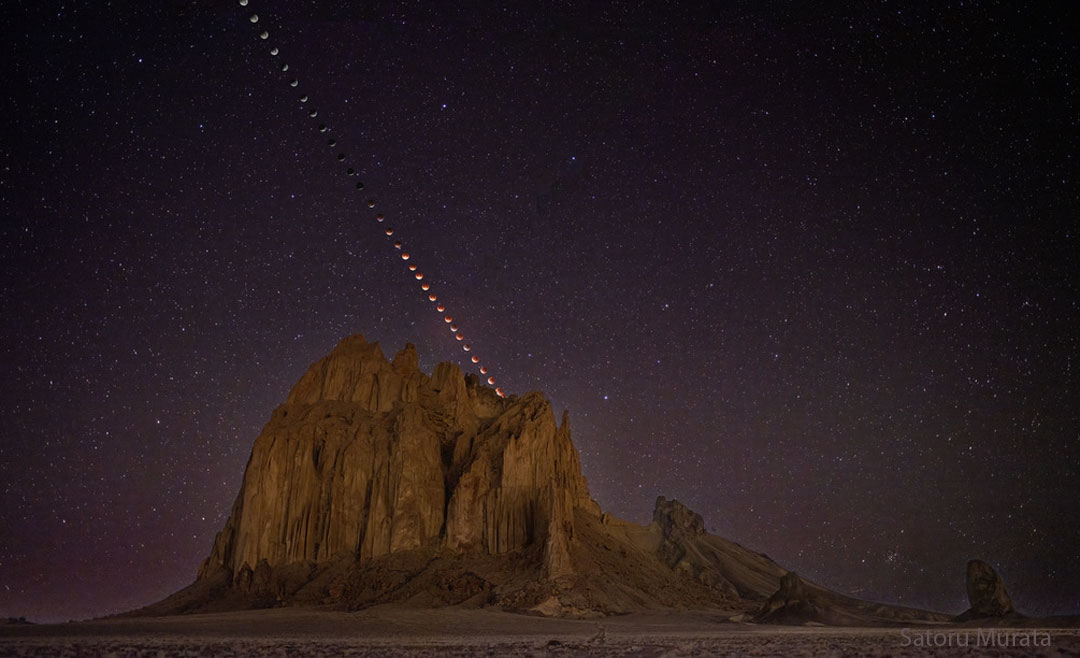
Total Lunar Eclipse over Tsé Bit'a'í
Image Credit & Copyright: Satoru Murata; Text: Keighley Rockcliffe (NASA GSFC, UMCP, CRESST II)
Explanation: Earlier this week, Earth’s shadow swept across the full Moon in the year’s only total lunar eclipse. This stunning sequence combines images showing the Moon’s path across the night sky. Each lunar image captures our planet’s shadow gradually engulfing the Moon, culminating in its red glow. Sunlight scatters and refracts as it passes through Earth’s atmosphere toward the Moon. Shorter wavelength light (blue and green) scatters more efficiently, leaving red, orange, and yellow hues to paint the lunar surface. Tsé Bit'a'í (”rock with wings”, also known as Shiprock), located in Navajo Nation, provides a powerful volcanic foreground central to this photo and to stories of Navajo origin, adventure, and heroism. As the first full moon of the lunar new year, this eclipse held significance across cultures. Visible from East Asia to North America, this eclipse united observers across great distances, a cosmic reminder that we share the same sky.