The Trump administration's bombing of Iran lacks a coherent strategy for the Iranian people, with contradictory messages and no plan for post-conflict governance. This reflects a long-term U.S. failure to address Iran's regime ideology while undermining tools for civic engagement.
Key Takeaways
•The Trump administration launched military action against Iran without a clear strategy for supporting the Iranian people or enabling self-determination.
•U.S. policy has been inconsistent, oscillating between encouraging regime change and engaging with the regime, without addressing its ideological roots.
•The administration has dismantled key tools for promoting civic engagement in Iran, such as defunding human-rights groups and restricting media access.
•Historical opportunities to support Iranian human rights and opposition movements were missed by both Obama and Trump administrations.
•A stable Iran requires pluralist self-determination, not just military action, to achieve regional peace and normalcy.
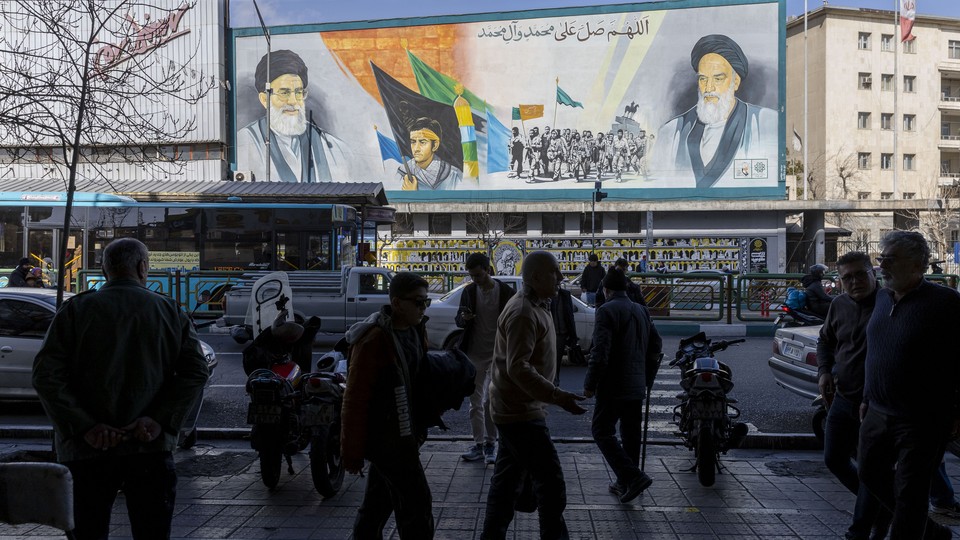
The mere act of bombing Iran will not by itself create a stable regime. Majid Saeedi / Getty The American bombardment of Iran has been launched without explanation, without Congress, without even an attempt to build public support. Above all, it has been launched without a coherent strategy for the Iranian people, and without a plan to let them decide how to build a legitimate Iranian state.
This lack of coherence has plagued the Trump administration’s policy for many weeks. On at least eight occasions during Iran’s nationwide uprising in early January, President Trump encouraged Iranians to “take over their institutions” and promised that American help was “on its way.” But just last month, days after the Iranian regime massacred thousands of its own citizens, Trump’s special envoy, Steve Witkoff, sent out the opposite message. He described Iran as “a deal that ought to happen” and said that the country could be welcomed into “the league of nations.” Vice President Vance has also said that America’s interests in Iran are limited. “If the Iranian people want to overthrow the regime, that’s up to the Iranian people,” Vance recently told reporters. “What we’re focused on right now is the fact that Iran can’t have a nuclear weapon.”
The absence of a broader strategy fits a pattern. For decades, American presidents from both parties have oscillated between coercion and engagement with Iran, sometimes offering diplomacy, sometimes sanctions. Doves and hawks both sought to manage the tactics of the Islamic Republic—its nuclear ambitions, its ballistic missiles, its network of proxy militias throughout the Middle East—without ever coming up with a meaningful strategy to combat the root problem: the ideology of the regime itself.
The Islamic Republic is a theocracy founded explicitly to oppose the deepest principles of liberal democracy and the rule of law. During its 47-year reign, this theocratic state underwent no meaningful political reform, made no improvement to its human-rights record, and never stopped trying to export its radicalism abroad. To maintain control, the regime has used mass violence, intimidation, and surveillance. In recent years, the regime has also sought, successfully, to use online smear campaigns to divide and denigrate the Iranian opposition. Nevertheless, as the scholar and activist Ladan Boroumand has written, Western liberal democracies have long preferred to engage the Islamic Republic “almost solely through the paradigm of Realpolitik,” to engage in negotiations that never seem to work.
There were plenty of opportunities to try something different. In 2009, at the time of mass protests in Iran, the Obama administration could have put a human-rights campaign at the heart of its Iran policy, promoting the people, ideas, education, and media that might have helped change Iran from within. In 2019, after the cancellation of Barack Obama’s nuclear deal with Iran, the first Trump administration could have done the same. But it did not.
The second Trump administration has gone much farther in the opposite direction, actually dismantling tools that could have helped promote civic engagement and build a united opposition in Iran. The administration has taken money away from Iranian-human-rights-monitoring groups and defunded media projects. Under the leadership of the former Arizona political candidate Kari Lake, the U.S. Agency for Global Media has prevented Radio Farda, the Farsi-language channel of the U.S. broadcaster Radio Free Europe/Radio Liberty, from using American transmission equipment.
Voice of America, the U.S. government’s other Persian-language channel, cut back coverage and lost credibility by producing partisan broadcasts. The channel’s leadership has actually banned any mention of Crown Prince Reza Pahlavi, the son of the late shah of Iran, who commands a substantial following both inside and outside the country. As a result, VOA lost ground to the Saudi-funded channel Iran International. Lake also cut funding for another agency, the Open Technology Fund, dedicated to providing virtual private networks and satellite access to Iranians, among others. That decision might also help keep Iranians inside the country isolated from the large dissident movement in the diaspora.
The administration’s apparent lack of interest in the Iranian opposition adds a layer of surreality to the video that Trump posted early this morning. He called on the Islamic Revolutionary Guards Corps, the Iranian Armed Forces, and the police to “lay down your weapons.” But to whom should they surrender? He almost taunted the Iranian people to take charge. “Let’s see how you respond,” he said. “America is backing you with overwhelming strength and devastating force.”
But who is “you”? The civil-society and women’s-rights activists who want to build a rule-of-law society, with transparency, accountability, and independent courts? The ethnic minorities—Kurdish, Baluchi, Azerbaijani, and others—who want a decentralized state and more autonomy? The sometimes-fanatical supporters of a new monarchy, who have tried in recent months to push others to the sidelines? Breakaway groups inside the IRGC who might be interested in creating a military dictatorship?
The answer matters. As one opposition insider told me at the time of the previous American attack, the mere act of bombing Iran will not by itself create a stable regime. “If there was ever a fantasy that a leader would fly in under the wings of foreign aviators,” he told me, “that is definitely not going to happen.” Another Iranian activist texted me this morning: “This is one of the best days of my life, Anne; also I am very worried about what comes next.” (Both the opposition insider and the activist requested anonymity for fear of retaliation.)
The point is not that the U.S. should promote democracy for its own sake. The goal, rather, must be to help Iranians achieve normalcy. For the region to be at peace, Tehran must transform itself from the headquarters of an insurgency back into the capital of a country seeking to build peace and prosperity for its own citizens. A stable, law-abiding Iran will help build a stable, law-abiding Middle East. But in order to achieve that, Iran needs not a new dictatorship but self-determination and a pluralist government that respects basic rights. Right now, the Trump administration is not trying to build one.