An ISIS attack in Syria highlights the challenges of state-building amid poverty, division, and extremism. President Ahmed al-Sharaa balances Western alliances with Sunni loyalists while combating infiltration in fragile regions like Palmyra.
Key Takeaways
•An ISIS infiltrator attacked U.S. and local forces in Palmyra, Syria, killing three Americans and exposing security vulnerabilities in new government forces.
•Syria faces immense state-building obstacles including poverty, social divisions, and foreign interference, with limited control outside the capital.
•President Ahmed al-Sharaa navigates a delicate balance between Western support and maintaining loyalty from Sunni factions with extremist elements.
•The attack underscores the ongoing threat of extremists infiltrating security forces, complicating efforts to establish stability and order.
•Sharaa's shift from jihadist ideology to political pragmatism risks alienating former supporters, posing an ideological threat to his government.
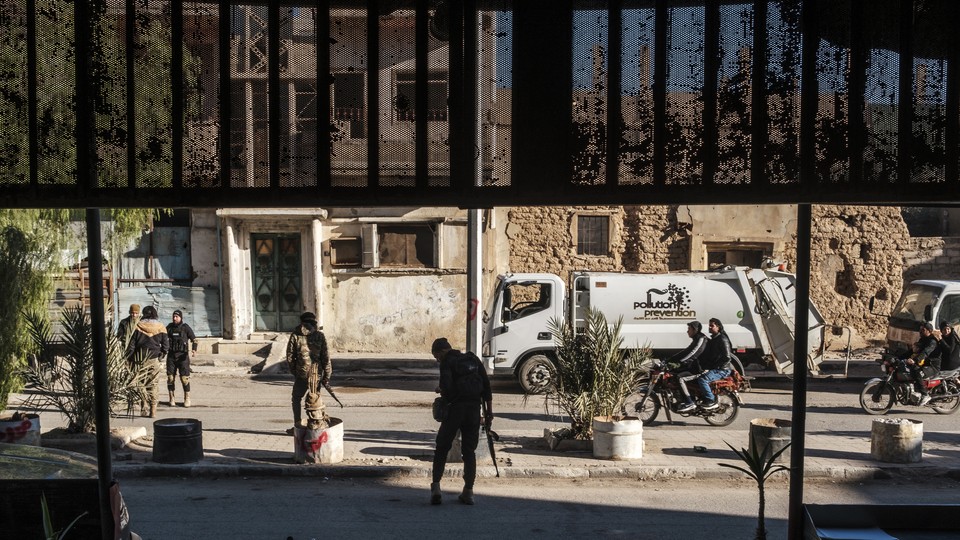
Ahmed al-Sharaa is serious about battling extremists, but his country isn’t fully under government control. Eduardo Soteras / Panos Pictures / Redux Last Saturday, an Islamic State infiltrator ambushed a meeting between American soldiers and their local counterparts in a Syrian desert town. Two members of the Iowa National Guard and a U.S. civilian interpreter were killed in the assault—whose perpetrator may or may not have known that the subject of the meeting was how to counter ISIS.
The incident didn’t just illustrate the danger of extremists hiding within Syria’s new security forces. It points to a broader problem: Outside of the country’s capital, there is still virtually no state in Syria, and the obstacles to building a new one—poverty, social and religious divisions, foreign interference—are so large that the effort could take decades.
Ahmed al-Sharaa, the former al-Qaeda leader who is now Syria’s president, had 30,000 soldiers at his command when he toppled the dictatorship of Bashar al-Assad a year ago—a small fraction of what he needed to control all of Syria. Since then, he has been directing a state-building effort that would be daunting even if his country were not destitute and littered with rubble. He must recruit and vet tens of thousands of new security forces into a new government whose leaders once espoused an ISIS-style militancy, but are now committed to overcoming it.
The ancient desert town where the Americans were killed, Palmyra, illustrates the limits of the new state’s remit. Hours from the capital by way of loosely patrolled roads, Palmyra is a former Roman trading post whose ruins were once among Syria’s most celebrated tourism sites. But the town was controlled by ISIS at times during Syria’s civil war, and the economy remains moribund. Saturday’s attack will not help to lure tourists back. The new government is thinly staffed in Palmyra and still struggles to build relationships with locals. A recent influx of former residents and displaced people has made the town easy for extremists to infiltrate.
Under the circumstances, Sharaa has done a remarkable job of maintaining a semblance of order and rallying international support for his country. He won the enthusiastic support of President Donald Trump, who has repeatedly praised and endorsed him as a “young, attractive guy” with a “real shot at pulling it together.” During his visit to Washington, D.C., in November, Sharaa officially joined the U.S.-led coalition against ISIS. Although Trump promised “very serious retaliation” for the killing of the three Americans last week, he did not hint at any retreat from Syria, where the United States now has about 1,000 troops.
Sharaa spent years gradually purging the more extreme elements from his coalition before the fall of the Assad regime. And his government takes the ISIS threat seriously. After the three Americans were killed, a Syrian government spokesperson said that the infiltrator—who was shot and killed after he opened fire—had been suspected of extremist sympathies during an evaluation and was about to be dismissed from the security forces. He appears to have been a longtime member of ISIS who joined the new security forces after the fall of the Assad regime, according to Aaron Zelin, a senior fellow at the Washington Institute who has written extensively on jihadism.
Still, Sharaa’s loyalties have long been a subject of intense speculation. Jerome Drevon, an analyst with the International Crisis Group and a co-author of a recent book on Hayat Tahrir al-Sham, the militia Sharaa led, told me he is confident that Sharaa and his top advisers now prioritize politics over theology and have fully embraced the idea that they must ally with the United States and other Western countries. But that is not necessarily true of the Sunni factions that still form an important part of their political base.
For Sharaa, the result is a difficult balancing act. He must placate Western supporters who are concerned about the safety of Syria’s religious minorities and the danger of Islamist militancy. At the same time, he has to retain the loyalty of the Sunni fighters who brought him to power, and whose most extreme members have been involved in massacring members of Syria’s beleaguered religious minorities.
“Now the leaders are favoring political considerations over religious ones,” Drevon said. “But your people were originally recruited and trained on religious principles. They were told that it was religiously forbidden to ally with the West, and now the government says the U.S. is our new partner.”
Some of Sharaa’s former supporters left his movement when he began moving away from a jihadist perspective, and they, along with a number of Islamist ideologues, have condemned him as a traitor. These disappointed radicals will remain an ideological threat to Sharaa’s new government whether or not they decide to take up arms or join ISIS.
“There is real fear about this within the leadership,” Drevon said, “and they are doing everything they can to contain it.”