How Mary Todd Lincoln Lands Totally Out of Context
AI Summary9 min read
TL;DR
The play 'Oh, Mary!' reimagines Mary Todd Lincoln as a monstrous, campy figure in a satirical farce. Its transfer to London relies on pantomime traditions and physical comedy, contrasting sharply with earnest historical dramas like 'Hamilton'.
Key Takeaways
•The play 'Oh, Mary!' portrays Mary Todd Lincoln as an exaggerated monster and narcissist, diverging from feminist historical revisionism.
•In London, the play's humor is framed through pantomime conventions, making it feel familiar yet dated to British audiences.
•The show embraces Trump-era camp and nihilism, contrasting with Obama-era earnestness seen in works like 'Hamilton'.
•Playwright Cole Escola intentionally avoided research to keep the humor accessible, resulting in a historically inaccurate but entertaining portrayal.
•Despite its absurdity, the play highlights historical boredom and the pathetic loneliness of privileged women like Mary.
The challenge of staging Oh, Mary! for a British audience Manual HarlanBy now, you will be used to the feminist practice of finding a historical woman and rescuing her from the clutches of evil biographers who have done her dirty. What if Marie Antoinette or Typhoid Mary were a more rounded figure—more constrained by the expectations of her time, perhaps, or a victim of her circumstances and upbringing?
That is not the approach that the playwright Cole Escola has taken in Oh, Mary!, which is currently playing on Broadway and has just opened in London. Escola’s question about Mary Todd Lincoln, wife and widow of America’s 16th president, is this: What if she were an absolute monster? The idea for the show came from an email Escola sent to themselves in 2009, which read: “Write a play (maybe musical?) about Mary Todd and Abraham Lincoln in which it comes out being a good thing that Abe Lincoln dies.”
To fulfill that brief, the 39-year-old playwright has taken the Mary of the historical record—a laudanum user, prone to wild mood swings and shopping sprees, eventually confined to an asylum by her own son—and made her worse. This Mary drinks paint thinner and pushes her companion, Louisa, down the stairs. Above all, she desperately wants to be a cabaret star, and believes that Abraham has thwarted her dream. Fatally, he reacts to her constant complaints by hiring a handsome actor—whose identity becomes important later in the plot—to give her lessons for the “legitimate theater.”
Having already seen the show on Broadway, I was curious to know how such a quintessentially American story would land in Britain. (No one here could pick Mary Todd Lincoln out of a first-lady lineup, even though this is the second play about her to open in London in 2025.) How does a show whose satirical power comes from cutting against received wisdom deal with the audience having no idea what that received wisdom is? The answer is: Training wheels and a reliance on physical comedy help, up to a point.
In London, the play begins with a straightforward exposition dump: A preshow voiceover establishes Mary Todd Lincoln as the wife of President Abraham Lincoln, who was assassinated by the actor John Wilkes Booth. Oh, Mary!, shorn of its political resonance, falls squarely into an established populist British stage tradition: pantomime, in which unwitting 7-year-olds are corralled into a theater at Christmastime to watch well-worn favorites such as Aladdin or Dick Whittington and His Cat, a folktale in which a young man (always played by a woman) leaves home to make his fortune in London. Pantomime leans heavily on popular songs, risqué jokes, and melodrama, just like Oh, Mary!
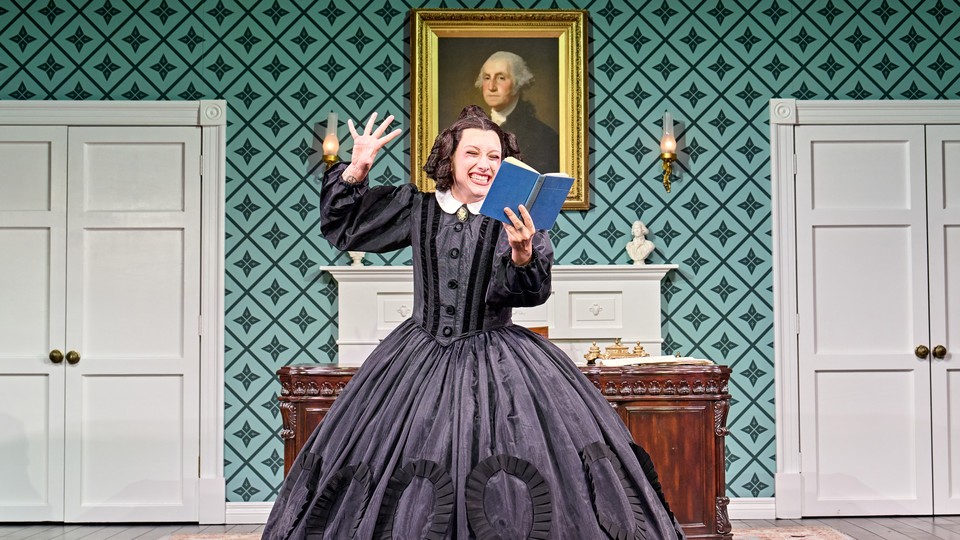
In addition to writing the play, Escola originated the lead role, playing Mary as a 19th-century Veruca Salt, all wobbling curls and petulantly folded arms. “Mary is just me,” Escola once told NPR. “It’s all based on me and my feelings, and all of my characters are some aspect of me that I’m ashamed of or curious about.” Since then, the Marys have tended to be either queer actors or gay icons, underlining the show’s immersion in gay culture. (Mary repeatedly addresses a portrait of George Washington as “Mother,” and this Abraham Lincoln is gay, too.) The London Mary is played by the nonbinary actor Mason Alexander Park, best known for portraying Ariel in Jamie Lloyd’s truly cursed production of The Tempest.
I saw the play on Broadway with the drag queen Jinkx Monsoon, who followed Escola and others, and was herself followed by Jane Krakowski. The role does not call for subtlety. “I have to imagine that somewhere along the line someone had to have told you, ‘You’re a little too big,’” Monsoon told Krakowski in September. “I’ve been told that a billion times.”
When I saw Monsoon’s (yes, very big) performance, I did think, snobbily: Oh, look, the Americans have discovered panto. I wasn’t alone. The London reviews have been positive, but the two harshest ones described the show as “sophomoric” and “farce at its broadest” (The Guardian) and “a bit … ’70s? A little bit Airplane!, a little bit Benny Hill, maybe even a touch of Mr Bean” (Time Out). In the British context, these reviewers implied, Oh, Mary!’s humor reads as dated rather than groundbreaking. That’s largely because of the pantomime tradition. I was brought up on this genre, which also usually features a dame (always played by a man: In a production of Aladdin, Ian McKellen once gave a fantastic Widow Twankey) and volleys of double entendres for parents. The title character in Dick Whittington has a cat mostly so all the other characters can remark on his “lovely pussy.”
This is the energy that Escola has brought to Oh, Mary! Todd Lincoln, under her prim crinoline, is wearing red-and-white-striped bloomers, which is very panto. And just like a panto, the staging is deliberately lo-fi: two static sets, a wheeled-on theater box, and a bit of front-of-curtain business. On Broadway, The New York Times described it as having “the cheesy naturalism of community theater.”
What Escola has built on this foundation, however, is truly unhinged. Do you remember the end of Inglourious Basterds, when Quentin Tarantino kills off the entire Nazi Party in an exploding movie theater? Yeah, about that unhinged. Mary might be awful, but Escola makes her pathetic too, with her terrible loneliness and her deluded belief that she could have been a star. “I don’t even want to be alive,” she tells her acting teacher at the start of their first lesson. More than anything else, she is bored—a default condition for humanity before smartphones and reliable Wi-Fi. History isn’t just battles and bowers; it’s privileged people in gilded rooms waiting for death or the invention of streaming services, whichever comes first. For aristocratic women, this boredom was particularly acute, because their enforced inactivity was a status symbol. The Mitford sisters, growing up in rural Oxfordshire in the 1920s, found their lives so tedious that they invented, as one of them put it, “a contest to see who could best stand being pinched really hard.” This sounds exactly like something Escola’s Mary would inflict on her companion, Louisa.
Earlier this year, Oh, Mary! was a finalist for the Pulitzer Prize for Drama, an award that in 2016 went to Lin-Manuel Miranda’s Hamilton. As it happens, I rewatched Hamilton not long ago, and its earnest paeans to diversity (“Immigrants, we get the job done”) now feel like the last gasp of the Obama era.
When Hamilton first came to Britain, I wrote that its blend of rap, classical music, and Gilbert and Sullivan operettas showed that it “speaks all the cultural languages of America, and it echoes Obama’s ability to change cadences depending on his audience.” Added to that, by offering cheap tickets in a daily street lottery alongside the usual sky-high prices of Broadway, “Miranda created a fan base that mirrors the ‘Obama coalition’ of Democrat voters: college-educated coastal liberals and mid-to-low-income minorities.” Hamilton might have been great entertainment, but it also took seriously the idea of educating America about its history, in a spirit now continued by the popular Substack historian Heather Cox Richardson.
Like Hamilton, Oh, Mary! uses color-conscious casting, reframing white historical figures by having nonwhite actors play them. And like Hamilton, it is an improbable box-office smash: It became the first production to gross more than $1 million a week at the Lyceum Theater in New York. But otherwise, the two plays could not be more different. Instead of Obama-era earnestness, Oh, Mary! is steeped in the signature moods of the Trump era: pure camp, twisted humor, and lol nothing matters nihilism. (Think: Donald Trump dancing to “YMCA,” or the casual cruelty of all those deportation videos.) Escola did “less than no research” into Mary Todd Lincoln, to avoid the temptation of writing in-jokes. “I wanted to have the same knowledge that the audience had,” Escola told Seth Meyers. “I didn’t want to do research and then be making jokes about, like, ‘Well, that’ll get a laugh ’cause that’s where she was born.’” This artistic decision worked out well for me, a person who had no idea where Mary Todd Lincoln was born until I looked it up for this article.
The audience also learns precisely nothing about Mary’s divided loyalties—she was born in Kentucky, and several of her half-brothers fought for the Confederacy. Her real-life grief over the death of her sons Eddie and Willie is completely absent; Mary assures her acting teacher that “I never go near the children.” Even the Civil War barely gets a look-in. When Abraham complains about fighting with the South, Mary growls, “The South of what?!” His announcement of the end of the war is included only to set up a contrast with Mary’s activities that afternoon—discovering that Louisa “wants to rub ice cream on her pussy!”
In its absolute refusal to take history seriously, Oh, Mary! is basically the anti-Hamilton. But then, we are living through the mirror image of the Obama era right now. Escola’s Mary is a monster, but also a ham, a narcissist, and a born entertainer—and the audience ends up glued to her every move. I mean, you could suggest a parallel with contemporary America there. Or you could just enjoy the wigs and the gags and the spotted bloomers.