The Astrosphere of HD 61005
AI Summary2 min read
TL;DR
The astrosphere of HD 61005, a young Sun-like star, is a bubble formed by its stellar wind, detected by Chandra X-ray Observatory. It protects the star from cosmic radiation, similar to our Sun's heliosphere, and features debris giving it the nickname 'the Moth'.
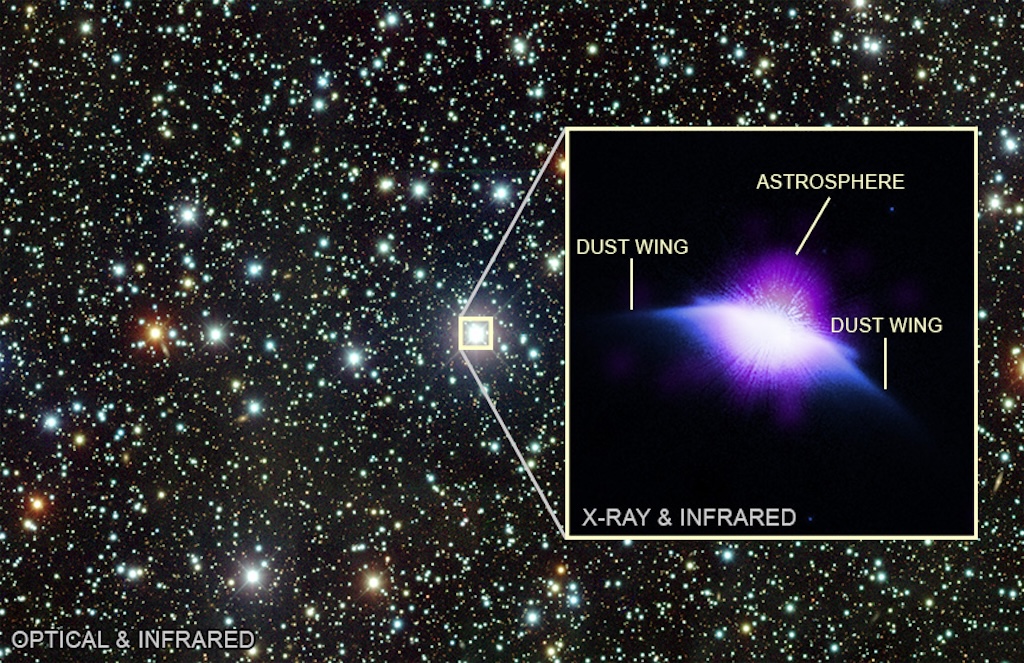
The Astrosphere of HD 61005
Image Credit: X-ray: NASA / CXC / Johns Hopkins Univ. / C.M. Lisse et al.; Infrared: NASA / ESA / STIS; Optical: NSF / NoirLab / CTIO / DECaPS2
Processing: NASA / CXC / SAO / N. Wolk - Text: Cecilia Chirenti (NASA GSFC, UMCP, CRESST II)
Explanation: Do young stars blow bubbles? The larger view shows a stellar field observed with the Cerro Tololo Inter-American Observatory in Chile, and the inset highlights HD 61005, a star like our Sun, only 120 light-years away. Much younger than the Sun, at just about 100 million years old, it blows a fast and dense stellar wind that pushes out the cooler dust and gas that surrounds it, forming a bubble called an astrosphere. The star-blown bubble was detected with the Chandra X-ray Observatory, and it has a diameter roughly 200 times the Earth-Sun distance. Our Sun has a bubble too, called the heliosphere, which protects the planets from cosmic radiation. Also shown in the inset is debris left behind from star formation, observed by Hubble. The debris appears as wings, giving the star its nickname: the Moth.