US Tech Giants Unite to Battle China’s Open-Source AI Dominance
TL;DR
U.S. tech giants like Anthropic, OpenAI, and Google have formed the Agentic AI Foundation to counter China's lead in open-source AI adoption. They aim to standardize protocols like MCP to ensure U.S. competitiveness and avoid dependency on Chinese models. This collaboration promotes open-source development and neutral governance under the Linux Foundation.
Key Takeaways
- •U.S. tech companies launched the Agentic AI Foundation to address China's growing dominance in open-source AI, with key contributions like MCP and AGENTS.md.
- •The foundation emphasizes standardization and open protocols to prevent vendor lock-in and ensure U.S. models remain competitive globally.
- •China's strategy focuses on low-cost, modular open-source models, creating dependency risks for U.S. cloud providers and APIs.
- •The initiative operates under the Linux Foundation with neutral governance, involving major companies like Amazon, Microsoft, and IBM as members.
- •This move aims to benefit users worldwide by fostering better open-source AI development and addressing geostrategic vulnerabilities.
Tags
Some of the largest tech titans in the U.S. just joined hands to launch a new Agentic AI Foundation.
The group—formed by Anthropic, OpenAI, and Block, with support from Google, Microsoft, AWS, Bloomberg, and Cloudflare—comes together at a moment when China is rapidly pulling ahead in global open-source AI adoption, forcing America’s fiercest competitors into the same tent.
“Open standards and protocols like MCP are essential to enabling a thriving developer ecosystem for building agents," Cloudflare’s Chief Technology Officer, Dane Knecht, said in a public statement. "They ensure anyone can build agents across platforms without the fear of vendor lock-in."
U.S. companies face a paradox. They want recurring revenue from closed APIs, but losing the base layer to China makes them irrelevant, no matter how profitable those APIs become.
Better to standardize on MCP and agentic AI, ensure U.S. models stay competitive, and capture value through superior models rather than ecosystem lock-in, or so the thinking goes.
The foundation is a pragmatic collaboration and a win for the open-source community, with major competitors acknowledging that standardization benefits everyone more than fragmentation.
The U.S. AI industry's move to regain open-source dominance may be a net positive for users (including Chinese users), as it could lead to better open-source development.
Anthropic donated its Model Context Protocol—a protocol that enables AI models to use tools creatively rather than being restricted to API calls—to the Linux Foundation as the centerpiece.
MCP achieved remarkable traction since launching a year ago: over 10,000 active servers, first-class support from ChatGPT to Gemini to Microsoft Copilot to VS Code, and 97 million monthly SDK downloads.
"Open-source software is essential for building a secure and innovative ecosystem for agentic AI," Anthropic said in a statement.
OpenAI contributed AGENTS.md, a lightweight specification used by 60,000 repositories, which provides AI agents with standardized project instructions. Block added Goose, a local-first agent framework. All three now operate under the Linux Foundation's neutral governance.
The timing isn't coincidental.
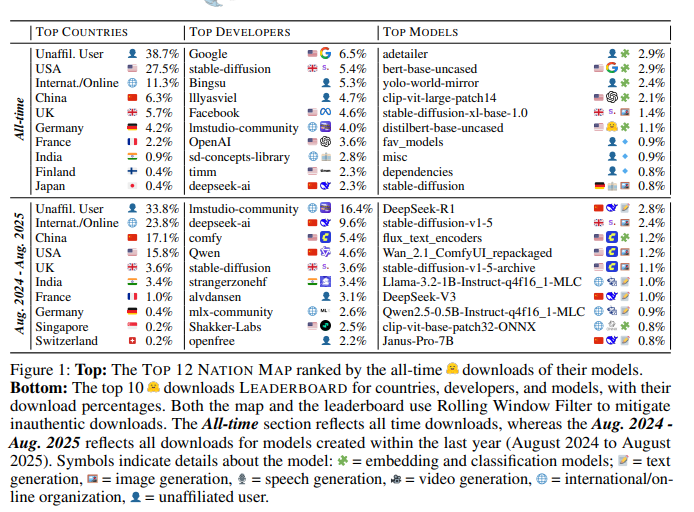
A December 2025 MIT study analyzing 2.2 billion model downloads found that China now accounts for 17.1% of global open-source AI downloads, up from 15.8% for the U.S. Companies like DeepSeek and Alibaba flooded the market with high-performance open models while American firms retreated behind closed APIs, chasing profitability.
"We are seeing AI enter a new phase, as conversational systems shift to autonomous agents that can work together," said Jim Zemlin, executive director of the Linux Foundation.
The foundation addresses a strategic vulnerability: Chinese open-source models create dependency—developers worldwide build on that infrastructure, reducing reliance on U.S. cloud providers and APIs.
The foundation operates with responsive governance while maintaining vendor neutrality.
Platinum members include Amazon, Anthropic, Block, Bloomberg, Cloudflare, Google, Microsoft, and OpenAI.
Gold members include Cisco, Datadog, Docker, IBM, Oracle, SAP, Snowflake, and Twilio; Silver members include Hugging Face, Uber, SUSE, and others. The group said no single company steers its direction.
China's advantage, meanwhile, comes from a deliberate strategy.
Rather than massive AI factories like OpenAI or Google, Chinese companies emphasize lower-cost adaptability and modular innovation. They provide open weights for developers to build their products on top of their technology.
The Trump administration's AI Action Plan explicitly recognizes the threat.
"Open source and open-weight models could become global standards in some areas of business and in academic research worldwide. For that reason, they also have geostrategic value," according to a statement from the White House.