The Trump administration hopes Maduro's fall will destabilize Cuba's regime, but experts call this 'magical thinking.' Cuba has survived decades of hardship through alliances with Venezuela, Russia, and China, and lacks internal opposition for change.
Key Takeaways
•The Trump administration views Maduro's removal as a potential catalyst for Cuba's collapse, but experts are skeptical due to the regime's historical resilience.
•Cuba's survival relies on complex alliances with Venezuela (oil/doctors barter), Russia (military/oil support), and China, despite U.S. sanctions and geopolitical pressure.
•Cuba lacks a viable internal opposition, with many citizens discontented but still reliant on state services like healthcare and education, making regime change unlikely without external military intervention.
•U.S. policy toward Cuba is often driven by domestic politics, particularly appealing to Cuban and Venezuelan American voters in Florida, rather than a clear strategic plan.
•Cuba's history of adapting to crises—from Soviet collapse to U.S. embargoes—suggests it will endure current challenges, as symbolized by its long-standing barter systems and foreign support.
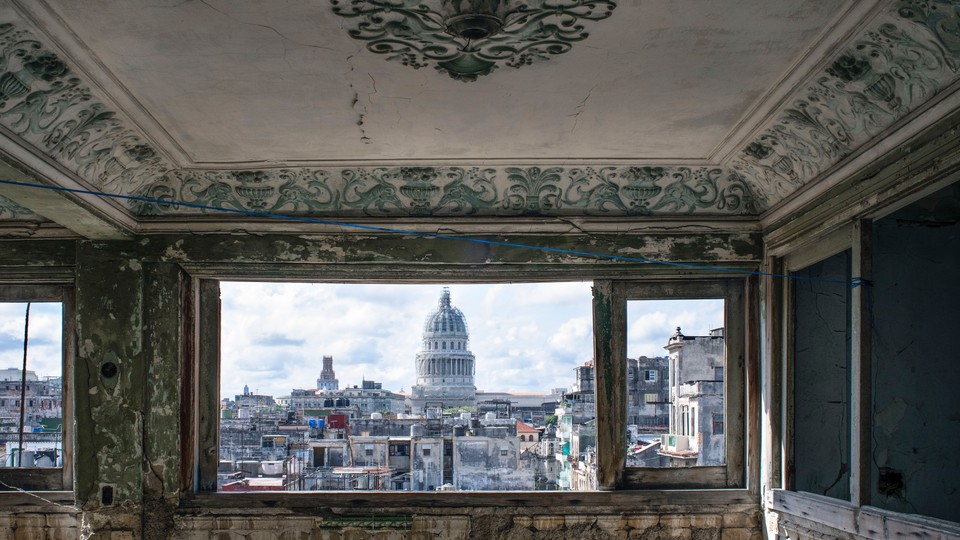
Predictions of Cuba’s demise after Maduro’s capture may be greatly exaggerated. Carl De Keyzer / Magnum Photos In November 1999, Havana’s Latinoamericano stadium sold out for a baseball game that was billed as a friendly rivalry between Latin America’s oldest and newest revolutionary leaders. Hugo Chávez had been Venezuela’s president for fewer than nine months when he took the field opposite Cuba’s Fidel Castro, who had led his country’s revolution 40 years earlier, when Chávez was just 4 years old. The crowd roared “Chávez! Chávez!” as the energetic Venezuelan leader trotted onto the field, dressed in white pinstriped pants and a red-blue-and-yellow windbreaker with white stars across the sleeves—a nod to his country’s flag. Castro, dressed in green slacks, a red cap, and a blue windbreaker emblazoned with the letter C, spent most of the night calling the plays in the manager’s box.
Castro saw Chávez as a loyal protégé, a fellow socialist traveler who shared his dream of creating the united Latin America that Simón Bolívar, known as El Libertador, strove to build as a soldier and statesman in the early 19th century. U.S. sanctions were stifling Cuba, and Castro was still trying to recover from the loss of his country’s top benefactor, the Soviet Union, when it collapsed in 1991. He saw Chávez’s ascendance as a turning point, the baseball game epitomizing the ideological union between Havana and Caracas. The relationship proved so symbiotic that it outlived both Castro and Chávez, surviving decades of geopolitical tumult and hostility from Washington.
Today, that relationship is being tested in new ways. The Trump administration has forecast that the arrest and extradition of Chávez’s successor, Nicolás Maduro, is only the first in a series of dominoes to fall, with Cuba perhaps the most important and symbolically resonant. “We are not big fans of the Cuban regime, who, by the way, are the ones that were propping up Maduro,” Secretary of State Marco Rubio said on NBC’s Meet the Press the day after Maduro was seized.
“If I lived in Havana and I was in the government, I’d be concerned,” he’d earlier told reporters at Mar-a-Lago.
So intertwined are the two Latin American nations that among the roughly 75 people killed by U.S. forces in the Caracas raid, at least 32 were Cubans. They were part of a large cadre working as Maduro’s bodyguards and in Venezuela’s domestic intelligence services to determine “who spies on who inside, to make sure there are no traitors,” Rubio said.
The administration has no plans to conduct any military operation against Cuba akin to its raid on Caracas, U.S. officials told me. (One official, sounding exhausted by recent events, just laughed in response to my question.) For now, those who want to see the Cuban government fall hope that Maduro’s removal will be enough to sink the regime that Castro’s revolution installed in 1959.
Many experts I spoke with are skeptical. Yes, the future looks bleak for the island of 11 million people, who are already suffering from a dismal economy and aggressive state repression. Yes, the regime appears fatigued, having lost the leadership of both Fidel (who died in 2016) and his brother, Raúl, who is 94 and has yielded power to President Miguel Díaz-Canel.
But Cuba has survived many periods of severe hardship over the past six decades, and it remains difficult to discern any real impetus for dramatic change, absent a major U.S. military attack (and the last time Washington tried such a thing, in 1961, it ended in disaster). There is no opposition capable of igniting change from the inside. The intricate barter system that Cuba and Venezuela developed to survive U.S. sanctions may be hard to unwind, especially because the regime in Caracas continues to reign, even without Maduro. Russia and China, though chastened by their inability to protect Venezuela, retain a strong interest in propping up Havana, given Cuba’s location just 90 miles south of Key West. And the oil that Havana depends on from Venezuela can, at least in part, be substituted by supplies from elsewhere.
“I’ve spoken to people in the Department of State, and when they say, ‘This is it, it’s going to collapse,’ my question is, ‘Explain to me how it’s going to collapse?’ And they don’t have an answer for that,” William LeoGrande, a co-author of Back Channel to Cuba, a history of negotiations between Washington and Havana, told me. “They’re engaging in a kind of magical thinking.”
When President Trump talked about Venezuela in the months before Maduro’s capture, he repeated three mantras: We need to hit drug traffickers; we need the oil; and we need Maduro to go. When Trump talks about Cuba, there are fewer particulars. Observers believe his central aim is to appeal to Cuban and Venezuelan Americans, who make up an influential voting bloc in the president’s adopted home of South Florida.
I saw this firsthand at a July 2024 rally in the 100-degree-plus heat near the tenth hole of Trump’s National Doral hotel and golf club in Miami. Over the course of nearly two hours, Trump mentioned Cuba more than a dozen times, eliciting big cheers as he drew parallels between socialism there and the views espoused by his Democratic opponents. “They are turning America into Communist Cuba or socialist Venezuela,” he told the rapturous crowd. He said he would stand with the “people of Cuba in their long quest for justice, liberty, and freedom.” Many people I spoke with had been born in the U.S. but raised by parents or grandparents who’d lost everything to socialism.
Enter Rubio, the former Republican senator from Florida, who was influenced as a child by his Cuban grandfather’s stories about the Cold War. Rubio was a driving force for the overthrow of Maduro and now is the chief intermediary with his successor, former Vice President Delcy Rodríguez.
For Rubio and many other officials from Florida, toppling the Cuban regime represents the ultimate victory of American liberty over Soviet-inspired Latin American repression.
After the military operation in Venezuela, Trump continued to speak about Cuba in terms of domestic politics, and in a manner less belligerent than he uses even when speaking about Greenland, a protectorate of a NATO ally. “We want to help the people in Cuba, but we want to also help the people that were forced out of Cuba and are living in this country,” Trump told reporters after Maduro’s capture, adding, “I think Cuba is going to be something we’ll end up talking about.”
For all their connections and shared ideologies, Venezuela and Cuba have very different histories. Venezuela had a vibrant democratic society prior to the rise of Chavismo, the political ideology named for Chávez, who came to power less than 30 years ago. Although the administration has not made restoration of democracy in Venezuela a near-term goal—Trump didn’t mention democracy once during his Mar-a-Lago press conference after the Maduro raid—the country’s former democratic institutions could be restored now that Maduro is out, Trump officials told me. Venezuela was “an imperfect but long-standing democracy” with opposition groups and a civil society, Jeffrey DeLaurentis, a former U.S. diplomat who served in Havana, said. Cuba, meanwhile, has been a one-party Communist state for almost 70 years.
Venezuela also has a vibrant political opposition, which the U.S. worked with to pile pressure on Maduro. Cuba’s opposition? “They don’t even exist anymore,” LeoGrande said. He told me there is “nearly universal discontent” among Cubans with their government over the state of the economy, which has been acutely suffering since the coronavirus pandemic. GDP is at least 10 percent down from pre-COVID levels. But there is no counterweight to the regime that might help change the country’s direction. And many Cubans still appreciate the provision of state-financed health care and education, even if the quality has deteriorated. Should the regime end, Cubans may opt for reform rather than completely abandoning socialist practices.
“Cuba has human resources. They have a good educational system,” Brian Nichols, the State Department’s top Latin America official under President Biden, told me. “They generate a significant number of professionals, but their ability to take advantage of that is largely absent.”
Venezuela is also attractive to Trump because of its oil; the country holds the world’s largest reserves, estimated at 300 billion barrels. Cuba’s offshore reserves are estimated at a fraction of that, between 4.6 billion and 9.3 billion barrels. “Cuba is much less enticing in terms of payoff,” one U.S. official told me, although this morning on Truth Social, Trump said of Havana: “I strongly suggest they make a deal, BEFORE IT IS TOO LATE.”
One of the rallying cries of the Cuban Revolution was Patria o Muerte, Venceremos, “Homeland or death, we shall overcome.” Cuba has had to embrace that approach constantly since Castro took power in 1959.
The following year, Cuba seized and nationalized American economic assets, including oil refineries, prompting President Dwight Eisenhower to end U.S. exports, save for food and medicine. His successor, President John F. Kennedy, broadened the embargo to almost all goods and services. Moscow, eager for a Communist beachhead in the Americas, replaced the U.S. as the chief economic sponsor of the Cuban regime, purchasing sugar at subsidized prices and providing oil on credit.
After the failed Bay of Pigs invasion—the covert White House plan to overthrow Castro using 1,400 CIA-trained Cuban exiles—the U.S.S.R. ramped up military aid too, deploying the nuclear missiles that sparked the Cuban missile crisis of 1962.
The Soviet Union’s deterioration in the late 1980s sent Cuba’s economy into a free fall. Havana resorted to extreme austerity, shifted to more sustainable agriculture, introduced market-oriented reforms, and accelerated oil extraction. It also forged a major new alliance across the Caribbean, in Caracas. By 2013, the year Maduro succeeded Chávez, Venezuelan financial aid and oil subsidies accounted for almost one-quarter of Cuba’s national output, though Mexico recently supplanted Venezuela as Cuba’s chief source of oil as U.S. sanctions constricted Venezuela’s ability to do business.
Russia, meanwhile, has revived its Cuban partnership, docking warships and nuclear-powered submarines at Cuban ports for drills, and providing the regime with oil and grain. In return, Cuba has dispatched thousands of mercenaries to bolster Russian forces in Ukraine. Havana also turned to China for military and intelligence cooperation, although both Beijing and Moscow may value their alliances as much for their symbolism, given Cuba’s proximity to the United States. Chinese and Russian support for Cuba “was always designed to poke us more than it was to do anything substantive,” Alexander Gray, who served as a top national-security official during Trump’s first term, told me.
Through the decades, the U.S. has maintained its blockade, now the longest in modern history. Otherwise, Cuba policy has ebbed and flowed. President Ronald Reagan, for instance, named Cuba as a state sponsor of terrorism in 1982. President Obama lifted the designation. President Trump, in his first term, restored it. President Biden gave notice in the final days of his presidency that he would rescind it again, but the measure never took effect.
Cuba’s complicated barter system with Venezuela—exchanging oil for thousands of Cuban doctors, teachers, sports trainers, technical advisers, and intelligence operatives—has endured. “What Cuba gave back didn’t have much actual market value,” Francisco Monaldi, a Latin America–energy expert at Rice University, told me. “But politically, it was extremely valuable because the intelligence advisers and political advisers, especially, were key for the sustenance of the regime.”
Foreigners greased the system. Companies in Panama set up by Ramon Carretero, a Panamanian businessman, for example, received contracts worth millions of dollars from Venezuela’s national oil company, Ivan Ruiz, a writer at Transparencia Venezuela en el Exilio, an activist group, told me. In turn, Carretero’s companies made payments to Maduro’s niece and nephew, Ruiz said. (In September, Carretero walked away from the mysterious crash of a plane used by Maduro’s regime for official trips to Cuba, according to local news reports and activists. His whereabouts are unknown; the U.S. slapped sanctions on him in December for facilitating oil payments on behalf of the Venezuelan government.)
On that night nearly 30 years ago at Latinoamericano stadium, Castro and Chávez, beaming and sweaty after the long-awaited game, declared their union unbreakable. Castro awarded Chávez Cuba’s highest honor, the Order of José Martí, named after a 19th-century poet—a leader in Cuba’s movement for independence from Spain.
The teams comprised veteran baseball stars from both nations. But as the game wore on, spectators realized that Castro had disguised some young professional players as bearded, older men to play cleanup in the final innings. The Cubans beat the Venezuelans, 5–4. As another U.S. official told me: “The Cubans always find a way.”