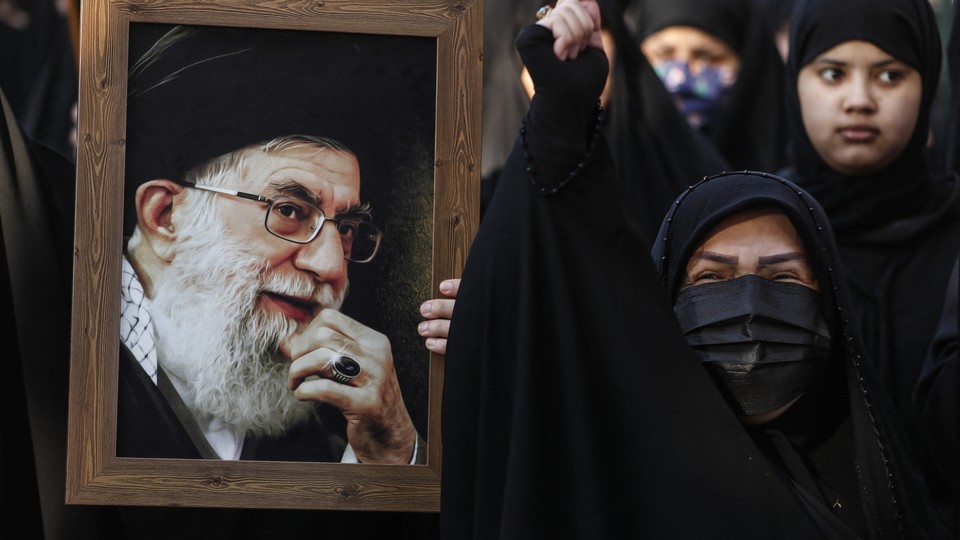
Ayatollah Ali Khamenei's death marks the end of an era for Iran's Islamic Revolution. He spent decades ruthlessly preserving a rigid, anti-Western ideology through repression and isolation, but failed to adapt to a changing world. His demise by the hands of the nations he vowed to destroy represents a pivotal moment for the 47-year-old regime.
Key Takeaways
•Khamenei inherited and preserved Iran's 1979 Islamic Revolution through force, maintaining its anti-American, anti-Israeli ideology long after society had moved on.
•He consolidated power by cultivating the Revolutionary Guards as his praetorian force, making them Iran's dominant political and economic institution.
•Khamenei maintained power through insularity, repression, and using America as a unifying 'devil' while micromanaging citizens' lives and suppressing dissent.
•His death represents a hinge moment as the last first-generation revolutionary leader, leaving a regime increasingly composed of opportunists rather than true believers.
His life’s work was to preserve a revolution that is heading for the ash heap. Ahmad Al-Rubaye / AFP / Getty “The essence of oligarchical rule,” George Orwell wrote in 1984, “is the persistence of a certain world-view and a certain way of life, imposed by the dead upon the living.” For nearly four decades, Ayatollah Ali Khamenei presided over exactly that. He did not build the Islamic Republic of Iran. He inherited it from its founder, Ayatollah Ruhollah Khomeini, who in 1979 led a revolution that deposed a U.S.-aligned monarchy and replaced it with an Islamist theocracy whose three ideological pillars were “Death to America,” “Death to Israel,” and the mandatory covering of women—the hijab, he said, was “the flag of the revolution.”
Khomeini died in 1989, and his successor’s life’s work was to keep that revolution alive long after the society it governed had moved on. In this, Khamenei was remarkably, ruthlessly successful. But the worldview he imposed was never truly his own. He was the spokesman for a ghost.
Khamenei’s death by the hand of a nation he worked very hard to kill is a hinge moment in the history of the 47-year-old revolution. He was the last of the regime’s first-generation founders.
Khamenei’s rise was engineered not by destiny but by maneuver. In 1989, Ali Akbar Hashemi Rafsanjani, the shrewd speaker of Parliament and the son of a pistachio merchant, helped anoint Khamenei as supreme leader by claiming that it was Khomeini’s dying wish. Rafsanjani likely believed that he was working to install a pliant figurehead. Khamenei—the son of a poor cleric from the shrine city of Mashhad—had other ideas.
The rivalry between them endured for three decades. Rafsanjani favored wealth creation and détente with the United States; Khamenei believed that compromising on revolutionary principles would hasten the regime’s collapse, just as perestroika had undone the Soviet Union. As Machiavelli warned, “He who is the cause of another becoming powerful is ruined.”
Khamenei’s lack of clerical legitimacy, and his general insecurity, led him to cultivate the Islamic Revolutionary Guard Corps as his praetorian force; he handpicked commanders and rotated them to prevent rivals from accumulating power. The IRGC eclipsed the clergy as Iran’s most powerful institution—politically expedient for Khamenei and financially expedient for the Guards, which became the dominant economic force in the theocracy it defended. Khamenei wielded Iran’s elected institutions as facades, allowing just enough political theater to project legitimacy. No matter what agenda the president espoused—the economic pragmatism of Rafsanjani, the liberal aspirations of Mohammad Khatami, the populist provocations of Mahmoud Ahmadinejad, the nuclear diplomacy of Hassan Rouhani—Khamenei emasculated him.
An Iranian academic, some of whose students rose to senior government positions in Tehran, once told me that at the revolution’s beginning, the regime consisted of “80 percent indoctrinated believers—largely ignorant of global realities—and 20 percent charlatans and chameleons.” By Khamenei’s final years, he said, the ratio had inverted: 20 percent believers, 80 percent opportunists who flocked around officials for wealth and privilege.
Khamenei’s anti-Americanism was cloaked in ideology but also driven by self-preservation. The powerful cleric Ahmad Jannati once articulated the regime’s deepest anxiety: “If pro-American tendencies come to power in Iran, we have to say goodbye to everything.” Khamenei shared this conviction absolutely. “Reconciliation between Iran and America is possible,” he once said, in a revealing formulation, “but it is not possible between the Islamic Republic and America.” The American philosopher Eric Hoffer captured this logic in his 1951 book on mass movements, The True Believer. “Hatred is the most accessible and comprehensive of all unifying agents,” he wrote; mass movements “can rise and spread without belief in a god, but never without belief in a devil.” America was Khamenei’s devil.
Khamenei understood that his power was best preserved in a bubble. Not complete isolation—he wanted to sell Iran’s oil—but calibrated insularity, walled off from the global forces of capitalism and civil society that would expose and erode the regime. He had translated the works of the radical anti-Western Egyptian thinker Sayyid Qutb into Persian during his years in the shah’s prisons; decades later, he remained in the same intellectual bunker, convinced that Western culture posed a greater threat than Western bombs.
But insularity has its costs, and they were borne entirely by the Iranian people. Khamenei treated the relationship between the state and its citizens not as a social contract but as a predatory lease—nonnegotiable, imposed by the landlord, long since expired. The regime micromanaged the personal lives of more than 90 million people, dictating whom they were allowed to love, what they drank, what women wore on their heads. It preached austerity while the Guards operated as a tax-exempt conglomerate. It built a digital wall around the country, blocking global platforms while regime officials posted propaganda on X. It charged protesters with “waging war against God” and maintained the world’s highest execution rate per capita. When even that was not enough to quell dissent—last month, as protests again swept the country—Khamenei ordered what may prove to be one of the deadliest episodes of state violence in modern history.
Khamenei confronted the paradox that every revolutionary caretaker must face: The revolution he preserved was designed for a world that no longer exists. George Kennan once wrote of the Soviet Union, “No mystical, Messianic movement can face frustration indefinitely without eventually adjusting itself in one way or another to the logic of that state of affairs.” Khamenei staved off that adjustment for nearly four decades through force of will, brutality, and the conviction that bending would mean breaking.
In the end, he was felled by Donald Trump and Benjamin Netanyahu, an American president and an Israeli prime minister whom he loathed. He lived by “Death to America” and “Death to Israel.” He died by death from America and Israel.