J.D. Vance's isolationist foreign policy views and economic populism have been marginalized within the Trump administration, as evidenced by the U.S. joining Israel's war with Iran despite his opposition. His influence has waned compared to figures like Marco Rubio and Stephen Miller.
Key Takeaways
•Vance's isolationist stance against war with Iran was overruled as Trump joined Israel's conflict, highlighting his diminishing influence on foreign policy.
•His economic populist agenda, including expanded child tax credits and antitrust enforcement, has largely been ignored except for tariffs.
•Vance's role has been reduced to that of a loyal TV surrogate, with less policy impact than key administration figures like Treasury Secretary Scott Bessent or Stephen Miller.
•His past opposition to U.S. intervention in Ukraine and skepticism of aid were initially influential but later reversed by Trump.
•The vice president's typical fate of being visible but not influential has befallen Vance, contrasting with his initial promise as a leader of post-Trump Republicanism.
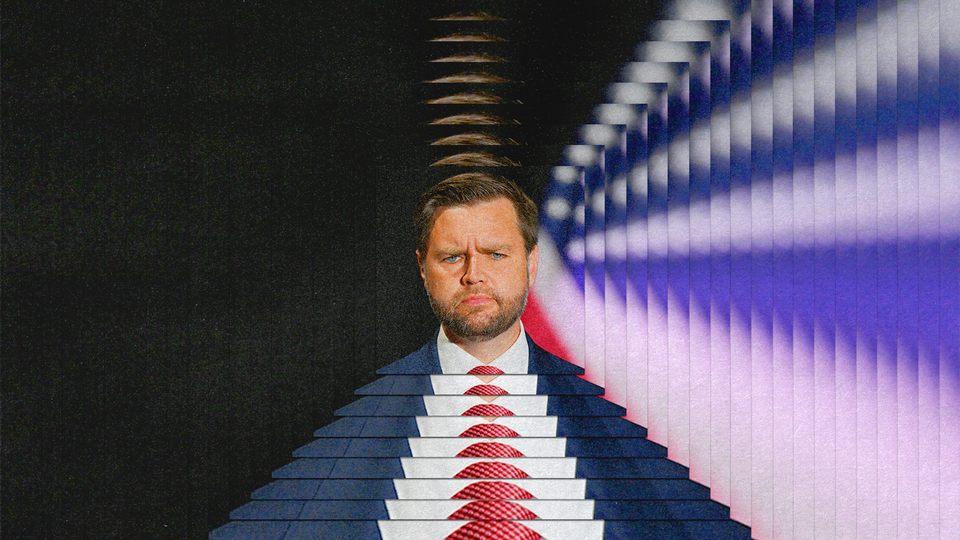
Trump’s war with Iran shows that, within the administration, the vice president’s opinions matter less and less. Illustration by The Atlantic. Souce: Drew Hallowell / Getty.If J. D. Vance promised one thing during the 2024 presidential campaign, it was that America would not enter into a war with Iran of the kind that is currently raging. “America doesn’t have to constantly police every region of the world,” Vance told the comedian Tim Dillon on his podcast. He continued: “Our interest, I think very much, is in not going to war with Iran. It would be a huge distraction of resources. It would be massively expensive to our country.” In another podcast interview, with Shawn Ryan, in September 2024, Vance even said that a war between Israel and Iran was in fact “the most likely and most dangerous scenario” for provoking World War III.
These arguments look farcical now that President Trump has chosen—months after bombing Iran’s nuclear facilities and pronouncing its enrichment efforts “completely and totally obliterated”—to join Israel in launching a war on the Islamic Republic. The ensuing conflagration now involves a dozen countries in the Middle East. Trump says that he will do “whatever it takes” militarily and that “wars can be fought ‘forever.’” Vance’s X account, normally hyperactive, went silent in the days after bombs began falling on Saturday morning. The vice president was not at Mar-a-Lago with Trump as he oversaw the attack. The administration instead released a photo of him running a secondary meeting at the White House, flanked by a can of Diet Mountain Dew and a sullen-looking Tulsi Gabbard, the director of national intelligence.
Vance entered the White House as a man full of ideas—about a more modest place for the United States in world affairs; a new, worker-friendly version of Republican economics; and aggressive, Teddy Roosevelt–style regulation of Big Business. Yet Iran is just the latest example of a noticeable trend: Within the Trump administration, Vance’s opinions seem to matter less and less.
On foreign affairs, Vance was on the isolationist end of the MAGA coalition, which now includes people, such as Secretary of State Marco Rubio, who have previously been fervid advocates of American intervention abroad. Vance had a coherent, well-articulated theory for his beliefs: America could not fight on multiple fronts and should not pointlessly expend its scarce munitions on regional conflicts, such as the war between Russia and Ukraine, because it was competing with the rising superpower China. Yet, as vice president, he has been forced to square his stance with the administration’s January capture of the Venezuelan dictator Nicolás Maduro—a raid that Vance defended as a law-enforcement action rather than an act of war. He has gamely taken up Trump’s desire to control Greenland, donning a parka and visiting the island.
In private, Vance seems more consistent with his prior positions. In Signal chats accidentally disclosed to The Atlantic last year, he registered his opposition to strikes on Houthi militants. (After he was overruled, he quickly acquiesced.) His extreme skepticism of Ukraine’s war effort—as a senator, Vance described Ukrainian President Volodymyr Zelensky’s lobbying for more U.S. aid as “grotesque”—initially seemed to gain purchase within the Trump administration. In an Oval Office meeting with Trump and Zelensky, Vance berated the Ukrainian president by asking, “Have you said thank you once?” One of the few close Vance allies who secured a major administration post, Elbridge Colby, the Pentagon’s top policy official, was behind the decision last summer to suspend arms shipments to Ukraine.
Still, Trump reversed this decision within days. The president is not just allowing previously passed American aid packages to go to the Ukrainians; he is also expanding access through a new program that lets European countries pay for weapons and transfer them. America is still assisting Ukraine significantly in other ways. Its intelligence agencies are providing extensive support; the military is squeezing Russia’s economy by seizing “shadow fleet” ships that evade U.S. sanctions; the Trump ally Elon Musk deactivated Starlink terminals that Russian forces were using to guide drones.
The irony now is that, as Vance feared, American missile interceptors necessary to deter the Chinese military are being burned through at an astonishing rate—just not by the Ukrainians. The Trump administration is using them in a discretionary war in the Middle East.
Vance’s heterodoxy within conservative circles was even more marked on economic matters. The hillbilly elegist turned venture capitalist once seemed poised to remake Reaganite Republican dogma. Vance wanted to boost American fertility rates by expanding the child tax credit, perhaps to as much as $5,000 per kid. He wanted to protect American workers by expanding unionization, breaking up big tech companies, accelerating antitrust enforcement, raising tariffs, and implementing an industrial strategy. Aside from tariffs—a decades-long obsession of Trump’s, anyway—little Vanceism is discernible in the administration’s actions. The One Big Beautiful Bill Act, the administration’s signature legislative achievement, modestly increased child tax credits to $2,200 per child. It also created special tax-advantaged “Trump accounts” for children, but these will exist only through 2028—a mere teaser of pronatalist policy. The pillars of Hungarian-style family policy, which Vance repeatedly praised, are nowhere near codification in America. Vance once entertained grand ideas of putting workers on corporate boards, as in Germany, and letting unions negotiate across an entire industry at once, as in Scandinavia, rather than company by company. But far from taking up such proposals, the Trump administration is instead priming the National Labor Relations Board for rollbacks of prior decisions.
In the Senate, Vance worked with Democrats on legislation to claw back compensation from bank executives and remove tax breaks for corporate mergers. But his past antagonism toward corporations is not apparent in Trump’s policies. Vance’s former policy adviser Gail Slater recently lost her job as the Justice Department’s head of antitrust enforcement, in an apparent power struggle with Attorney General Pam Bondi. Roger Alford, a Slater deputy who was ousted before her, alleged in a speech last year that “MAGA-in-Name-Only lobbyists and DOJ officials enabling them are pursuing a different agenda” and are seeking to “enrich themselves as long as their friends and supplicants are in power.” You seldom hear the slogan “Drain the swamp” from this administration anymore.
The Trump administration’s embrace of an all-out culture war, particularly in its aggressive campaign against Ivy League institutions, does echo some of Vance’s favorite themes. So does its castigation of Europe as being so enthralled by multiculturalism that it faces, as the 2025 National Security Strategy put it, “civilizational erasure.” But these moves are also in line with the views of Stephen Miller, the president’s deputy chief of staff for policy, who appears to exercise far more power in the White House.
Vance seemed poised to be a serious policy maker on artificial intelligence after he delivered a major speech in Paris last year, in which he argued against “excessive regulation of the AI sector” and pledged to “safeguard American AI and chip technologies from theft and misuse.” Yet the Trump administration has gone the other direction by, in December, granting export licenses of advanced chips to China in exchange for a 25 percent cut of the proceeds, and last month by trying to hamstring Anthropic, the frontier AI company, over failed negotiations with the Pentagon. He remains the White House’s best television surrogate, and is valued for his loyalty. But when policy views clash in the White House, it is hard to see where Vance is triumphing.
In some sense, Vance is suffering the typical fate of the vice president, who is forever on display but seldom listened to. This is a major comedown from the role he once seemed likely to fill. Vance’s nomination as vice president was not a concession to the Republican Party of old, but a promise of the Republican Party to come, of Trumpism after Trump. Instead, he has receded in importance in the past year, less essential to economic policy than Treasury Secretary Scott Bessent, less influential on immigration than Miller, less persuasive on foreign affairs than Rubio and the special envoy Steve Witkoff. That may help explain why, after the Iran strike, Vance ended up alongside not Trump but Gabbard, who like the vice president seems out of sync with the administration’s policies. (During her 2020 presidential campaign, Gabbard sold T-shirts emblazoned with the logo No War With Iran.)
Vance came to public attention as a resounding critic of Trump who could nonetheless explain his appeal among heartland Americans to coastal elites. Before his Senate campaign in Ohio in 2022, he emerged as the personification of national conservatism—the new populism-inflected strain of thought that was becoming dominant in America and Europe. He angrily rejected the so-called forever wars of the George W. Bush administration—disillusioned from his experience as a young soldier deployed to fight them. Reinvention is obviously possible for a man who has reinvented himself before. But if he seeks the Republican nomination for president in 2028, he may find himself bound to an unpopular series of policies that the 2024 version of Vance would oppose.