The article contrasts Lincoln's high-minded, fair Cooper Union address with Trump's 2026 State of the Union speech, which degraded listeners through mendacity and partisanship. It argues that presidential oratory should elevate audiences with dignity and seriousness, not debase them for political gain.
Key Takeaways
•Lincoln's 1860 Cooper Union speech exemplified presidential oratory that elevated audiences through high seriousness, artful rhetoric, and fairness toward opponents.
•Trump's 2026 State of the Union speech degraded listeners with mendacity, partisan attacks, and self-aggrandizement, ignoring substantive national issues.
•Recent presidents have increasingly used State of the Union addresses for partisan sucker punches and exploiting citizens as political props, eroding the event's dignity.
•The country needs a restoration of Lincoln-esque presidential tone—balanced, respectful, and focused on national rather than partisan concerns—to heal partisan divisions.
•Future leadership must address institutional damage and corruption while changing rhetorical tone, as dignity in speech elicits dignity in response.
Tags
State of the UnionPresidential RhetoricAbraham LincolnDonald TrumpPolitical Discourse
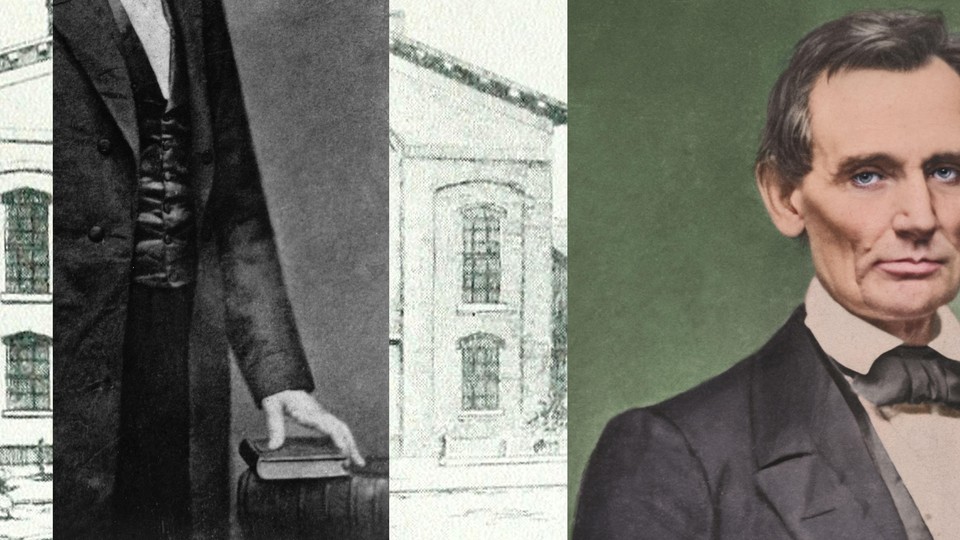
Presidential oratory once sought to elevate its audience, through high seriousness and artful rhetoric, but also by being high-minded and fair. Illustration by The Atlantic* Believing it some sort of civic duty to watch President Trump’s 2026 State of the Union address, I considered fortifying myself first with a large rye whiskey on ice, but wisely chose instead President Abraham Lincoln’s Cooper Union address of February 27, 1860. The contrast with Trump’s speech was not so much dispiriting (though it was also that) as instructive, even inspiring.
In 2004, the actor Sam Waterston recited the speech in the same Great Hall at Cooper Union, in New York City, where Lincoln had spoken, describing the exercise as “a kind of experiment to see if a speech like this could hold a modern audience’s interest.” The long standing ovation he received provided the answer. Waterston may be Cambridge born, but his voice that night had a prairie twang, and like Lincoln he was lanky, urgent, and utterly in earnest.
The original speech addressed three audiences: skeptical easterners who wondered if the frontier lawyer was made of presidential stuff, those who agreed with Senator Stephen A. Douglas that the existence of slavery should be decided by the popular vote in territories or states, and the hostile, fearful, and angry molders of southern opinion. It included a detailed examination of the history of the Founders’ view of slavery, but rested on blinding clarity about the central issue:
All they ask, we could readily grant, if we thought slavery right; all we ask, they could as readily grant, if they thought it wrong. Their thinking it right, and our thinking it wrong, is the precise fact upon which depends the whole controversy.
Waterston’s recital lasted 90 minutes: Watch it, and you will see that the audience is rapt, through the knotty history and intricate legal argument as well as the inspiring 20-minute peroration.
Speechmaking today is a different affair, but less because of those who are listening than because of those who speak. Lincoln’s Cooper Union speech elevates his listeners now, as it did then, because of its high seriousness and artful rhetoric, but also because it is high-minded and fair. He believed that “if slavery is not wrong, nothing is wrong,” but he understood that the slave states were embroiled in an institution they had inherited. He did not despise his opponents, he did not sneer at them, and he did them the justice of considering their arguments—before demolishing them.
The 2026 State of the Union speech stands in contrast, a speech by a mendacious demagogue who has degraded his listeners by debauching their instincts. If the Republicans listening to it leapt, like a band of trained monkeys, to deliver applause every few sentences, it was because they have been conditioned to do so.
In the past, the State of the Union was a serious affair, in which a president recounted the country’s challenges as much as, or more than, his personal successes. For Trump this was, as ever, an occasion to brag and boast, to lie about his achievements, and to berate and denigrate the opposition party.
There is no lack of important matters that the country needs to confront: a burgeoning deficit that will, in time, grow crippling; the more imminent bankruptcy of an unreformed and unsustainable Social Security system; the rise of a China seeking to push the United States out of its environs; the disruptions caused by new information technologies; and more. Trump ignored all those in an effort to convince his listeners of two mutually contradictory notions: that the United States has entered a golden age thanks to his leadership, in which the country is prosperous, safe, well governed, and optimistic; and that it has barely escaped the clutches of an opposition party that is sick, crazy, and a constant menace not only to the country’s finances but its ability to function.
There were some particularly odious moments, none more than the sentence or two in which Trump declared that he would like the Congressional Medal of Honor. Those who achieve it often do so posthumously. For a man whose alleged bone spurs kept him out of the Vietnam draft to muse about receiving an award reserved for the bravest of the brave of the American armed forces is contemptible.
Yet Trump, as in so many other cases, has not introduced the corruption of republican mores so much as taken them to new depths. The State of the Union speeches of his recent predecessors have also been filled, as this one was, with sucker punches thrown at the opposition party. Barack Obama famously denounced the Supreme Court ruling in Citizens United v. Federal Election Commission while the justices were seated before him, and both he and Joe Biden mocked the Republicans, albeit with less intensity and venom than Trump shows for his enemies.
Moreover, all recent presidents have resorted to the degrading spectacle of dragging humble fellow citizens into the spotlight, either to celebrate their achievements or, far worse, to make a spectacle of their private grief by putting it under the klieg lights of national publicity. This use of others, far junior to them in rank or status, as human props in a political circus is inimical to the dignity of those who deserve to be acknowledged either in solemn ceremonies at the White House, or anywhere but in public view.
When the Trump presidency ends, and when a different-minded president takes his place, there will be much work to be done—the purging of a bureaucracy staffed by unqualified or downright malicious Trump appointees; the undoing of damage to public institutions such as the National Park Service and the U.S. Institute of Peace; and a meticulous public rendering of the corruption, self-dealing, and disregard of law by Trump appointees. There will be reconstruction needed, too—for example, the creation of new safeguards against the abuse of presidential power that antedate Trump by curtailing the president’s pardon power.
But the country will require no less urgently a change in tone from its leaders. Judging by the smashmouth rhetoric of too many of the Democrats eyeing the presidency, that may not be in the cards. But it should be: The American people deserve it, and most of the electorate, exhausted by the partisan poison of our time, want it.
The Lincolnesque tone is not beyond normal politicians. John F. Kennedy was a problematic president in some ways, but his 1963 State of the Union Address bears rereading as a model of what could be. There are no sharp elbows flung at his political opponents. The tone is balanced; the issues he addresses (tax legislation, the well-being of the mentally ill, the expansion of high-school education) important. He speaks as much about foreign policy as about domestic politics, though he notes, “We shall be judged more by what we do at home than by what we preach abroad.” The only mention of individuals comes at the very end, in a short paragraph that honors three fallen soldiers. He spoke the way a president should.
Dignity elicits dignity, gravity elicits gravity, and respect elicits respect. The president who understands this, and can speak accordingly at an occasion such as the State of the Union—which is intended to be a national, not a partisan, event—will render an emotionally battered country an enormous service. One need not be a Lincoln to do it.