The Trump administration avoids calling military actions 'war' to evade legal and political responsibility, while using aggressive rhetoric to project strength. This semantic manipulation reflects a preference for image over substance.
Key Takeaways
•The administration avoids the term 'war' to bypass congressional approval and public backlash, using euphemisms like 'operation' instead.
•Historical precedents show similar semantic dodges, such as 'police action' for the Korean War, to minimize perceived conflict.
•Rhetorical use of 'war' is reserved for abstract concepts like the 'War on Terror,' allowing aggressive posturing without accountability.
•This strategy highlights a focus on surface-level messaging over substantive policy and responsibility for consequences.
Trump’s administration has both used and avoided the word war in ways that seek glory and evade responsibility. Celal Gunes / Anadolu / Getty What’s happening in Iran right now? The Trump administration and Republican lawmakers have been twisting themselves into semantic pretzels to avoid answering this very easy question with the word war, although it is very clearly a war. Even the writers at Saturday Night Live couldn’t help but notice the absurdity. “War? Whoever called this a war?” Colin Jost said on this weekend’s show, playing Defense Secretary Pete Hegseth in full testosterone-rage mode. “This isn’t a war; it’s a situationship. We’re just going to hook up and see where it goes.”
Four days into this situation in the skies over Tehran, Speaker of the House Mike Johnson said, “We’re not at war right now.” This was, rather, a “very specific, clear mission—an operation.” Operation does seem to be the preferred word in government talking points, even as it encompasses assassinating an ayatollah, torpedoing an Iranian naval ship, blowing up fuel depots and a desalination plant, and losing the lives of (so far) eight American service members along the way.
Why don’t Republicans call this war what it is? First, there is a solid legal reason to avoid the W-word. According to the Constitution, only Congress can declare war. But President Trump, with his party’s acquiescence, has reserved that lever for himself, as have other recent presidents before him. So, the logic goes, if we don’t call it a “war,” there’s no reason to declare war. Individual members of Congress are inventing new definitions on the fly for what war actually is; Senator Josh Hawley, channeling his inner Sun Tzu, said that, for the purposes of a congressional declaration, it counts as war only once there are American “boots on the ground.”
There is something more profound going on than constitutional legerdemain. Leaders are sidestepping the term not just to avoid liability, but because Americans clearly want nothing to do with what it signifies. For most people, after the experience of Iraq and Afghanistan, war is just another word for “quagmire.” To some generations, it is less likely to conjure images of a flag being raised over Iwo Jima than it is to evoke the tortures at Abu Ghraib, a roadside IED blowing up soldiers in Fallujah, or the panicked American withdrawal from Kabul. Operation is much less fraught. It is preceded more naturally by the word successful. Many people associate operations with surgery, which can be dangerous, of course, but you’re usually unconscious while it’s happening. It sounds pretty painless. So does the more laparoscopic-sounding surgical strike, an outpatient procedure that pinches, but just for a moment.
Trump’s administration is not the first to want to dissociate itself from this word. What we now call the Korean War, which began in 1950, was referred to by President Harry Truman as a “police action,” partly to avoid congressional approval but surely also because the entire world was still recovering from World War II. This “police action” cost more than 36,000 American lives. Even the Vietnam War—also never approved by Congress—was at first called a “conflict.” More recently, in 2011, Ben Rhodes, the President Obama aide, described the United States’ bombing campaign of Libya as a “kinetic military action.”
This is not to say that war never crosses presidential lips. But when it does, it is usually invoked as a war against an abstraction, such as Lyndon B. Johnson’s “War on Poverty,” or Richard Nixon’s “War on Drugs,” or even George W. Bush’s “War on Terror” (which was doubly confusing because terror is a tactic; you might as well fight a war on nunchucks). These wars are more confidently proclaimed because Americans accept that they are open-ended. There is no real consequence for declaring war on poverty (poverty won’t counterstrike), and no real measure of when its goal has been achieved. The use of war here is meant to telegraph urgency and seriousness—a willingness to fight. But the flip side, the responsibility this entails, is absent, as is any clear boundary or mission.
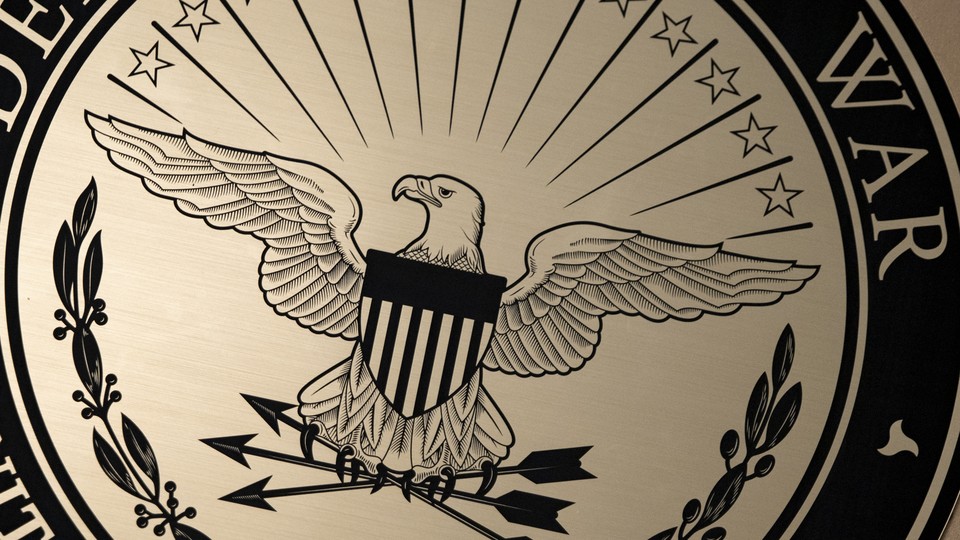
As much as Trump officials hate to use war literally—even as they wage it, literally—they seem to love it rhetorically and aesthetically. They even insisted that people start calling the Department of Defense the “Department of War” instead, because, as a fact sheet read, it “conveys a stronger message of readiness and resolve.” (Officially, its statutory name has not changed.) Defense sounded cautious; war sounds like you’re going to punch someone in the face. Or as Hegseth put it, expressing his philosophy in a pair of rhyming couplets, “Maximum lethality, not tepid legality; violent effect, not politically correct.”
Hegseth has been a particularly big promoter of a “warrior” ethos; he loves a speech in which he can exhort soldiers to “kill the enemy and break their will.” Pumping the words war and warrior into his sentences while being careful, for instance, to describe the overthrow of Venezuela’s government as a “counter-narco-terrorism campaign” can create cognitive dissonance. You could sense the confusion in a whiplash-inducing clip of Mike Johnson speaking last week: After insisting, “We are not at war,” he referred to the “Department of Defense” but then quickly rewound his sentence and switched to the “Department of War.” I don’t blame him; it’s hard to keep straight the idea that the government agency desperate to be called the Department of War has, as Johnson put it, “no intention of being at war.”
This is more than just a shell game. It reveals what the Trump administration has shown many times: an interest in surface over substance, and publicity over policy. Its officials like an attention-grabbing name such as DOGE, but not the responsibility for what happens when “government efficiency” is attempted with a chainsaw. Hegseth’s posturing often reminds me of the futurist and protofascist poet F. T. Marinetti, who also had romantic notions about war. In his 1909 Manifesto of Futurism, Marinetti called it “the world’s only hygiene,” glorifying violence, militarism, and destruction as necessary tools to purge old traditions and accelerate technological and cultural change. It was easy for Marinetti to evoke such sanitizing dreams in the abstract, in the years leading up to World War I, before the millions of corpses piled up.
I don’t mean to equate any abstracted sense of “war” with fascism. War, as a word and an act, is at times a moral imperative, but the case for it needs to be made clearly and the consequences understood and anticipated. (See the speeches of Franklin D. Roosevelt and Winston Churchill for examples of leaders who knew how to do this.) The selective use of the word matters because the administration is attempting to have it both ways: projecting aggression and causing destruction but throwing its hands up when the time comes to deal with the repercussions. In a short Truth Social video announcing the Iran strikes on February 28, Trump did use the W-word while referring to American casualties—but only to say, ruefully, “that often happens in war,” as if someone else entirely had started it. All he did was launch an operation.