The Secret Agent explores Brazil's authoritarian past through a scientist's flight from corruption, arguing that societal violence and forgetting are systemic issues requiring collective memory, not just a dictatorship's legacy.
Key Takeaways
•The film critiques Brazil's 'logic' of corruption, inequality, and historical amnesia rather than focusing solely on dictatorship-era politics.
•It portrays violence as stemming from societal issues like envy and bruised masculinity, not just state repression, through characters like the assassin Bobbi.
•The narrative emphasizes the importance of testimonies and memory in combating authoritarianism, contrasting with Brazil's delayed truth commission.
•Director Kleber Mendonça Filho connects past and present, showing how historical erasure enables figures like Bolsonaro and persists beyond slavery's abolition.
•The film avoids simplistic hero/villain binaries, instead highlighting empathy and human connections as forms of resistance in a morally ambiguous world.
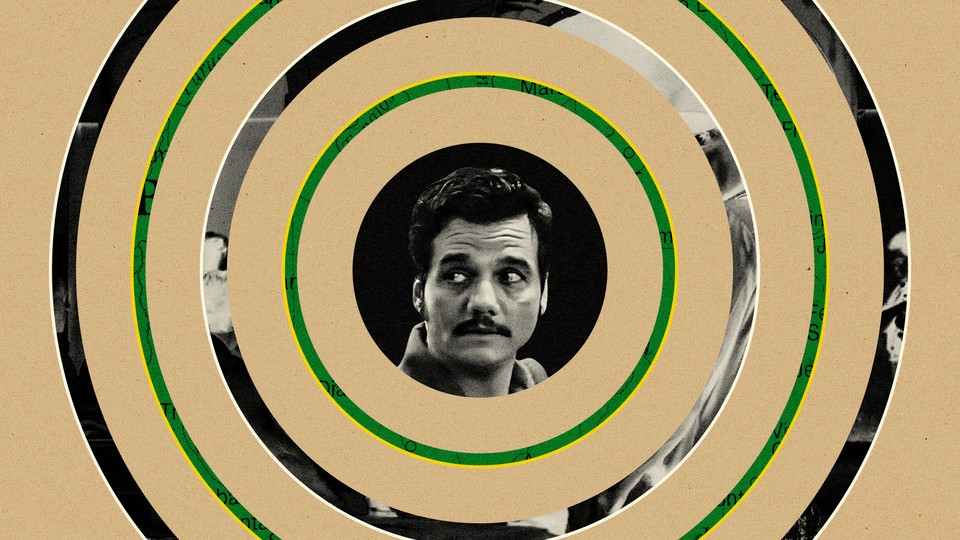
The Secret Agent is a deep reckoning with an authoritarian regime—and with how those affected can move forward. Illustration by Lucy Naland. Sources: Neon / Everett Collection; Getty. A mystery looms over the first 90 minutes of The Secret Agent, the Brazilian director Kleber Mendonça Filho’s masterful fifth feature: Why is Armando Solimões on the run?
The sad-eyed research scientist might be, as the title suggests, some kind of spy, perhaps working to undermine the U.S.-backed military regime that governed Brazil from 1964 to 1985. The film’s amber light and ample bell-bottoms situate it firmly in the late 1970s, a time of repressive dictatorships and jittery paranoia, triggered by political malfeasance and instability across the world.
But Armando, played with cagey vulnerability by Wagner Moura, who is up for Best Actor in a Leading Role at the Oscars, doesn’t read as a man accustomed to subterfuge. He’s no political dissident or intrepid freedom fighter, much less the elusive secret agent of the film’s title. Instead, he has simply crossed the wrong man and become a hapless victim of corruption, impunity, and greed—problems still common in contemporary Brazil. As Mendonça Filho told the Brazilian news magazine Veja in 2023, The Secret Agent, then still being made, “is not a dictatorship film: It’s about the logic of Brazil.”
That “logic” has been a central focus of Mendonça Filho’s work across his career. His first two features, Neighboring Sounds and Aquarius, dealt with the rapacious development transforming Recife, the sprawling coastal metropolis where he grew up, and the persistent tensions of race and class roiling beneath the city’s surface. In 2019, he and Juliano Dornelles co-directed Bacurau, a gruesome spaghetti Western in which a group of bloodthirsty anglophone tourists pay a venal Brazilian politician for the right to hunt the inhabitants of a rural village. That lurid fable was followed by 2023’s Pictures of Ghosts, an impressionistic documentary that told the parallel stories of Mendonça Filho’s life in movies and Recife’s decaying cinemas. Pieced together from found footage, archival imagery, and clips from his own oeuvre, Pictures of Ghosts tracks Recife’s transformations and, by extension, Brazil’s tendency to build over its past. Early in that film, the director’s late mother, the historian Joselice Jucá, appears in an archival television interview to talk about her research: “Through oral history,” she says, “we collect the information that’s been left out of history.”
The Secret Agent emerged from that idea. Intermittent flash-forwards bring the action to the present day, where a pair of young contractors hired by an unnamed university transcribe tape-recorded testimonies by Armando and others caught in the regime’s crosshairs. The plot’s pure fiction takes on the weight of historical reconstruction. While neighboring countries such as Argentina and Uruguay moved to investigate the crimes of their dictatorships shortly after their respective leaders fell out of power, Brazil did not found its own National Truth Commission until 2011. That lack of an official accounting encouraged a willful amnesia about the regime’s crimes and, Mendonça Filho has argued, led directly to the 2018 election of Jair Bolsonaro, who ran on a platform of sneering nostalgia for the era of military rule.
But in societies with shallow memories, testimonies make powerful weapons. For many American moviegoers, Walter Salles’s Oscar-winning 2024 hit, I’m Still Here—the true story of Eunice Paiva, who sought justice for her husband, an opposition congressman disappeared by the state—served as an introduction to the cruelty of the Brazilian dictatorship, one of many brutal regimes across Latin America supported by the United States. Based on a memoir by Paiva’s son, I’m Still Here concludes with a hopeful final image of a family gathered together in a better, brighter Brazil. For many viewers in both Brazil and the U.S., Salles’s dutiful portrait of individual courage was genuinely eye-opening. At a moment of rising global authoritarianism, it also proffered a reassuring, sentimental narrative of light prevailing over darkness.
The Secret Agent illustrates a more complicated reality. Rather than focus on a single irreproachable hero, Mendonça Filho dilates his lens to take in an expansive world. As the movie begins, Armando takes shelter in a Recife safe house, overseen by a cigarette-ripping matron called Dona Sebastiana and populated by refugees navigating their own unspecified troubles. He has fallen into his absurd predicament by refusing to turn over potentially lucrative research to a corrupt businessman named Ghirotti from Brazil’s wealthy southeast, who has since hired a pair of assassins to hunt him down. Armando’s forced separation from his young son, Fernando, is a pointless outrage, and the violence he and others encounter is largely meaningless, spurred more often by envy, desperation, and bruised masculinity than by explicit state repression.
But life abounds too. At Dona Sebastiana’s suggestion, Armando starts a casual fling with a fellow runaway, Claudia, whose reasons for hiding are never revealed. Carnival parties rage in the street, and audiences crowd into movie theaters for screenings of Jawsand The Omen. Cruisers meet up in a city park and—in a surreal turn of events—are terrorized by a stop-motion severed leg. The sequence is not a totally abrupt break from reality, but a visual sleight of hand: In real life at the time, local Recife reporters invented the symbol of the severed leg as a way of alluding to domestic violence and police brutality. For Armando’s fellow fugitives, who imagine the grisly scene by reading the paper, the story is a gleeful distraction from paranoia and pain. Unlike the elaborate, leftist underground in Paul Thomas Anderson’s One Battle After Another, their network of resistance is accidental and humane. Their primary virtue isn’t action; it’s empathy.
This Dickensian narrative sprawl allows Mendonça Filho to render his villains in the same Technicolor. Consider Bobbi, one of the assassins sent north to find Armando. Bobbi, we learn, fell into this work after his stepfather—and partner in violence—murdered his mother years before. Bobbi boils with resentment and shame when Recife’s crooked police chief undermines his masculinity. (“What’s with ‘Bobbi’ anyway? That a man’s name?” the chief scoffs.)
Not long after, we watch Bobbi pass that humiliation on to the dark-skinned dockworker he contracts to assassinate Armando: “You work in this shithole carrying sugar like some animal,” he snarls. Throughout, the camera lingers on Bobbi’s taut body and adonic profile; beauty and brutality are never far apart. Here is what Mendonça Filho calls “the logic of Brazil,” compressed into the storyline of a largely silent supporting character: Bobbi, a white man from the south and the secondary victim of a femicide, delegates his dirty work to a poor brown man from the north, passing on cruelty and casual bigotry like a virus. The government may not have hired Bobbi or urged Ghirotti to seek his petty revenge, but the men’s savagery is inseparable from that of a state sustained by atrocity.
Ultimately, the movie does not provide a tidy narrative of vindicated heroes and punished villains. As in the real Brazil, where a notorious 1979 law extended equal amnesty to political opponents of the regime and to the perpetrators of crimes against them, the film’s heightened world offers no coherent moral order; the “arc of the moral universe” does not necessarily bend toward justice. Still, The Secret Agent avoids facile nihilism. More than halfway through the film, Dona Sebastiana, in a tender address to her brood of exiles, says, “Life has bad things but also has good things”—a pithy rejoinder to despair.
Brazilians, Mendonça Filho claimed in a recent interview with The New Yorker, prefer to “not talk about unpleasant things.” But as the film quietly signals, a society’s obscenities are not aberrations, only parts of an ugly chapter in a long history. (The Brazilian government, at least, has taken steps toward reckoning with recent events, sentencing Bolsonaro to 27 years in prison for his failed 2023 coup and barring him from participation in electoral politics until 2030.)
History finally catches up to the present in The Secret Agent’s final scene, when one of the women tasked with conserving Armando’s testimonies tracks down his now-adult son, Fernando (also played by Moura), to learn more about his family history. He tells her what little he knows: Armando, who spends much of the movie searching for evidence of his mother’s existence in the densely packed files of a government office, was conceived when a 17-year-old white boy impregnated the 14-year-old daughter of his family’s Indigenous housemaid.
She was “a kind of servant. Like … a slave … or an enslaved person,” Fernando explains, stumbling over the ugly vocabulary of forced labor, which persisted—and, arguably, persists—long after Brazil’s abolition of slavery, in 1888. Violence, the exchange suggests, did not begin with the dictatorship, and it didn’t end with it either; autocracies are not just a cause of historical erasure but also a consequence. Nations can’t just blink away the nightmares of authoritarianism or assume that removing a strongman will resolve the societal conditions that led to his rise. The past is an unforgiving mirror, and forgetting is as easy as looking away. Remembering, The Secret Agent argues, takes hard, collective work.
An actual nightmare marks the transition into The Secret Agent’s explosive third act. Armando dreams that he is back at the rural gas station where he stops on his way to Recife at the movie’s outset. The corpse of a gunned-down thief, rotting in the dust, rises with a strangled moan. The camera cuts to Armando’s apartment at Dona Sebastiana’s house, where a Carnival dancer in a blood-red mask appears at his bedside. He jolts up, screaming. Claudia wakes beside him, but she doesn’t tell him that everything’s okay; she doesn’t offer platitudes or lie. Instead, she takes his face between her hands and directs his gaze to her steady, wide-open eyes. “Look at me,” she says, pulling him close. “I’m here.”