Bitcoin Volatility Rises Ahead of $23 Billion Options Expiry
TL;DR
Bitcoin faces heightened volatility with $23 billion in options expiring next Friday, amplifying downside risks. Traders remain bearish as price swings and liquidations persist, with key levels like $85,000 acting as pressure points.
Key Takeaways
- •$23 billion in Bitcoin options set to expire next Friday, accounting for over half of Deribit's open interest, threatens to increase market volatility.
- •Traders are pricing in continued downside risk, with bearish positioning and volatility near 45%, while call options at $100,000 and $120,000 show residual optimism.
- •Key catalysts include the Jan. 15 MSCI decision and call-overwriting flows, which may cap upside and boost downside volatility in early 2025.
- •Bitcoin is down about 30% from its October all-time high and on track for its worst quarter since Q2 2022, with sentiment fragile and prices in a holding pattern.
Tags

Options are showing that Bitcoin is heading into the final weeks of 2025 under intense pressure, with around $23 billion in contracts set to expire next Friday that threaten to amplify already-elevated volatility.
The amount accounts for more than half of all the open interest on Deribit, the largest Bitcoin options venue. The looming buildup shows traders are pricing in continued downside risk in what’s become an even more perilous market.
Bitcoin’s overall market value saw price swings of over $130 billion within an hour during US trading on Wednesday, triggering a cascade of both long and short liquidations. The broader crypto market has fluctuated around the $3 trillion threshold.
“Markets continue to slide as we head into the New Year, with prices sitting on a knife’s edge,” said Nick Forster, founder at digital assets trading platform Derive.xyz.
Bitcoin jumped as much as 3% to $88,328 on Friday, leaving it slightly up for the week overall. The largest cryptocurrency is down about 30% since reaching an all-time high of more than $126,000 in early October. Other tokens including Ether, Dogecoin and Solana traded up by around 4% as of early morning in New York on Friday.
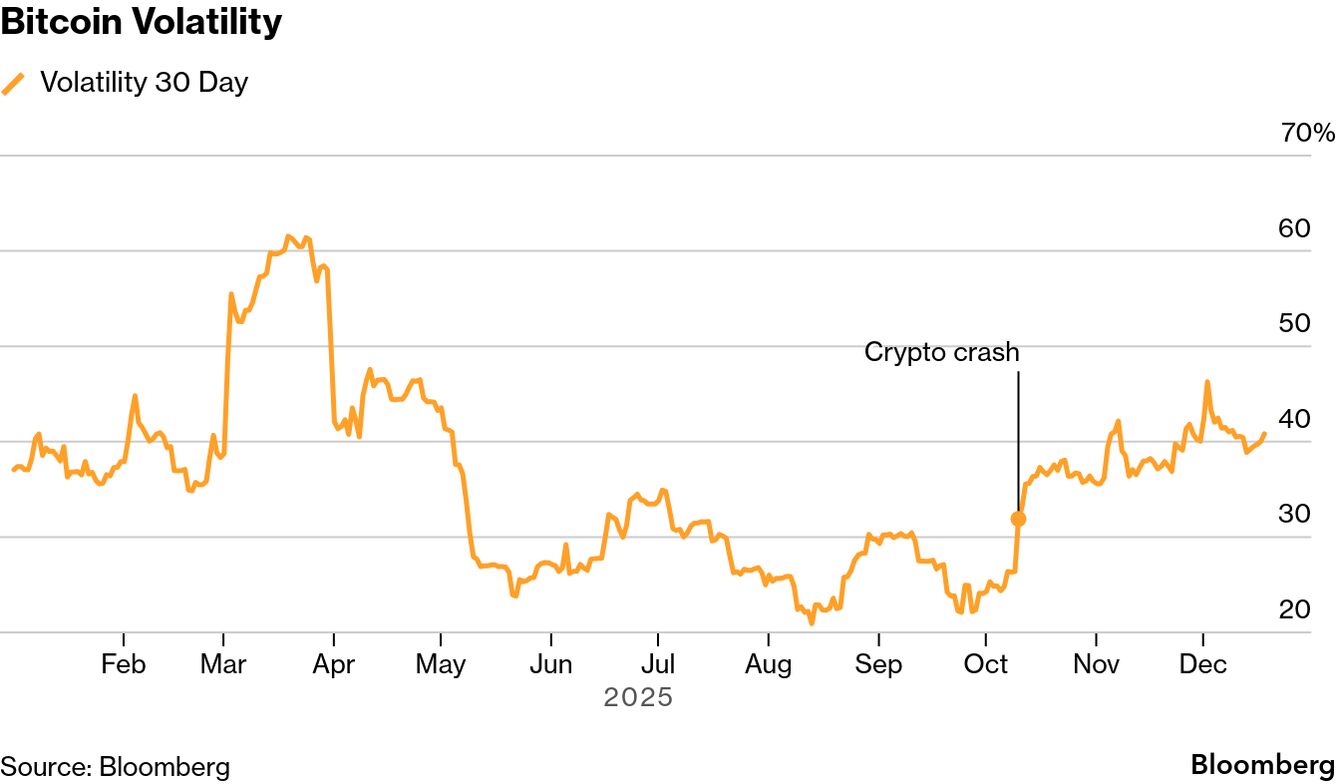
“Bitcoin positioning remains decisively bearish. Thirty-day volatility has climbed back toward 45%, while skew hovers around -5%. Longer-dated skew is also anchored around -5%, signaling that traders are pricing continued downside risk through Q1 and Q2, as ongoing sell pressure from previously inactive wallets weighs on spot prices,” Forster said, referencing the measure of the relative cost of upside potential versus downside protection known as the skew.
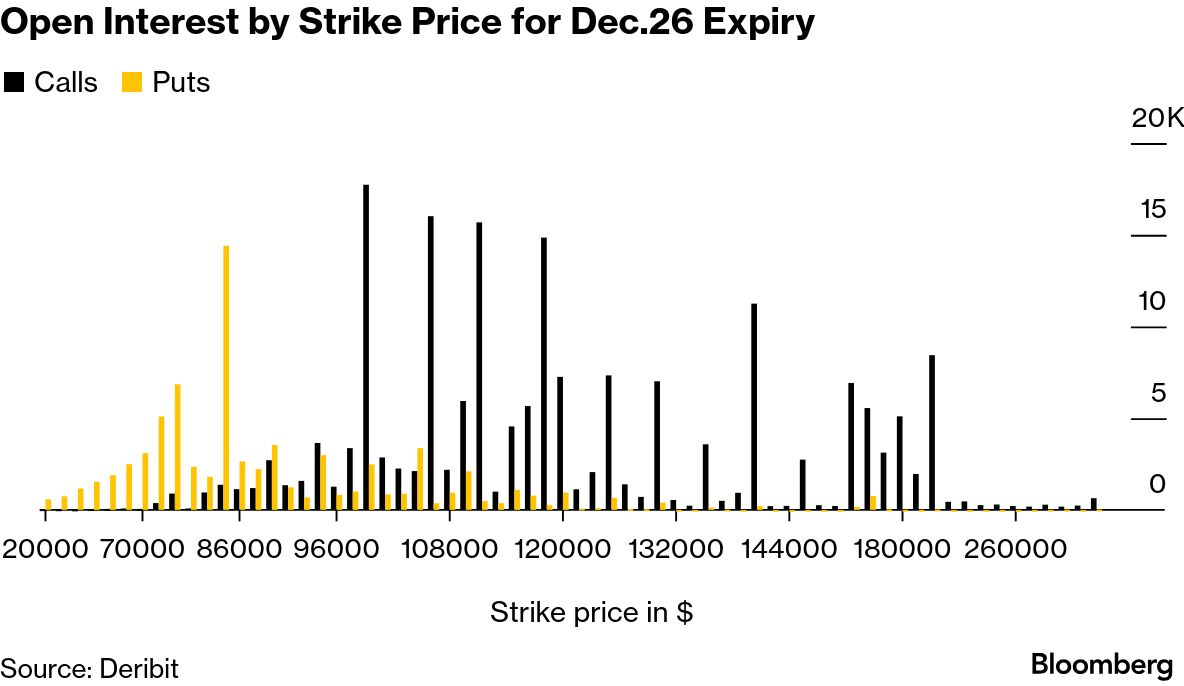
Positioning around the Dec. 26 expiry reflects that divide. Call options are clustered at strike prices of $100,000 and $120,000, hinting at residual optimism for a year-end relief rally. Yet bears dominate the near-term picture, with heavy put option exposure accumulating at $85,000 — a level that digital asset trading firm STS Digital estimates holds roughly $1.4 billion in open interest and may act as a gravitational “magnet” into the options expiration date.
Beyond the expiry, traders expect repositioning around two catalysts: hedging ahead of a Jan. 15 MSCI decision that could eject digital-asset treasury firms whose crypto holdings exceed 50% of assets from its indexes, and renewed call-overwriting flows. “Together, these flows should increase downside volatility while capping upside,” said Maxime Seiler, chief executive at STS Digital.
Sentiment remains fragile. Bitcoin is on track for its worst quarter since the second quarter of 2022, when the collapses of TerraUSD and Three Arrows Capital roiled the industry. Timothy Misir of BRN said Bitcoin’s inability to reclaim key levels leaves the market “trapped in a fragile holding pattern.”
Apparent demand growth for Bitcoin entered a slowdown period in early October and is now growing below that trend, according to analysts at research firm CryptoQuant. “Bitcoin demand growth has decisively slowed, signaling a transition into a bear market,” the analysts wrote in a note on Friday.