The Iran War Has Four Stages. We’re in the Second.
AI Summary12 min read
TL;DR
The U.S. and Israel are in the second phase of a four-phase military plan against Iran, but lack a clear endgame or vision for postwar Iran. While achieving tactical military successes, the campaign risks creating a failed state without addressing long-term strategic objectives.
Key Takeaways
•The U.S. military is executing a four-phase plan (initial strikes, airspace control, stabilization, withdrawal) but administration officials cannot articulate clear postwar objectives for Iran.
•Military successes (reduced Iranian missile/drone capabilities, damaged infrastructure) contrast with uncertainty about Iran's future - regime survival could create instability while regime collapse could lead to a failed state.
•Diverging U.S. and Israeli interests emerge: Israel seeks to eliminate Iranian threats even if it creates a failed state, while U.S. officials debate the risks of an unstable Iran.
•Historical parallels with Vietnam, Iraq and Afghanistan suggest tactical victories don't guarantee strategic success, especially without clear political objectives.
•The Trump administration's ambiguous war aims and aversion to nation-building complicate prospects for a stable postwar outcome in Iran.
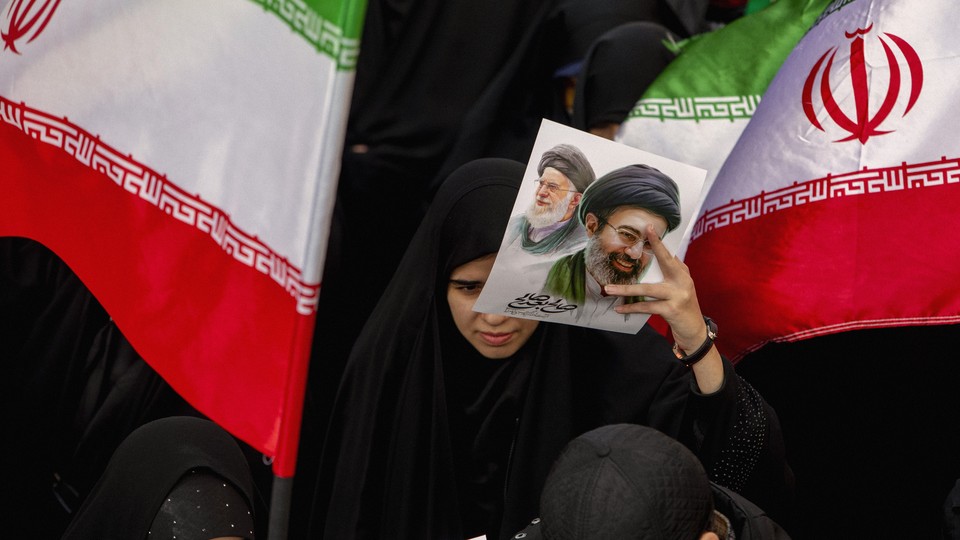
Regime change appears a lost cause, so what endgame are the U.S. and Israel pursuing? Majid Saeedi / Getty The death of Supreme Leader Ayatollah Ali Khamenei on the first day of the Iran war generated hope that the regime change the Trump administration and Israel yearned for would come to pass, perhaps with a more moderate new leader stepping up. That, after all, is what happened two months ago in Venezuela, where Delcy Rodríguez assumed power after her boss, NicolásMaduro, was captured by U.S. forces. The nationwide protests in Iran late last year and early this one hinted at a country potentially on the cusp of seismic change. For a few hours after the bombing started, the maximalist outcome the administration sought seemed within reach, officials told me.
Instead, the U.S. and Israel moved through their military-strike plan over the following days without a palpable change in Iran’s position. The regime named the ayatollah’s son Mojtaba Khamenei—whose ideas are believed to be more hard-line than his father’s—as successor. And rather than create the circumstances for a popular uprising, which Trump had called for in his first speech of the war, the air campaign has left Iranians feeling stuck between a regime they do not want and a war whose objectives are ill-defined. The strikes that once promised Iranians liberation have instead led to black rain caused by oil from stricken infrastructure, damage to historical sites, and, according to the preliminary findings of a U.S. military investigation, the deaths of at least 175 children and teachers from a U.S. Tomahawk missile. Trump’s assertion that Iran would “probably not” keep its borders only added to fears among Iranians that the war will lead to a divided country.
Almost two weeks into the war, as the Pentagon releases a growing roster of targets that have been struck (more than 5,000 in the first 10 days), administration officials remain at a loss to explain how they see the war ending, and what they want Iran to look like afterward. The military has said it is in the second phase of what is likely a four-phase plan: initial strikes, control of Iran’s airspace, stabilization, and withdrawal. Administration officials have suggested that completing the operation could take at least another two weeks. At a rally in Kentucky last night, Trump asked his supporters, “We don’t want to leave early, do we? We’ve got to finish the job, right?” He defined the goal only as avoiding the need to return “every two years.”
But what would postwar Iran look like? “The administration still hasn’t decided what they want to see happen,” one Defense Department official told me. In a closed-door briefing yesterday on Capitol Hill, Pentagon officials didn’t offer legislators any more clarity. “They can’t give answers other than acknowledge the immediate military objectives,” a congressional official told me. (Asked for comment, the Pentagon pointed to public statements from the secretary of defense and the president.)
General Dan Caine, the chairman of the Joint Chiefs of Staff, and Defense Secretary Pete Hegseth have boasted at Pentagon briefings that the U.S. has weakened Iran’s navy, as well as its drone and ballistic-missile capability. They have offered impressive statistics but few details. Iranian ballistic-missile strikes are down by 90 percent since Iran began retaliating; drone strikes are down by 83 percent. (It’s not clear if Iran is simply choosing to not launch at the same pace that it did at the start of the war or whether its capabilities have been destroyed, or a mix of both.) Many Iranian leaders have been assassinated. More than 50 Iranian vessels have been damaged or destroyed, Caine said. And U.S. strikes have moved farther east into the country. Militarily, the plan is on track, officials say.
So far, the list of achievements produced by U.S. Central Command, which leads military action in the Middle East, does not cite any new damage to Iran’s nuclear program. (Trump said it was “obliterated” in last June’s strikes.) On Tuesday, Hegseth made clear that to “permanently deny Iran nuclear weapons forever” remains a U.S. objective. That could potentially require a Special Forces operation to seize Iran’s uranium, though the Pentagon has been mum on that prospect. Caine notably didn’t mention Iran’s nuclear capabilities at the same event.
In congressional briefings, the Pentagon has given the classified percentage of its targets that have been hit, saying the campaign is ahead of schedule, the congressional official said. In the second phase of the plan, the military depends less on long-range missiles and instead is sending more aircraft over Iran to strike targets, given that the U.S. and Israel are close to controlling Iranian airspace. This could be the longest phase of the U.S. attack plan.
But at the same time, hopes of a new direction for Iran—further dashed by recent U.S. intelligence assessments that the regime is not at imminent risk, according to Reuters—have been superseded by fears that either the regime survives or, possibly worse, the regime’s ability to govern collapses, splinters, or is so weak that it leaves behind a failed state. That uncertainty raises the possibility that the U.S. and Israel could seek divergent ends to the war.
A broken Iran consumed by internal fighting poses a minimal threat to Israel. Israel’s targets expanded last weekend to key Iranian economic assets, including energy facilities, signaling an interest in weakening Iran beyond just its military capacity.
“The Israelis are looking to ensure that they don’t have a threat from the Iranians, but their way of going about it means if they are successful, Iran is a failed state, sooner or later,” H. A. Hellyer, a Middle East security and geopolitics expert for the Royal United Services Institute and at the Center for American Progress, told me.
The senior ranks of the U.S. military are divided over the prospect of a weakened or failed state. Some commanders see a benefit: Only a functional state can pursue nuclear ambitions. Others fear that an unstable and unpredictable Iran could pose a serious risk to the U.S., both economically and for long-term security, U.S. defense officials told me. A failed state could become a haven for terrorist groups that target U.S allies and interests in the region. Or one of Iran’s minority groups, such as the Kurds, could seek to grab parts of the existing state and make similar calls for greater autonomy for Kurdish populations in Turkey and Iraq. Above all, a weakened state puts 92 million Iranians in jeopardy from internal instability or, possibly, from a new emboldened regime, should one arise. If Iranians choose to leave, they could trigger a disruptive mass migration, as happened after the start of Syria’s civil war 15 years ago, a calamity with which the Middle East and Europe are still reckoning.
Israel and the U.S. have different pain tolerance for achieving their aims in Iran. Israelis consider higher gas prices caused by obstructions or threats in the Strait of Hormuz “a small price to pay” to combat their chief nemesis, Danny Citrinowicz, a nonresident fellow with the Atlantic Council’s Middle East programs, told me from Israel.
But President Trump may balk at the prospect of sustained high oil prices, with some predictions that oil could reach $200 a barrel (from slightly less than $73 at the start of the war) ahead of November’s midterm elections. Even now, with oil about $100 a barrel, the war has caused what the International Energy Agency says is the largest oil-supply disruption in history; Gulf producers are cutting output by at least 10 million barrels a day—roughly 10 percent of global demand. The U.S. has listed a panoply of rationales for the war—10 were offered in just the first six days—suggesting that victory could have many definitions. If the principal U.S. aim is to destroy Iran’s nuclear capabilities, that does not require Iran’s regime to collapse but just that it be so weakened that it can’t rebuild for years. That doesn’t necessarily mean, however, that the conditions would be right for the people to overthrow their government.
“Tacitical success does not guarantee a successful post-regime Iran,” Christopher Preble, the senior fellow and director of the Reimagining U.S. Grand Strategy program at the Stimson Center, a think tank, told me. “A strategic victory means that you are in a stronger position than when you started the war.”
U.S. history is riddled with wars won on the battlefield and lost in the aftermath. The military achieved one battlefield success after another in Vietnam, inflicting high casualties, only to fail to preserve stability. The Vietcong needed only to not lose in order to effectively win. More recently, the U.S. declared “mission accomplished” six weeks after taking control of Iraq in 2003, only to spend the next eight years trying to stop an insurgency that undermined its ambition to transform the nation into a model of Middle Eastern democracy. In Afghanistan, the U.S. took Kabul within a month, only to have the Taliban spend the next 20 years not collapsing under strikes and then return to power hours after the U.S. withdrawal. In all three conflicts, the U.S. had clearly stated its initial strategic objectives, even if they turned out to be unachievable. The Trump administration, by contrast, has been inconsistent, to say the least, in its stated objectives, and regime change has slipped from many of its pronouncements.
Whether that ambiguity is strategic—giving the president plenty of alternative paths to declaring victory should he decide to end the war—or reflects a lack of coordination isn’t clear. The White House has repeatedly said the war will end at a time of the president’s choosing after an “unconditional surrender” from Iran. But wars rarely end so neatly, nor is it clear to whom the regime would surrender, given there are no U.S. or Israeli forces in the country. Even if Iran’s nuclear programs are decimated, a weakened regime or its proxies might keep harassing the Strait of Hormuz, where one-fifth of the world’s oil traveled before the war. Yesterday, Iran struck at least three ships near the strait, according to Kpler, a global ship-tracking company.
“There is probably a range of outcomes that the administration would deem acceptable in the current war, ranging from the best-case outcomes they hope for and the less good but not intolerable outcomes they can live with," Peter Feaver, a professor of political science and public policy at Duke University, told me. But he noted that all wars “end with negotiations leading to compromises,” such as the U.S. concession to retain Japan’s emperor as a condition for ending World War II. What Trump might be open to is not known.
Trump’s unwillingness to define what a postwar Iran might look like should perhaps be no surprise. His love of real estate has never crossed over into a love of building nations. One month into his second term, Trump began air strikes to combat terrorist groups in Somalia, and he has since ordered more strikes there than any U.S. president. Yet he hasn’t said what type of government he believes would be effective in stopping the extremist groups there. He sent Special Forces into Caracas in early January to remove Maduro, but he has yet to articulate a vision for Venezuela beyond the regime’s compliance with U.S. authority, and he hasn’t said whether a transition to democracy is a necessary prerequisite for enduring U.S. support. And although Trump said, one day before launching strikes on Iran, that the U.S. “could very well end up having a friendly takeover of Cuba,” he has not said what should come in place of the Castro regime or whether the U.S. would participate in that change.
Instead, the president has celebrated U.S. strength and the military’s ability to achieve quick tactical victories, usually led by air and naval power. In a 2019 speech, Trump said he liked Caine because the then–National Guard general told the president that he could end the U.S. war in Syria against the Islamic State quickly with air power.
“I was upset with my generals because they weren’t getting it finished. I want the job done,” Trump said in the speech. “And I said to the generals, ‘Listen, we got to get out. I want to know: Why is it going to take two years to knock off 2 or 3 or 4 percent, which is what we had left?’” Caine, then a one-star general, told the president, according to Trump’s recollection: “If we attack them in a different manner, we can do it much faster.”
Earlier this year, the administration released a National Defense Strategy that calls for a refocusing away from the Middle East and toward the Western Hemisphere and threats from China, reflecting a sentiment that Trump articulated in a speech in Riyadh last year. The U.S. needed to stop nation building because of its poor track record in shaping what happens after the invasion ends, he said. “So-called nation builders wrecked far more nations than they built, and the interventionalists were intervening in complex societies that they did not even understand themselves,” Trump told the U.S.-Saudi Investment Forum. “They told you how to do it, but they had no idea how to do it themselves.”
But perhaps the only thing worse than having an ineffective post-conflict plan may be having no plan at all.