The Film Students Who Can No Longer Sit Through Films
AI Summary8 min read
TL;DR
Film professors report students struggle to watch full movies, often using phones or speeding through films. This reflects broader attention-span issues shaped by social media and short-form content consumption.
Key Takeaways
•Film students increasingly fail to watch assigned movies fully, with many using phones during screenings or streaming distractedly.
•Professors attribute this to changed media diets, where students are accustomed to short-form content and constant digital switching.
•Some professors adapt by teaching 'slow cinema' to rebuild attention, while others adjust assignments to shorter formats.
•Even dedicated film students now often lack broad cinematic knowledge, having grown up primarily on social media content.
•The attention crisis affects learning outcomes, with students unable to answer basic questions about films they supposedly watched.
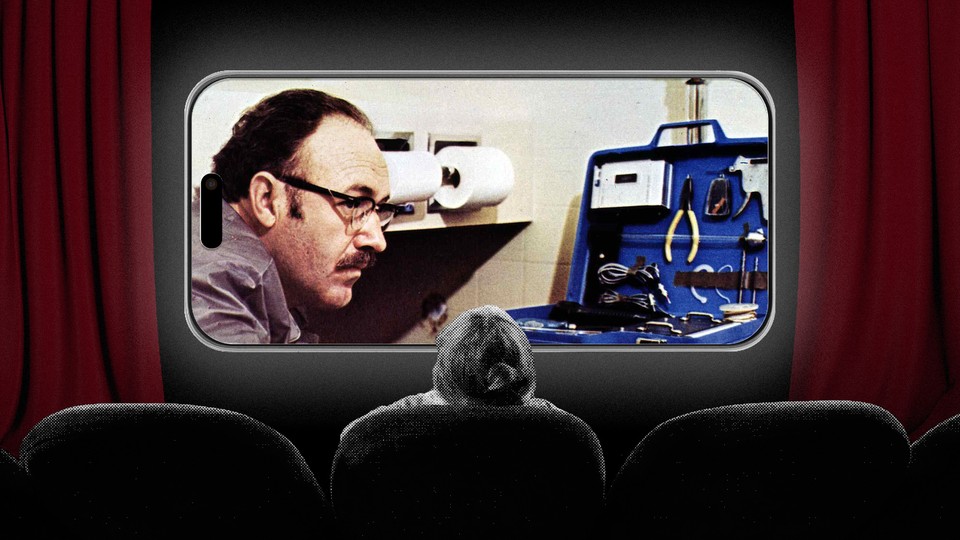
The attention-span crisis goes to the movies. Illustration by The Atlantic. Sources: bilalulker / Getty; FilmPublicityArchive / United Archives / Getty; Julian Stratenschulte / Picture Alliance / Getty; Prasert Krainukul / Getty. Everyone knows it’s hard to get college students to do the reading—remember books? But the attention-span crisis is not limited to the written word. Professors are now finding that they can’t even get film students—film students—to sit through movies. “I used to think, If homework is watching a movie, that is the best homework ever,” Craig Erpelding, a film professor at the University of Wisconsin at Madison, told me. “But students will not do it.”
I heard similar observations from 20 film-studies professors around the country. They told me that over the past decade, and particularly since the pandemic, students have struggled to pay attention to feature-length films. Malcolm Turvey, the founding director of Tufts University’s Film and Media Studies Program, officially bans electronics during film screenings. Enforcing the ban is another matter: About half the class ends up looking furtively at their phones.
A handful of professors told me they hadn’t noticed any change. Some students have always found old movies to be slow, Lynn Spigel, a professor of screen cultures at Northwestern University, told me. “But the ones who are really dedicated to learning film always were into it, and they still are.”
Most of the instructors I spoke with, however, feel that something is different now. And the problem is not limited to large introductory courses. Akira Mizuta Lippit, a cinema and media-studies professor at the University of Southern California—home to perhaps the top film program in the country—said that his students remind him of nicotine addicts going through withdrawal during screenings: The longer they go without checking their phone, the more they fidget. Eventually, they give in. He recently screened the 1974 Francis Ford Coppola classic The Conversation. At the outset, he told students that even if they ignored parts of the film, they needed to watch the famously essential and prophetic final scene. Even that request proved too much for some of the class. When the scene played, Lippit noticed that several students were staring at their phones, he told me. “You do have to just pay attention at the very end, and I just can’t get everybody to do that,” he said.
Many students are resisting the idea of in-person screenings altogether. Given the ease of streaming assignments from their dorm rooms, they see gathering in a campus theater as an imposition. Professors whose syllabi require in-person screenings outside of class time might see their enrollment drop, Meredith Ward, director of the Program in Film and Media Studies at Johns Hopkins University, told me. Accordingly, many professors now allow students to stream movies on their own time.
You can imagine how that turns out. At Indiana University, where Erpelding worked until 2024, professors could track whether students watched films on the campus’s internal streaming platform. Fewer than 50 percent would even start the movies, he said, and only about 20 percent made it to the end. (Recall that these are students who chose to take a film class.) Even when students stream the entire film, it’s not clear how closely they watch it. Some are surely folding laundry or scrolling Instagram, or both, while the movie plays.
The students I spoke with admitted to their own inattentiveness. They even felt bad about it. But that wasn’t enough to make them sit through the assigned movies. Mridula Natarajan, a freshman at the University of Texas at Austin, took a world-cinema class this past fall. “There were some movies that were extremely slow-paced, and ironically, that was the point of the movie,” she told me. “But I guess impatience made me skip through stuff or watch it on two-times speed.”
After watching movies distractedly—if they watch them at all—students unsurprisingly can’t answer basic questions about what they saw. In a multiple-choice question on a recent final exam, Jeff Smith, a film professor at UW Madison, asked what happens at the end of the Truffaut film Jules and Jim. More than half of the class picked one of the wrong options, saying that characters hide from the Nazis (the film takes place during World War I) or get drunk with Ernest Hemingway (who does not appear in the movie). Smith has administered similar exams for almost two decades; he had to grade his most recent exam on a curve to keep students’ marks within a normal range.
The professors I spoke with didn’t blame students for their shortcomings; they focused instead on how media diets have changed. From 1997 to 2014, screen time for children under age 2 doubled. And the screen in question, once a television, is now more likely to be a tablet or a smartphone. Students arriving in college today have no memory of a world before the infinite scroll. As teenagers, they spent nearly five hours a day on social media, with much of that time used for flicking from one short-form video to the next. An analysis of people’s attention while working on a computer found that they now switch between tabs or apps every 47 seconds, down from once every two and a half minutes in 2004. “I can imagine that if your body and your psychology are not trained for the duration of a feature-length film, it will just feel excruciatingly long,” USC’s Lippit said. (He also hypothesized that, because every movie is available on demand, students feel that they can always rewatch should they miss something—even if they rarely take advantage of that option.)
Kyle Stine, a film and media-studies professor at Johns Hopkins, usually begins his course with an icebreaker: What’s a movie you watched recently? In the past few years, some students have struggled to name any film. Kristen Warner, a performing- and media-arts professor at Cornell University, has noticed a similar trend. Some of her students arrive having seen only Disney movies. Erpelding, at UW Madison, said he tries to find a movie that everyone in his class has seen, to serve as a shared reference point they can talk about. Lately, that’s become impossible. Even students who are interested in going into filmmaking don’t necessarily love watching films. “The disconnect is that 10 years ago, people who wanted to go study film and media creation were cinephiles themselves,” Erpelding told me. “Nowadays, they’re people that consume the same thing everyone else consumes, which is social media.”
Of course, young people haven’t given up on movies altogether. But the feature films that they do watch now tend to be engineered to cater to their attentional deficit. In a recent appearance on The Joe Rogan Experience, Matt Damon, the star of many movies that college students may not have seen, said that Netflix has started encouraging filmmakers to put action sequences in the first five minutes of a film to get viewers hooked. And just because young people are streaming movies, it doesn’t mean they’re paying attention. When they sit down to watch, many are browsing social media on a second screen. Netflix has accordingly advised directors to have characters repeat the plot three or four times so that multitasking audiences can keep up with what’s happening, Damon said.
Some professors are treating wilting attention spans as a problem to be solved, not a reality to accept. Stine, at Johns Hopkins, is piloting a course on “slow cinema”—minimalist films with almost no narrative thrust—with the goal of helping students redevelop long modes of attention. Rick Warner, the director of film studies at the University of North Carolina, deliberately selects films with slow pacing and subtle details, such as Chantal Akerman’s Jeanne Dielman, 23 quai du Commerce, 1080 Bruxelles, a three-hour movie that mostly follows a woman doing chores in her apartment. “I try to teach films that put their habits of viewing under strain,” Warner told me. “I’m trying to sell them on the idea that a film watched properly can actually help them retrain their perception and can teach them how to concentrate again.” Once they get used to it, students enjoy the challenge, he said.
But other professors, perhaps concluding that resistance is futile, are adjusting to the media their students grew up on. Some show shorter films or have students watch movies over multiple sittings. Erpelding, who primarily teaches filmmaking courses, has moved from teaching traditional production methods to explaining how to maximize audience engagement. He now asks students to make three- or four-minute films, similar to the social-media edits they see online. After all, that seems to be the only type of video many young people want to watch.
By the way, the last scene of The Conversation has the paranoid Gene Hackman destroying his apartment in a desperate and futile search for listening devices. He eventually gives up, and mournfully plays the saxophone amid the wreckage. It’s a brilliant scene, and worth the wait.