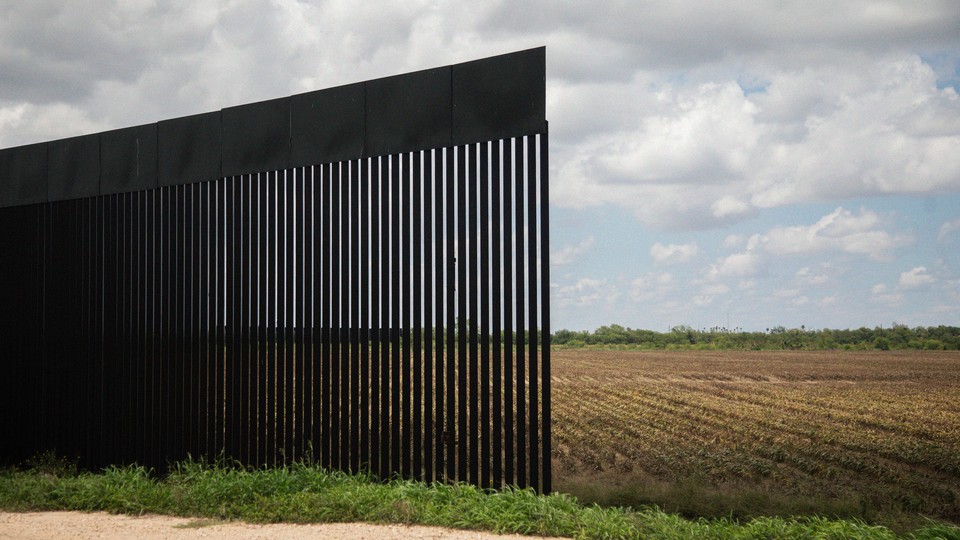
Before he botched the Reflecting Pool, the president wanted the border wall black. The Washington Post / Getty Halfway through President Trump’s first term, as construction crews were busy installing hundreds of miles of barriers along the southern border, a puzzling edict came down from America’s aesthete in chief. Trump wanted the border wall painted black.
The president had already lost an argument about what his “big, beautiful wall” should look like. Trump envisioned a solid-concrete structure, like the one Israel has built through the West Bank. But U.S. Customs and Border Protection already had a preferred prototype, consisting of vertical steel bars that, crucially, allowed border agents to see through to spot potential threats on the Mexican side. The competing visions pointed to a larger fundamental question: Whose border wall was it?
How quaint that seems now. Trump in his second term treats federal property as his own, demolishing the East Wing of the White House, adding his name to the Kennedy Center, and ordering the construction of a 250-foot arch opposite the Lincoln Memorial. His fixation with paint continued as he ordered a blue coating on the Reflecting Pool that turned it into a slime lagoon. He also wants to cover the Eisenhower Executive Office Building’s granite in white paint to make it better match the White House, next door.
Trump in 2017 was still willing to defer to experts, especially those in uniform. Although CBP officials managed to talk him out of the concrete-wall idea, along with a proposal to add sharp spikes to the top so that climbers would risk impaling themselves, they relented on the black paint. Trump saw it as another way to deter migrants. He told a story—since recited many times—about his golfing buddies scalding their arms after he installed a black-granite countertop at the snack bar of one of his clubs. The president even had a specific shade of paint that he called “flat black,” whose heat-retention properties he deemed superior. Potential border jumpers would burn their hands if they tried to touch the steel bars, Trump insisted. The president seemed to enjoy discussing the various ways that migrants could be injured or killed by the wall, according to his aides, who said often that he talked about grisly scenarios as the best way to prevent illegal crossings.
Neither CBP nor the Army Corps of Engineers, which manages the construction of the wall, thought that the paint was a good idea. It would add hundreds of millions in costs and saddle the structure with long-term maintenance expenses. And what if a future Democratic administration didn’t want to pay for more paint jobs?
Then there was the steel itself. CBP had selected a type of high-grade alloy that is well suited for the desert environment. It doesn’t require paint, because it develops a sheen of exterior rust, or weathering, that acts as a natural protective layer. Industrial-materials experts I consulted during Trump’s first term told me that a rough surface increases the steel’s ability to absorb solar radiation and transfer heat, leaving it nearly as hot, or even hotter, than black paint would, despite Trump’s claims.
The bigger problem was that Trump didn’t like the reddish rusted look. He told everyone that black paint would do a better job preserving the steel.
A former CBP official who was involved with the project at the time told me that Trump’s claims about the heat-transferring properties of black paint were “not the bang for the buck that was touted.” The official, who retains good relations with Trump-administration officials and didn’t want to be identified, said that the steel used for the border wall “needs the rust layer to protect it and make it last longer.” There was also discomfort at CBP with the idea of explicitly trying to injure people. “The negative optics behind trying to make the wall too hot to touch were a detractor for us,” he said.
The border-wall project was more cost-sensitive back then too. The standoff with Democrats over funding in late 2018 led to a 35-day congressional shutdown. Trump lost the fight but moved billions from Department of Defense budgets to the project. His advisers persuaded him to prioritize getting as many miles of new barriers into the ground as possible, even if they couldn’t be painted, before he left office.
Trump pushed for the black coating anyway. He sent soldiers with brushes and rollers to paint the wall by hand, not unlike his use of National Guard troops to police the Reflecting Pool for alleged vandals. The Pentagon referred to the black paint as an “anti-climb coating.”
Trump ended up installing about 450 miles of new barriers during his first term, at a cost of more than $11 billion. Most of that was not painted black. During President Biden’s term, I went to a few locations in Arizona where Trump’s crews had rolled on the black paint. Some of it was already peeling off in the punishing desert sun. It was hot to the touch, but unpainted segments were too. And by then, smugglers on the Mexico side were already building cheap ladders out of rebar or wood. By leaning them against the top of the wall, they could bring migrants over the top, using ropes to lower them down the U.S. side.
Trump was still talking about the black paint after Biden took office in 2021. Biden halted border-wall construction, leaving Trump’s legacy project incomplete. When Trump visited a segment of the wall in the Rio Grande Valley with Texas Governor Greg Abbott that year, he stood near an unfinished gap and complained about the lack of black paint, saying that Biden had left the structure “rusting and rotting.”
“If they don’t paint it, bad things are happening,” Trump said. “And the best color to paint it is black. Because if you paint it black, it’s so hot, nobody can even try to climb it.”
By the time Trump returned to office, he was no longer interested in what experts or CBP officials had to say about paint. And money was no longer a limit. The One Big Beautiful Bill Act approved by Republican lawmakers last year included $46.5 billion for the barrier, enough to pay for 700 additional miles and all of the black paint Trump wants. The segments of fencing that I saw going up in southern Arizona earlier this year arrived at the border pre-painted with a uniform, factory-grade coating.
Trump spoke at length about the black paint last summer when FIFA President Gianni Infantino visited the Oval Office amid planning discussions for the World Cup soccer tournament. Then–Homeland Security Secretary Kristi Noem was there, and Trump said that he’d been pleased to see her painting the wall by hand with a roller on television the night before.
“I built the same wall that the Border Patrol asked me to build,” Trump said. “It wasn’t my first choice. I wanted to do concrete plank and everything nice, but you wouldn’t have been able to see through it.”
The president proceeded to tout the wall’s various physical properties. Infantino stood next to him, holding up an oversize World Cup–finals ticket with the president’s name on it, but Trump wasn’t interested in talking about soccer. “Good black flat paint. It would look beautiful,” Trump mused.
“If it’s white, it’s not hot,” Trump added. It wasn’t clear whether anyone had proposed painting the border wall that color, or whether it was just something he’d considered before choosing black.