Trump's critics often hesitate to respond effectively to his claims due to their commitment to facts, law, and fairness, allowing his ego-driven actions to thrive. This ineffectiveness risks enabling his growing imperial ambitions and undermining American democracy.
Key Takeaways
•The anti-Trump side's focus on facts and legality often leads to slow, cautious responses that fail to counter Trump's bold, often misleading claims effectively.
•Trump's actions, like the Venezuela operation, are driven by personal glorification rather than substantive results, exploiting his opponents' weaknesses.
•An ineffective opposition movement poses a serious threat to American democracy and global leadership, as Trump's ambitions continue to expand unchecked.
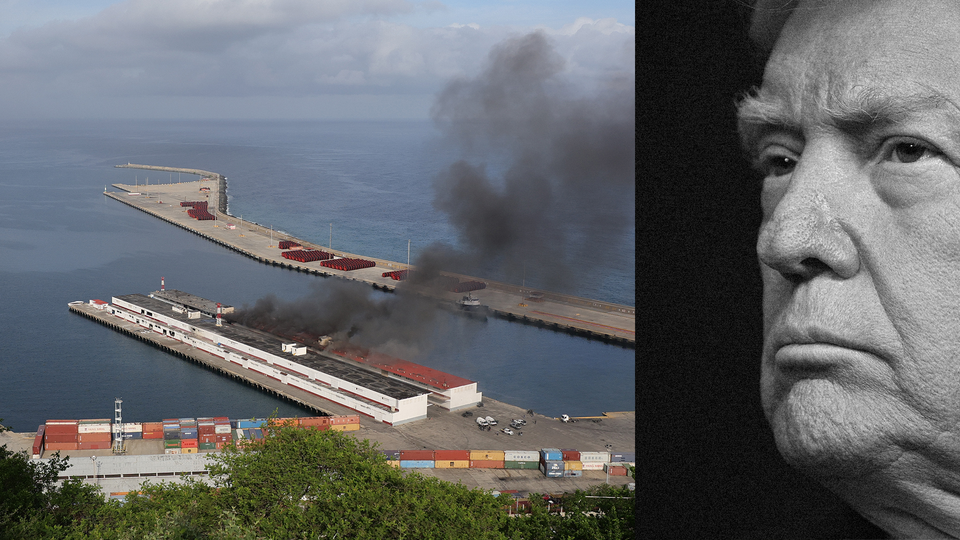
The capture of Nicolás Maduro is a show of ambition that calls for an effective response. Illustration by The Atlantic. Sources: Jesus Vargas / Getty; Jim Watson / AFP / Getty. When Donald Trump claims a success, two things quickly happen.
From the pro-Trump side, the American people hear a huge and unanimous whoop of triumph.
Because the Trump movement is a cult of personality, with no consistent principles and no concern for truth, many of its boosters don’t care whether the success is real or phony. They don’t care whether the advertised “success” actually happened the way Trump says it did. They don’t care whether the so-called success achieves anything important or lasting. They don’t care if there later turns out to be a corrupt underside. They celebrate peace plans that don’t bring peace, trade deals that don’t enhance trade. The Trump movement exists to glorify Trump, in all his erratic mania. Results in the real world don’t matter.
From the anti-Trump side, meanwhile, the American people hear a nervous rustling of vague doubts.
Because the anti-Trump side tends to care about facts, it hesitates to speak before it knows what it’s talking about. There’s a decent likelihood that the president’s story is a lie. But what kind of lie, covering up what truth? Because the truth takes time to come to light, the anti-Trump side will be slow to respond to the pro-Trump boast and brag.
Because most on the anti-Trump side care about institutions, they measure their words so they won’t be misinterpreted as criticism of those parts of the U.S. government that preexisted Trump and—they hope—will survive him. Trump uses the military so often because he correctly assesses that respect for the courage and professionalism of its personnel will transfer to him.
Because the anti-Trump side cares about fairness, many of its most prominent figures hesitate to accuse Trump of corrupt motives until sufficient evidence emerges to support the accusation. That Trump has ordered the military to seize an alleged drug-trafficking Latin American head of state barely a month after he pardoned and released a convicted drug-trafficking Latin American head of state is suspicious, to say the least. But until and unless there’s something to back those suspicions, and perhaps recalling the readiness of Trump’s regulatory agencies to retaliate against Trump-critical speech, many on the anti-Trump side deem it unwise to voice them. The possibility that U.S. armed forces could have been deployed because Trump insiders bought into a shady scheme to grab Venezuelan oil seems far-fetched—yet it may be much more grounded in reality than any learned article concocting a Trump grand strategy.
Because the anti-Trump side defends the rule of law, it can be drawn into legalistic objections that sound pettifogging and irrelevant. Americans want the flow of drugs reduced. They don’t much care how it’s done. Many on the anti-Trump side are so rightly outraged by the anti-constitutionality and illegality of Trump’s antidrug actions that they leave to later how useless those actions often are. Over Trump’s first year in power, the price of cocaine in the United States has dropped steeply, the one price Trump has reduced. That trend suggests that Trump’s multibillion-dollar operation against boats that may or may not be carrying drugs is wasteful and even counterproductive—but unless carefully stated, the arguments of the anti-Trump side can appear to emphasize legal forms over the lives Trump falsely claims to be saving.
Because the anti-Trump side includes progressives and others uncomfortable with American power, it often gets distracted by Trump’s militaristic show—and fails to reckon with the president’s inner weakness. When Trump officials briefed Congress and the press about Venezuela, they disavowed a goal of “regime change.” Now the U.S. has seized Nicolás Maduro, and some progressives have charged Trump officials with lying to them. But the real problem is that those officials may have been telling the truth. Just as Maduro’s dictatorial regime allowed Venezuela’s apparatus of repression to outlive its founder, Hugo Chávez, the removal of one regime figure now may merely transfer power to another. The United States government recognized Edmundo González as the rightful winner of Venezuela’s 2024 presidential election. It will take more than an abduction to bring González to power, however. The progressive impulse to blame Trump for doing too much in Venezuela can obscure the reality that—for all the noise—Trump may not have done enough.
Because the anti-Trump side is preoccupied with domestic politics, it sometimes overlooks how Trump is corroding American leadership in the world. The Venezuelan regime is broadly unpopular in Latin America; its socialism of plunder has sent millions of desperate people into Colombia and other states. But U.S. intervention is deeply mistrusted in the region, associated much more closely with bringing dictators to power than with toppling them. The administration could have courted greater legitimacy for its actions by cooperating with regional partners, such as Colombia and Brazil, which have both tangled with the Maduro regime in the recent past. Refusing such cooperation is not merely an incidental vice of Trump’s foreign policy. That vice is at its core. Military action in Venezuela today without allies may prefigure action tomorrow against allies—for example, to invade and annex Greenland. The big strategic idea of the second Trump administration is that major powers are entitled to dominate their neighbors: Russia to dominate Ukraine, China to dominate its neighborhood, and the U.S. to rule over Venezuela, Greenland, Panama, and ultimately Canada—Trump’s desired “51st state.”
We’ll all know more soon about the Venezuelan operation. But we know plenty already about the anti-Trump opposition. The qualities itemized above are not all faults. It’s good to care about law, institutions, and facts. But even good qualities can produce bad outcomes if they are not self-understood, self-restrained, and directed in the service of good goals.
Trump thrives on the ineffectiveness of his opponents. The military operation in Venezuela is a warning that Trump’s imperial ambitions are growing. He’s building himself a triumphal arch in Washington. He craves gaudy acts to justify his monument to himself. He announced his operation first on his own wacky social-media platform, then on a phone call to Fox—as if his fan base were the only part of the nation to whom the president owed an explanation for his actions. Trump’s ego poses clear and present dangers to American democracy and American world leadership. An ineffective anti-Trump movement is an indulgence that American democracy cannot afford or accept.