Our Olympians Are Being Put in an Impossible Position
AI Summary5 min read
TL;DR
American athletes at the Winter Olympics face impossible pressure when asked about U.S. political turmoil, leading to criticism from Trump and conservatives for expressing discomfort. The IOC's attempt to keep politics out of sports is unrealistic, as athletes historically use the platform to highlight social issues.
Key Takeaways
•American athletes are pressured to answer questions about U.S. political turmoil while competing, facing backlash from Trump and conservatives for expressing discomfort.
•The International Olympic Committee's rules against political expression are increasingly seen as unrealistic, with recent guidelines allowing limited expression in press conferences and social media.
•Athletes like Hunter Hess and Amber Glenn face personal attacks and threats for speaking about political issues, highlighting the risks of political engagement in sports.
•Historical examples like Tommie Smith and John Carlos in 1968 show that athlete activism at the Olympics has long been a way to spotlight social injustices.
•The U.S.'s declining international reputation due to controversial policies makes it difficult for athletes to defend or represent the country without addressing political concerns.
American athletes have been asked to account for Trump—then attacked for doing so. Matthew Stockman / Getty The International Olympic Committee (IOC) pushes the myth that the Olympics are meant to be a safe, apolitical space. Tell that to the American athletes at this year’s Winter Olympics who are being asked tough questions about the political and social turmoil in their home country.
Since the Games began earlier this month in Italy, journalists have asked a number of athletes how they feel about representing America, putting them in the tricky position of balancing national pride against their unhappiness with the actions of the current administration.
In response to a question about what it’s like to wear the American flag right now, Hunter Hess, a freestyle skier, said, “There’s obviously a lot going on that I’m not the biggest fan of, and I think a lot of people aren’t.” He added that he didn’t see himself as representing “everything that’s going on” in America—only “all the things that I believe are good about the U.S.”
President Trump lashed out at Hess on Truth Social, calling him “a real Loser” and saying that “he shouldn’t have tried out for the Team” if he felt that way about the country. Other conservatives piled on, including Representative Tim Burchett of Tennessee, who wrote that Hess should “shut up and go play in the snow.” Vice President Vance—who had just been booed by crowds while attending the opening ceremony in Milan—said that athletes “should expect some pushback” for speaking out: “You’re not there to pop off about politics.”
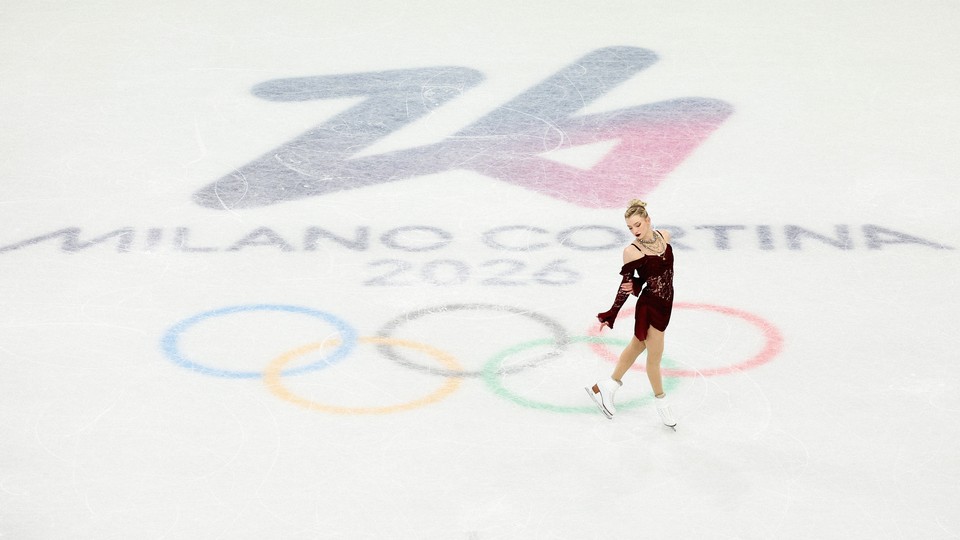
Hess wasn’t alone in expressing discomfort when asked about the political climate in the United States. His teammate, the gold medalist Chris Lillis, said that he was “heartbroken” over ICE’s recent actions in Minnesota. At a separate press conference, the figure skater Amber Glenn, who is pansexual, acknowledged, when asked about the issue, that the LGBTQ community has been having a “hard time” since Trump returned to power: “It’s not just affecting the queer community, but many other communities.” Glenn then wrote on Instagram that she was receiving such “a scary amount of hate/threats” for her comments that she was going to take a break from social media as she prepared to compete. To the delight of Glenn’s critics, a mistake during her short program on Tuesday caused the three-time national champion to finish the segment in 13th place. “Maybe she should focus less on her sexuality, and trying to dunk on conservatives, and focus on skating,” one conservative posted on X.
Trump and other Republicans may not like that some American athletes are expressing their unease about representing the country, but it’s the administration’s actions that have made the country so hard to defend and represent.
U.S. athletes are only acknowledging what anyone can see: America’s international reputation has taken a nosedive. Many people around the world are horrified by the Trump administration’s threats to invade Greenland, the controversial capture of Venezuelan President Nicolás Maduro, and the aggressive behavior of U.S. immigration agents, including the fatal shootings of two American citizens. Before the Games began, hundreds of people in Italy protested the news that the U.S. would be sending an ICE unit to the Olympics to assist with security. (Although the Department of Homeland Security routinely sends its agents overseas to help with major events, the demonstrations spoke to how poorly the agency is viewed outside of the United States.) Vance received a similarly frosty reception in Milan.
Despite Vance’s assertion that politics have no place at the Games, the Olympics have long been fertile ground for athletes to generate awareness about political tensions and social injustice. The most famous example comes from the 1968 Mexico City Summer Olympics. Tommie Smith and John Carlos, two Black sprinters, raised their fists in the air while on the podium accepting their gold and bronze medals. The moment was seen as a gesture of solidarity with the Black Power movement. It also highlighted America’s hypocrisy: They were world-class athletes competing for a country that treated them, and anyone who looked like them, as second-class citizens.
Smith and Carlos were vilified, suspended from the U.S. team, and sent home; it would be years before they were recognized as heroes. In 1975, the IOC revised its charter to forbid “every kind of demonstration or propaganda, whether political, religious or racial” at Olympic venues.
The IOC’s rules about demonstrations remained largely unchanged for decades, despite fierce debate. Then, in 2021, it issued new guidelines to allow athletes slightly more room to express their beliefs. Athletes can now broadcast their views in press conferences and on social media, but not in the Olympic Village, during competitions or in official ceremonies. With these changes, the IOC was admitting on some level that trying to separate sports from politics, especially on the international stage, is impossible.
None of the American athletes speaking up right now is violating the rules. But nevertheless, they’re being asked to account for what’s happening in this country. It’s not their fault that they can’t explain or defend it.