Stock Market’s 2025 Laggards See Revival in Year’s Final Stretch
TL;DR
Investors are rotating out of tech giants like Nvidia and Microsoft into lagging small-caps and value stocks, driven by AI trade concerns and economic optimism for 2026. This shift has boosted the Russell 2000 and sectors like transportation, signaling a potential change in market leadership.
Key Takeaways
- •Investors are shifting from tech behemoths to small-caps and value stocks, with the Russell 2000 gaining 9.4% since November lows.
- •The rotation is fueled by doubts about AI-driven gains and optimism for economic acceleration in early 2026, benefiting sectors like transportation and healthcare.
- •Market breadth is improving, as seen in the S&P 500 Equal Weighted Index outperforming the cap-weighted version, indicating a broader rally beyond tech.
Tags

For stock traders, December is normally a time for what’s known as window-dressing. Load up on your winners and ditch your losers to lock in a solid year.
The opposite is happening this time.
Investors are rotating out of the technology behemoths that drove virtually all of this year’s 17% advance in the S&P 500 Index and snapping up shares of risky small companies and old-economy transportation names that have lagged behind all year.
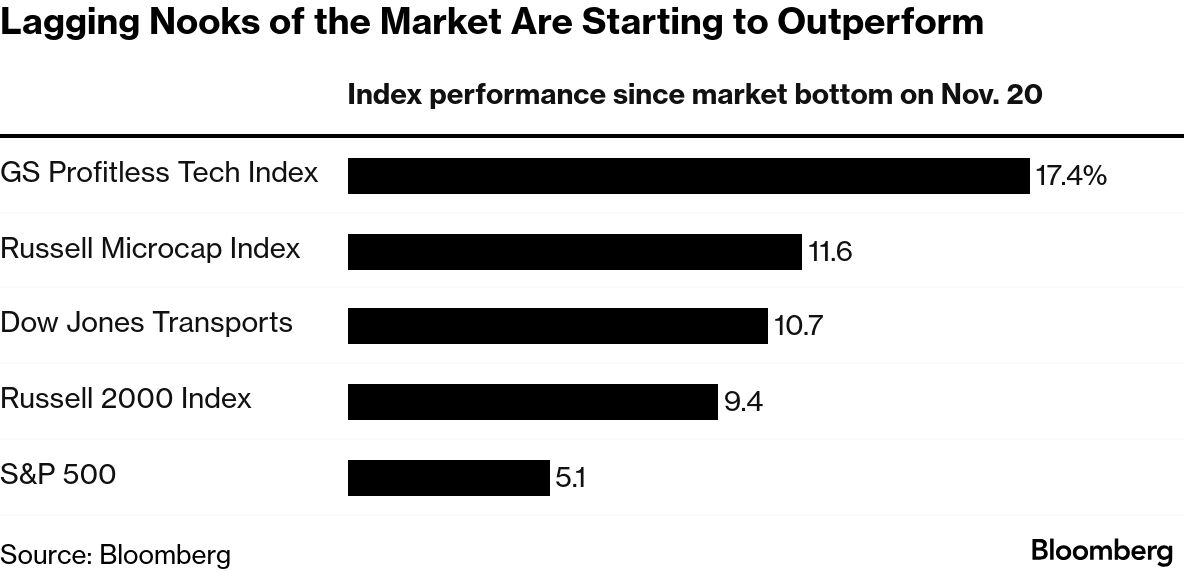
Since US stocks hit their near-term low on Nov. 20, the small-cap Russell 2000 Index has gained 9.4%, reaching an all-time high on Thursday. Micro-caps have added 12%, while an economically-sensitive cohort of trucking, shipping, and airline stocks has advanced 11%, rising in every session. The S&P 500 Index has gained 5.1% during that time.
The rotation comes as investors increasingly question the lift-all-tech-boats nature of the artificial intelligence trade, with heavyweights like Nvidia Corp. and Microsoft Corp. seeing rallies stall out. Optimism that the US economy is set to accelerate in the first half of 2026 has seen traders more willing to pile into value stocks at the cost of tech.
Strategas Asset Management LLC advises clients to overweight a version of the S&P 500 that strips out market-cap bias relative to the cap-weighted version, with co-founder Jason De Sena Trennert citing expectations that President Donald Trump’s tax bill will lift consumer and capital spending. He also pointed to the World Cup’s potential to drive and broaden economic and earnings growth next year.
Trennert isn’t alone in that view. Bank of America Corp. chief investment strategist Michael Hartnett on Friday advised clients to buy “inexpensive” mid-caps into 2026 with the White House likely to intervene to keep a lid on inflation and the unemployment rate. His team also sees the best relative upside in sectors linked to the economic cycle, such as homebuilders, retailers, REITs and transportation stocks.
November saw changing leadership on full display, with the S&P 500 Equal Weighted Index gaining 1.7% as the standard version rose just 0.3%. Meanwhile, the largest 50 companies in the S&P 500 slumped 0.6% for the month while the remaining 450 constituents in the gauge advanced 1.3%, according to BofA data.
| Read More: |
|---|
Health care, communication services and materials paced gains in November as big tech flagged. In fact, health care was the best-performing sector in the S&P 500, rising 9.1%, and information technology the biggest loser, posting a 4.4% drop. At the factor level, value outperformed growth and all factor groups in November, a sharp reversal in style hierarchy after value lagged substantially for the year through October.
Momentum stocks also saw sharp underperformance, which “might indicate a change in leadership, as established outperformers give way to former laggards,” BofA head of equity and quantitative strategy Savita Subramanian said.
Citadel Securities’ Scott Rubner also told clients on Friday that rotations “remain active beneath the surface,” with the Russell 2000 notably outperforming the S&P 500 and Nasdaq 100 Index on several days.
Read: Citadel Securities’ Rubner Bullish Into Year-End, Early 2026
The rotation was spurred by concern over AI spending numbers last month as Big Tech reported earnings, allowing the year’s laggards to catch up.
It was “part of a digestion process that has almost become routine over the past couple years, especially when it comes to tech earnings,” said Kevin Gordon, head of macro research and strategy at Charles Schwab & Co.
Tech is still sitting on solid gains for the year, Gordon said, pointing to more than two-thirds of the sector’s members trading above their 200-day moving average — even after a correction in the segment.
“A broadening of gains can continue, but I don’t expect it to be smooth, not least because some of the more rate-sensitive parts of the market might be disappointed by both fewer Federal Reserve rate cuts than expected next year and an increasingly soft labor market.”