A Test for Trump’s Most Faithful
TL;DR
Despite some conservative criticism of Trump's Iran war, his MAGA base remains largely unified in support. However, prolonged conflict risks economic consequences like rising fuel and grocery prices, which could test their loyalty as costs become directly tied to Trump's decisions.
Key Takeaways
- •Trump's MAGA base shows strong support for the Iran war (90% approval among MAGA Republicans), despite some prominent conservative critics.
- •Trumpism is characterized more by loyalty to the leader than adherence to specific ideological principles, as seen in shifting poll numbers after his actions.
- •The Iran war's economic impact—including volatile oil prices and rising costs for fuel, shipping, and groceries—could challenge base support if directly attributed to Trump's decisions.
- •Some critics on the right are attempting to frame a MAGA schism over foreign policy, but polling does not yet show a significant split.
- •Trump's confidence in his base may be tested if economic consequences from the war become unavoidable and explicitly linked to his choices.
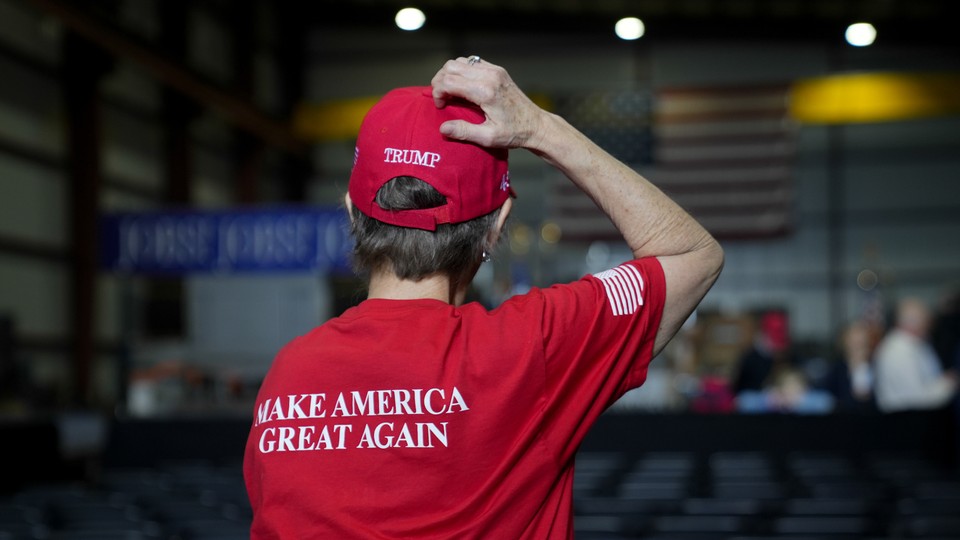
Let’s get this out of the way: Rumors of a major MAGA schism have been greatly exaggerated. For all the discussion on the ways in which prominent conservative voices are speaking out against the war in Iran (and against President Trump’s consistent hawkishness more broadly), the polling doesn’t point to a split of any real significance—77 percent of Republicans approve of the decision to take military action in Iran, according to CNN, and 90 percent of self-identified MAGA Republicans back the attacks, according to NBC.
Some Republicans are indeed openly upset about the war. Marjorie Taylor Greene, famous for her early association with Trump and her more recent split from MAGA, has called supporters of the Iran war “blood thirsty maniacs.” Tucker Carlson, a consistent critic of foreign intervention, has now devoted multiple episodes of his show to critiquing the conflict. And Megyn Kelly, another right-wing media personality who split off from the Fox contingent, said last week that “no one should have to die for a foreign country.” Even America’s most popular podcaster, Joe Rogan—who endorsed Trump in 2024 but has said that he doesn’t identify with either political party—described the war as “insane” in the context of the president’s campaign promises.
But these public instances of anger have not actually swayed Trump’s base. He has indeed reneged on his “America First” pledge to extract the United States from foreign wars, bombing Middle Eastern nuclear facilities, deposing global leaders, and threatening to attack long-held American allies such as Denmark and Mexico. In each of these cases, anti-interventionist Republicans have criticized him—without chipping away at loyalists’ support for the president’s moves. Two weeks into the war with Iran, Trump’s critics are once again attacking him from the right. The difference this time is that, as the conflict drags on, it risks creating tail effects that could be difficult for even the most faithful followers to ignore.
As my colleague Yair Rosenberg put it in his January story about the MAGA-schism myth, Trumpism is more about following the leader than it is about adhering to a particular set of ideological or political principles. Two weeks before U.S. forces snatched Nicolás Maduro, one poll showed that Republican support for invading Venezuela was at 43 percent. Once Trump actually intervened, that number rose to 74 percent. This somewhat mirrors the numbers on the Iran strikes; Republicans went from 58 percent supporting an attack late last month to 76 percent once the strikes actually began.
Despite the fact that, by historical standards, the Iran war is extremely unpopular with much of the country, the president isn’t working to sell it. That’s because he feels confident that his base will stand by him, a few people close to Trump told my colleague Jonathan Lemire this week. It would take something truly paradigm-shifting to test the fealty of the president’s supporters, but that moment may be coming.
The Iran war’s potential for economic devastation far outweighs that of other recent foreign interventions. Energy markets are experiencing historic volatility; oil nearly hit nearly $120 a barrel last weekend. This has already affected the average price of gasoline in the United States, which is now more than $3.60 a gallon. As the price of fuel goes up, so does the cost of shipping large containers around the country. That could end up increasing the price of groceries as well as that of virtually all the goods that businesses and consumers order online. As the war continues and ship traffic through the Strait of Hormuz remains effectively impossible, the likelihood of a broader economic crisis will only increase.
Sixty-two percent of all registered voters disapprove of the president’s leadership on inflation and the cost of living. But according to an Economist/YouGov poll, 86 percent of MAGA acolytes approve of Trump’s handling of the economy, suggesting that the movement is, as usual, taking Trump at his word. It’s one thing to write off rising costs (and costs have been rising for some time now) as a force majeure, as with COVID-19, or as an aftereffect of Bidenomics, as with inflation. How will that group react when costs go up explicitly because of Trump’s decision to attack Iran? “The Iran war is clearly Trump’s choice, and his voters will know that,” Yair told me.
Some of Trump’s critics on the right have been trying to create the perception of a rift in MAGA as a way to bring new converts over to their side, even if the polling doesn’t bear out anything quite so dramatic. Yesterday, Greene wrote on X that the administration and the Republican Party have been “hijacked” by the neoconservative establishment “we all voted against.” It’s an us versus them framework—a distinction between the interests of the broad conservative coalition that voted for Trump in 2024 and the reality of the administration’s goals. She’s right to say that the president has broken his core promise to stay out of foreign wars. But Trump’s most ardent supporters just don’t see it that way.
If Trump wants credit for what he’s already claimed is a victory in Iran, he should also get credit for the economic consequences. It’s telling that, rather than simply shrugging off rising prices, he suggested this week that high oil prices may actually be a good thing (true for energy companies, not as true for everyone else). Many Americans won’t buy it. The question is whether Trump loyalists, confronting a crisis that the president definitively owns, will ever start to share their doubts.
Related:
Evening Read
The Dieting Myth That Just Won’t Die
By Michaeleen Doucleff
Back in the early 1970s, psychologists at Northwestern University performed an experiment that, on the surface, looked like a child’s fantasy. The researchers gathered 45 college women and asked some of them to drink a milkshake—or two. Then they placed three pints of ice cream in front of each woman and asked her to taste each one. Afterward, they told each participant to “help herself to any of the remaining ice cream, as she wished,” the researchers wrote in the Journal of Personality. Finally—and this was key—each woman completed a survey meant to measure how much she dieted or “restrained” her eating, outside of the treats she had just consumed.
The findings were dramatic. On average, the women who said they didn’t diet or have weight concerns ate less ice cream if they drank at least one milkshake. The first sweet treat satiated their hunger. But for the women who dieted and felt worried about their weight, the milkshake appeared to unleash a hidden hunger …
Fifty years ago, psychologists concluded that dietary restraint caused the women to overeat the pints of ice cream. But the modern interpretation suggests that the reverse was likely true for many of the participants: An underlying tendency to overeat drove the women to try to diet.
Read the full article.More From The Atlantic
Explore. The Secret Agent (streaming on Hulu and Disney+) is a deep reckoning with an authoritarian regime—and with how those affected can move forward, Michael Snyder writes.
Watch. The Bride! (out now in theaters) is an incomprehensible genre mash-up, David Sims argues. Why on earth did Maggie Gyllenhaal make this movie?
Play our daily crossword.
Rafaela Jinich contributed to this newsletter.
When you buy a book using a link in this newsletter, we receive a commission. Thank you for supporting The Atlantic.