A Russian-Israeli academic was kidnapped in Iraq and held for 902 days by Kataib Hezbollah. His captors, ignorant and incompetent, tortured him based on conspiracy theories, revealing how authoritarian regimes rely on brutality over intelligence.
Key Takeaways
•The author's kidnapping by Kataib Hezbollah was opportunistic for ransom, but torture escalated after they discovered his Israeli citizenship.
•His captors were poorly trained, relying on movie tropes and conspiracy theories, yet were experts in torture techniques like 'the Scorpion'.
•Humor and mocking their ignorance helped the author cope, as repressive regimes fear exposure of their incompetence.
•Torture produced false confessions and bad intelligence, highlighting how such regimes prioritize brutality over effective interrogation.
•The mix of ignorance and brutality is common in regimes born from marginalized groups, leading to arbitrary violence and security failures.
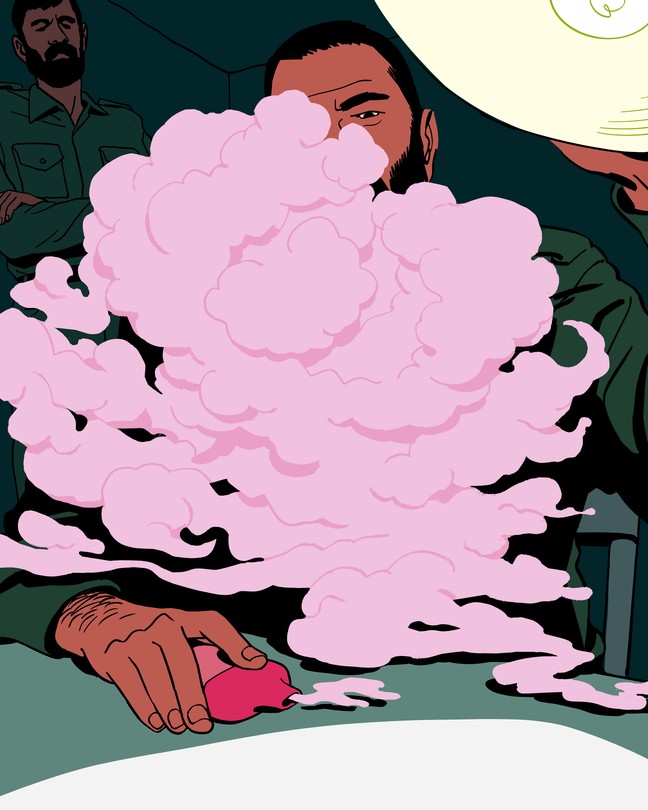
An academic trip to Iraq unexpectedly turned into an immersive field study on the ways authoritarian regimes use brutality. Illustration by Patrick LegerFour men searched my mouth for implanted tracking devices. I had told them I didn’t have any—that, as far as I knew, such things existed only in movies. They asked if I had fillings, and I confessed that I did. They looked again. “No, you don’t,” one of them corrected me, having failed to find any glint of silver. My fillings are white. The men, wearing dark civilian clothes and balaclavas, seemed convinced that these unfamiliar fillings posed a threat to their operational security. That’s when I knew that my kidnapping was going to be a little bit different.
I was violently snatched on March 21, 2023, from the outskirts of Baghdad, where I had been conducting fieldwork for my Ph.D. at Princeton University. When my kidnappers delivered me to my cell, they cut the restraints they’d placed around my arms and legs, and lifted the cloth bag off my head. The secret prison where I was brought was run by Kataib Hezbollah, an Iraqi militia backed by Iran.
That was my first day of captivity. Nine hundred and two more followed. I spent the first four and a half months in a prison usually used for holding the militia’s Iraqi victims. The militiamen, I later learned, worked for one of Iraq’s security agencies, many of which have been extensively penetrated by pro-Iranian paramilitary groups. Even so, my kidnapping was purely opportunistic—I was taken for ransom, not for any political reason.
I have researched the Levant for almost two decades under the auspices of several think tanks, conducting fieldwork across the region. The kidnappers knew I was a Russian national affiliated with an American university—which was why they saw me as a lucrative target for kidnap and ransom. What they did not know—and what I was not eager for them to learn—was that although I was born in Russia, I am also an Israeli citizen.
The kidnapping itself was extremely violent, but for the first month of my imprisonment, I was not otherwise physically abused. I was given very little to eat—mostly rice and bread, in one or two meals a day—something that I came to understand was intended to weaken me, to soften me up for interrogation.
An officer who introduced himself as Maher led the interrogations. He wore a balaclava throughout so that I would not be able to identify him. The idea of a Russian doing academic research on Iraq was utterly befuddling to Maher and his colleagues. They felt that as a Russian, I should research Russia alone. Maher promised that if I was able to prove that foreign researchers conducted fieldwork in Russia, then he would be my “greatest defender.” When I started listing some, he looked downcast. He did not become my greatest defender.
The problem I faced was that my interrogations were premised on the idea that legions of foreign spies are roaming the streets of Iraq, and that all foreigners in Iraq are spies: Maher once asked me whether the entire building in a gated area of Baghdad in which I briefly resided was occupied by spies. Compounding my difficulty of proving a negative—that I was the rare foreigner who wasn’t a spy—was their incompetence at interrogation. One officer didn’t bother to give me a fake name, but I’ll call him the Short Pervert because of his constant grabbing of my body and his foul language. The Short Pervert claimed that his organization had recordings and photos proving my espionage work, though he declined to produce any such evidence when I asked for it.
The interrogators kept threatening me with torture, but in those opening weeks, they refrained from acting on the threats—I assume on orders from higher up. Instead, because they were clearly untrained in conducting interrogations that did not involve torture, they fell back on interrogation methods they had probably seen in movies. To intimidate me, Maher would blow smoke in my face, but because he was using an e-cigarette, all I got was a gust of strawberry-smelling vape. It wasn’t quite the tough-guy routine he was after. Later, he tried the “good cop, bad cop” routine on me but undermined the effect by playing both characters himself, on alternate days, which just made him seem deranged.
The comic aspect of this all changed when, a month after my capture, the kidnappers opened my phone after forcing me to give them the passcode and discovered that I was Israeli. Now they didn’t need to ask me to admit I was a spy; they could torture me to say so.
Authoritarian regimes—and the militias and security agencies that buttress them—rely on instilling fear in their subjects. They rule by enforcing conformity and obedience through terror.
I knew something about this, not solely because of my research but also from my upbringing. I was born in late 1986 in Leningrad (now St. Petersburg) as the Soviet Union was sunsetting. Both of my parents were dissidents in the U.S.S.R. My father spent seven years in prison and another two years doing hard labor in Siberia for writing anti-regime flyers from a democratic Marxist point of view. My mother, for her part, was sentenced to three years in a Siberian prison after the KGB ransacked her apartment and found an extensive collection of anti-Soviet jokes that she had diligently collected from her dissident friends during their gatherings. This was the era of samizdat literature, when regime critics copied and shared reading material—essays, polemics, news—that they had diligently typed and retyped on paper, because publication was impossible. A typical satirical jest from my mother’s collection: A judge comes out of a Soviet courtroom laughing. A prosecutor asks him, “Why are you laughing?” The judge responds, “I’d tell you, but I just sentenced someone for five years in prison for telling this joke.”
In my own captivity, I recognized what many dissidents, including my mother, realized before me: Humor is a weapon that can be used even by the very weak to undermine the ruling authority, to break its terrorizing effect, to lift one’s morale. Repressive regimes fear being mocked because they hate having their incompetence and ignorance exposed. This is why they penalize the circulation of political jokes.
Once, when I was singing in my cell to keep my spirits up, a torturer who went by the name Yasser—a corpulent man who gave himself the rank of major—ordered me to lower my voice: “Volume down!” Then he asked in Arabic whether his English usage was correct. He was pleased with himself when I said it was. His need for affirmation was so pathetic that in other circumstances, it would have been touching. Even more pathetic was when Maher, who initially had claimed to be a captain, discovered that Yasser’s imaginary rank outranked his own. He immediately corrected himself, insisting that I call him Major Maher.
Even during my time in solitary in the torture facility, I would occasionally replay the interrogation scenes in my head—not to relive the torture but to lighten my mood by recalling my tormentors revealing their bottomless ignorance. These supposed intelligence agents knew little about their proclaimed enemies, Israel and the United States. One of the torturers, a chain-smoker who visited me only twice, insisted that 60 percent of Americans live in poverty and that the U.S. works to make Iraqi girls disobey their fathers and go out of the home without their permission.
Inwardly laughing at them made my situation more bearable, a little less scary. But my captors’ lack of professionalism about intelligence work contrasted with an almost medical-level of knowledge of how to torture—an expertise, I can only assume, gained through inflicting horrors on countless Iraqi citizens. They knew how to beat my face without leaving marks on it, by smashing the jaw from below. Maher discoursed on the different methods of torture they used on me, accurately ranking the pain dosed out by each method. Maher could also tell whether my shoulder was dislocated just by briskly touching it.
He bragged in my presence to a colleague that, whereas other operatives would merely hang me from the ceiling with my wrists handcuffed behind my back and then beat my knees so that I couldn’t support my weight to relieve the pressure on my shoulder joints and spine, he had started using an even more painful technique. This method, which involved handcuffing my arms crisscrossed behind my back, is known as “the Scorpion” in Iraq. It stops the flow of blood to the palms and causes immense pain in the shoulders that lasts for weeks. (Being strung up by these methods caused two of my discs to herniate and left permanent nerve damage in my hands.)
One day, the torture team presented me with the results of a misguided attempt at open-source intelligence, showing me screenshots from Facebook of foreign visitors to Iraq whom they insisted I knew and could identify. This presented me with a horrible problem: I could not confess my way out of the torture, as I usually would—making up any plausible answer I knew they would accept—because, although I genuinely did not know any of these individuals, the torturers had their names.
The militiamen strung me up and their commander, a man I knew as the Colonel, proceeded to whip me all over with a flat plastic pipe. When I passed out from the pain, the men lowered me to the floor, doused me with water, then strung me up again. I fainted again; they repeated the drill. On the third time, through a fog of agony, I thought that if I pretended I was still unconscious, they might leave me lying on the floor longer. But they’d done this so many times, and they knew I was faking.
“Have you rested enough?” Maher asked, mockingly. They yanked the chain again to haul me into the air, placing me in a kneeling position. I could not stabilize myself even on my knees, and was spinning like a dreidel. Although I was close to fainting with dizziness, they could detect that I was conscious.
After these sessions, they would usually give me time to rest in my cell and serve me some food. Then they’d take me back to record the “confession” I’d already made. For that, they would remove my handcuffs, as if I was confessing of my own volition.
I kept telling them that before my departure to the U.S. for graduate school in 2017, I had worked for human-rights organizations in Israel. Surely, they’d realize that I would be just about the last person the Israeli security apparatus would want to recruit. I repeatedly asked them to Google my name so that they could see the articles I’d written and the social-media comments I’d posted that were critical of Israeli-government policies. But they refused to do a search. In any case, they read only Arabic.
I had no interest in “resisting” interrogation under torture—after all, I had nothing real to hide, nothing I would not want to confess. So I freely admitted to whatever they seemed to want to hear: that I worked for the CIA and was a Mossad spy. To be both, of course, was hardly possible, but as these men beat me again and again over the next 14 weeks, I learned their bizarre conspiracy theories—and tried to match my fables to theirs.
The Colonel insisted that Masons and Zionists ran the world. Yet later on, he declared that Israel had been established by Saudi Arabia, Iran’s chief regional rival. If Jews were all powerful, why did they need the Saudis to help them establish the “Zionist entity”? All of my torturers believed that the Islamic State was created as a joint operation by Israel, the U.S., and Saudi Arabia to subvert Iraq. One of ISIS’s brutalities was to execute homosexuals by throwing them off buildings, but Maher saw no contradiction when he told me that the U.S. used male-only cafés to spread homosexuality in the country.
The torturers insisted that I provide them with an account of my Mossad-CIA training, so I made one up—it gave me something to think about while I lay prostrate in my cell between the torture sessions. Because I had to concoct something I knew nothing about, I ran out of content after two weeks of material, so I decided simply to claim that it took two weeks. Counting on their not knowing any better was a fair assumption. Because they so often betrayed their ignorance, I quickly realized that as long as my confessions matched their distorted view of reality, they would believe anything I confessed to, no matter how fantastical.
They compounded their ignorance with incompetence in basic aspects of tradecraft. Maher told me that his organization had followed my movements around Baghdad by accessing CCTV footage—except that this was contradicted by the Short Pervert, who described tailing me in the street and at a coffee shop, mentioning details that he could not have known otherwise. All of the torturers brought smartphones into the chamber where I would be screaming. Israel’s ability to hack smartphones and turn them into listening and recording devices has been widely reported. In addition, my torturers repeatedly provided pieces of information that could prove helpful in identifying them as part of investigations by the FBI and other agencies.
Two years later, in a second prison where I was not subjected to physical abuse and felt confident that I would not be tortured again, I dared to tell an Iranian officer the truth: that all of my confessions had been lies produced under torture. At first, he did not believe me, spitting back, “But how did you know that Mossad training takes two weeks?”
“I knew I could make up anything,” I told him, “since the Mossad has penetrated you, but you have not penetrated the Mossad.” After believing for two years that I was indeed a spy, he appeared to accept the truth.
Their ignorance makes these militiamen quite ineffective at halting their own intelligence breaches. In February 2024, shortly after a Kataib Hezbollah attack killed three U.S. service members in Jordan, the U.S. assassinated the commander responsible in Baghdad. Four years earlier, the U.S. had assassinated the previous commander of Kataib Hezbollah, Abu Mahdi al-Muhandis, alongside Qassem Soleimani, the Iranian commander in charge of running Iran’s proxy militias.
This mix of woeful ignorance and expert brutality may appear odd, but it is a hallmark of regimes that are born of marginalized, typically rural, victims of prior rulers. The downtrodden take power and exact revenge against the previous elites, and mete out violence against every suspected opponent. Such a regime existed in Iraq previously: Under Saddam Hussein, the Baath leadership was drawn largely from the Sunni minority, but the lower ranks of the security agencies, the interrogators and torturers, were recruited from the poor Shia-majority provinces. In Syria, an equivalent system existed under the Assad dynasty, in which rural Alawites (a heterodox sect that emerged from Shiism) dominated the security agencies that policed a Sunni majority. Going further back in history, Maoist China and Khmer Rouge Cambodia followed the same pattern.
Under such regimes, the state uses indiscriminate barbarity to instill constant terror in the population. The purpose is to deter resistance, but the arbitrary nature of the violence can stem from the unreliable information produced by ignorant interrogators: Informers may be settling personal scores; torture victims will, like me, say anything. Security agencies staffed by dumb thugs are typically inept at identifying genuine subversive threats.
As my experience showed, a heavy reliance on physical abuse makes for proficient torturers, not skilled interrogators. Again and again, torture has proved to produce false confessions and bad intelligence. The only knowledge that torture provides is the ultimate confirmation bias: information about the threats facing the regime that is entirely in line with the worldview of the torturers, who characteristically share the regime’s generalized paranoia.
This principle became my guide to confession. When I adopted conspiracy theories that the torturers believed in—a practice I’d refused during my first month’s captivity, before I was tortured—the militiamen were deeply satisfied with the verification. So when I confessed that the 2019 popular revolt against Iraq’s corrupt, militia-backed order was a Western plot, Maher was delighted: “And you were saying it’s a conspiracy theory!” Just for him, I was planning a detailed confession about spreading homosexuality in Iraq, but I was transferred out of the torture prison before I got a chance to present it.
History suggests that the proficient cruelty of such regimes is unable to compensate for the stupidity and incompetence of their cadres. Their security apparatuses have a distorted view of the threats facing the regime. The Kataib militiamen tried to come up with solutions for their vulnerability, but their countermeasures were laughable. My captors told me that they’d recruited informers in the anti-government protest movement to confirm that its activists are foreign agents (they’re not). Their lack of insight into their adversaries’ intelligence capability makes these militiamen demonstrably ineffectual at halting intelligence breaches.
In the last facility where I was held—briefly, just before my release on September 9—the men in charge of security were no more adept. They ordered the guards sitting with me not only to hide their faces with medical masks but also to wear medical gloves. I’m no spy, but I don’t think latex gloves will do the trick.