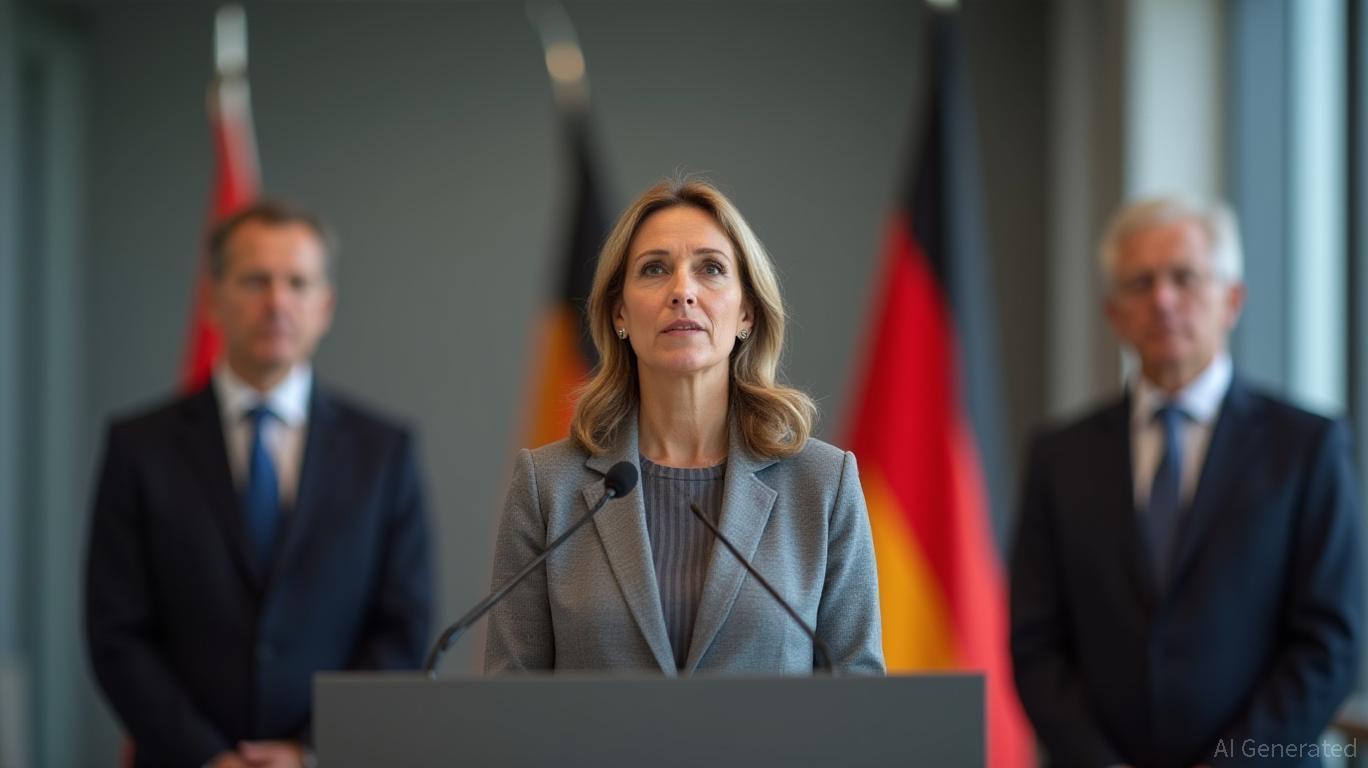
German government spokesperson says we expect the US to follow SCOTUS decision with clear policies
TL;DR
The German government urges the U.S. to provide clear policies after a Supreme Court ruling struck down most of Trump's emergency tariffs, citing uncertainty as a major risk to trade. German Chancellor Merz calls for stable U.S. trade policies, while industry groups seek swift dialogue to resolve ambiguities.
German government spokesperson says we expect the US to follow SCOTUS decision with clear policies
German Government Calls for Clear U.S. Policies Following SCOTUS Tariff Ruling
The German government has emphasized the need for clarity from the U.S. administration following the U.S. Supreme Court's decision to strike down most of former President Donald Trump's emergency tariffs, imposed under the International Emergency Economic Powers Act (IEEPA). German Chancellor Friedrich Merz stated that while the ruling may ease burdens on German businesses, uncertainty remains a significant risk to trade relations. "The biggest poison for the economies of Europe and the U.S. is this constant uncertainty about tariffs," Merz noted, urging the U.S. to adopt a more stable trade policy.
The ruling, delivered on February 21, invalidated tariffs on steel, aluminum, and Chinese goods, which had been justified under IEEPA during Trump's presidency. However, sector-specific tariffs on cars, steel, and aluminum—levied under national security grounds—remain unaffected. Additionally, Trump has since imposed a new 10% global tariff on imports, which he plans to raise to 15%.
The German government has maintained "close contact with the American government to obtain clarifications on the next steps," according to a European Commission spokesperson. This comes as the EU grapples with the implications for its recently negotiated trade deal with the U.S., which had temporarily suspended ratification amid geopolitical tensions. The agreement, which set tariffs on EU exports to the U.S. at 15%, now faces renewed uncertainty, with European lawmakers delaying a critical vote scheduled for February 24.
German industry groups have cautiously welcomed the ruling but stress the need for immediate clarity. The Federation of German Industries (BDI) called for swift dialogue between the EU and U.S. to resolve ambiguities, while the German Chamber of Industry and Commerce (DIHK) warned that the U.S. retains tools to impose sector-specific tariffs under other legal frameworks, such as Section 232 of the Trade Expansion Act.
As the U.S. administration navigates its post-ruling trade strategy, European leaders remain focused on mitigating economic risks while advocating for reduced tariffs. The outcome will likely shape the trajectory of transatlantic trade relations in the coming months.