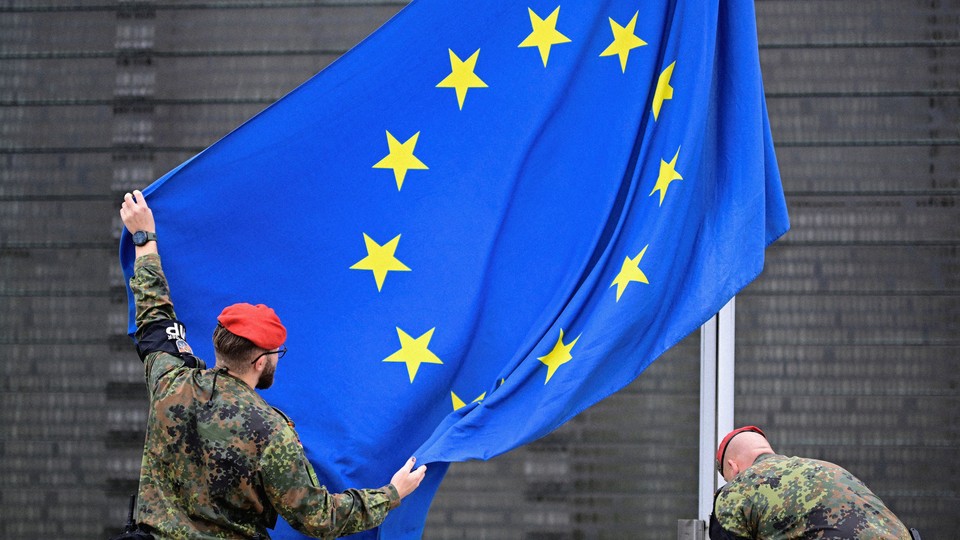
The EU is transforming into an independent global power due to reduced U.S. support under Trump and Russian aggression. It's boosting defense autonomy through EU-wide funding, prioritizing European arms, and reducing reliance on American technology. This shift includes new trade deals and decision-making changes to enhance geopolitical relevance.
Key Takeaways
•The EU is pursuing strategic autonomy in defense through initiatives like SAFE, which funds European arms production and reduces dependence on U.S. weapons.
•European countries are prioritizing 'buy European' policies for defense and expanding them to digital services and green technologies, reassessing open-market commitments.
•The EU is changing decision-making processes, bypassing unanimity rules in emergencies to act faster on geopolitical issues like freezing Russian assets.
•Europe is cultivating new trade relationships with Mercosur and India while reducing economic dependencies on both the U.S. and China.
•Political challenges loom with far-right movements potentially threatening this trajectory, but high EU approval ratings suggest continued momentum toward self-determination.
Without America to rely on, the EU is gearing up to be a global power in its own right. Tobias Schwarz / AFP / Getty The European Union is finally on its way to becoming a power in its own right. That’s not because its member countries have suddenly stopped squabbling or its bureaucratic inertia has melted away. It’s because the past four years have produced an unremitting state of crisis. Russia’s invasion of Ukraine was the beginning. Now the imperative comes from Donald Trump’s repositioning of the United States as something close to an antagonist.
Without the guarantee of American cooperation and NATO protection, the EU is newly vulnerable. And in response, in the past year, it has delivered a series of firsts that amount to a quiet revolution in how it exercises power.
In May, the EU decided, for the first time, to help finance defense spending for its 27 member states by taking on EU-wide debt. This move came from the realization that even serious spending hikes in individual countries—European states have doubled their defense outlays since 2015—would vary widely given the economic disparities. Germany, for instance, plans to invest roughly $77 billion over five years, meaning that by 2030, its defense budget could be the world’s third largest. But that kind of spending is not possible for countries that already carry more debt, and confronting Russian President Vladimir Putin, potentially without U.S. backing, will require the rearmament of all. To this end, the EU has now established an extraordinary instrument, called Security Action for Europe, or SAFE, that is prepared to fund up to $178 billion in upgrades to the continent’s capacity to produce and procure arms.
For the first time, Europe will essentially protect its defense industry. “European preference” was long dismissed as a French fantasy. But that was when buying U.S. weapons was a premium that allies paid for American protection. Now Trump has signaled that the deal is off: He talks with Putin over the heads of the Europeans and has suggested that America’s NATO commitments are a fiction. So European states that use SAFE funding will be required to procure more European-made weapons and parts than not. That priority has also been written into Europe’s recently agreed-on $107 billion debt-financed Ukraine package, which restricts Kyiv to purchasing European-made arms to the extent possible.
In general, European countries are making a point of reducing their dependence on the United States. Germany currently plans to spend only 8 percent of its rearmament budget on U.S. arms. It is even developing its own satellite-communications network to replace Starlink. Most striking, European capitals for the first time seek to address the core of Europe’s dependence: the American nuclear umbrella. Germany and Sweden are in talks with France and the United Kingdom on a potential European nuclear deterrent. Poland and the Netherlands have expressed an interest in joining.
Europe is benefiting economically from all of these changes in defense posture. In equity markets, homegrown defense firms outperformed the top seven U.S. tech stocks last year. And the defense firms are productive: Germany’s Rheinmetall will soon be able to produce more artillery shells than the entire U.S. defense industry. And EU leaders are currently considering applying the “buy European” provisions that have helped boost arms manufacturing to other industries, such as digital services and green technologies.
The EU once defined itself as a champion of open markets. Today it’s reassessing that commitment in light of its need for self-reliance. Berlin is planning to exclude Chinese suppliers from its 6G network and is testing an open-source alternative to Microsoft. The French government has replaced Zoom with a domestic video-conferencing platform. Together with reducing its dependence on the United States and China, Brussels is cultivating other relationships. In recent weeks it has concluded far-reaching free-trade agreements with members of the Mercosur trade bloc (Brazil, Argentina, Uruguay, and Paraguay) and India.
The way that Europe makes decisions is changing to meet the moment, and these changes are perhaps the most crucial of all the “firsts.” In the past, EU members had to unanimously agree before Brussels could adopt policies on matters of particular sensitivity. Former German Chancellor Angela Merkel fiercely defended this rule. But today’s leaders have come to accept that abandoning it is the price of geopolitical relevance. In December, the EU invoked an emergency legal provision to bypass the unanimity requirement in order to freeze Russian assets indefinitely. That same month, the EU approved its debt-financed Ukraine package, also without unanimous approval: Hungary, Slovakia, and Czechia were pushed to opt out rather than veto it.
Europe is not yet a fully autonomous power, and it won’t become one tomorrow. But thanks to Trump, a transformation is under way. With each new first, others become thinkable. The decisive question is whether Europe can stay this course. A super-election year looms in 2027, when France, Italy, Spain, and Poland will all hold votes. Victories by the far right—especially in France and Poland—could derail the current trajectory.
Or not: EU approval is at 74 percent, a record high. Young far-right politicians may well understand that returning to the nation-state means choosing powerlessness.
This may be the outcome that leaders in Washington, Moscow, and Beijing prefer. But in their effort to fragment Europe into pliable nation-states, they are instead galvanizing its slow-motion march toward self-determination.