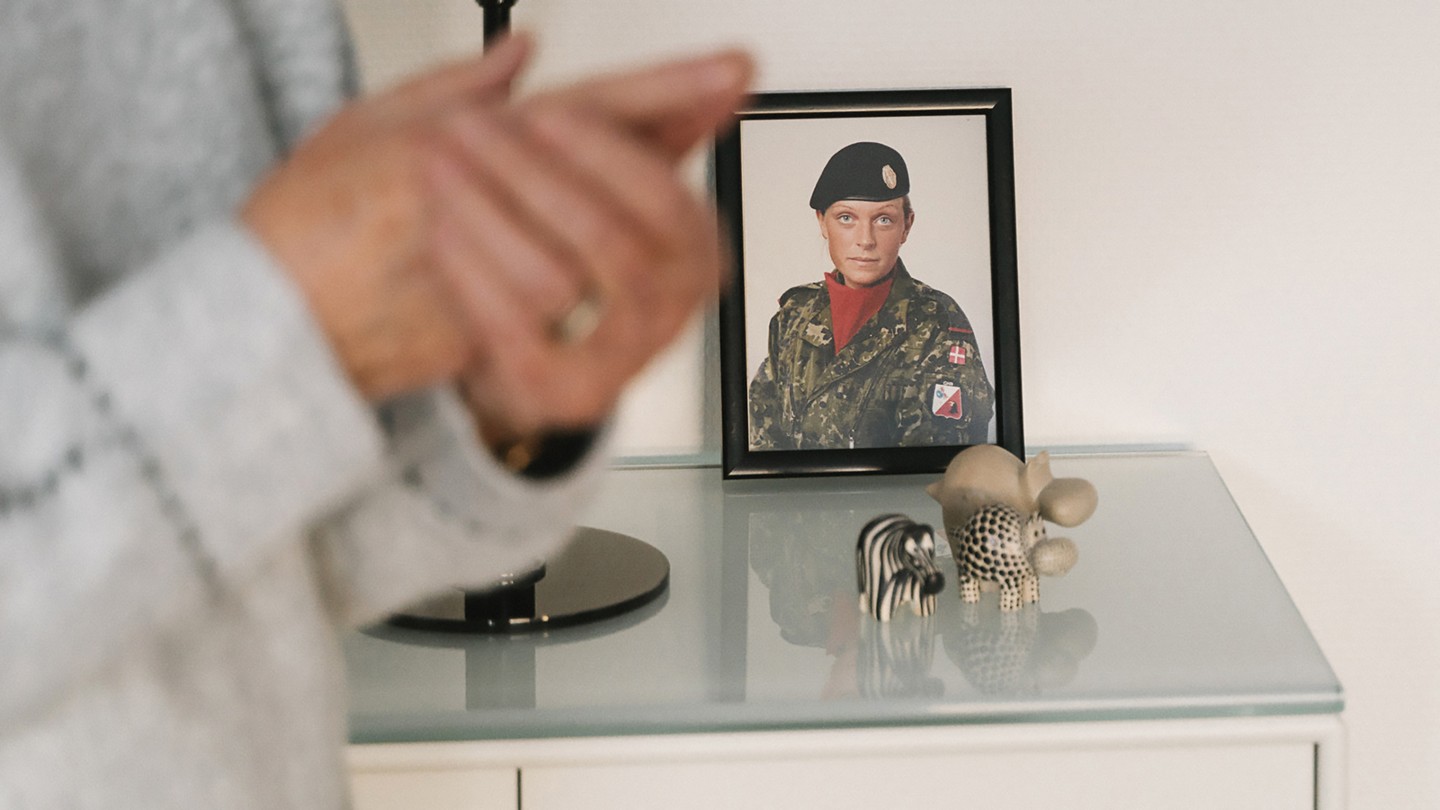
Denmark's significant sacrifices in Afghanistan, including the death of soldier Sophia Bruun, highlight its loyalty to NATO and the U.S. Now, families of fallen soldiers feel betrayed by Trump's threats against Greenland and dismissal of Denmark's contributions, raising concerns about NATO's future and mutual obligations.
Key Takeaways
•Denmark suffered high per capita casualties in Afghanistan, with 43 deaths, demonstrating its commitment to NATO and the U.S.-led war effort.
•Families of fallen Danish soldiers, like Sophia Bruun's mother, feel deep betrayal by Trump's threats to seize Greenland and his comments downplaying Denmark's alliance value.
•Trump's actions have forced European leaders to openly discuss the potential collapse of NATO, with Denmark's prime minister warning that a U.S. attack on an ally could trigger World War III.
•Despite the current tensions, many Danish military families still believe in the original mission in Afghanistan and don't blame the U.S. for the war's outcome, though they regret the hasty withdrawal.
•In response to geopolitical pressures, Denmark has increased defense spending to over 3% of GDP and expanded conscription to women, adapting to a new world where small allies must worry about great power conflicts.
After September 11, Denmark fought alongside its ally. The families of fallen soldiers have a message for Trump. Taby Cheng for The Atlantic It was sunny in southern Afghanistan on June 1, 2010, and the temperature quickly reached 104 degrees. Sophia Bruun was the gunner on a Piranha combat vehicle, guarding two platoons conducting a patrol near the town of Gereshk. They were looking for information from locals about the Taliban.
One of the Piranhas in Sophia’s battle group had hit an IED first thing in the morning, blowing off a wheel, but no one was injured. At the outskirts of a village, they were fired on by the Taliban. They returned fire, and the situation calmed. The patrol continued. But seven minutes after noon, an IED went off under Sophia’s vehicle, flipping it. She was killed instantly, at the age of 22.
In the years after Sophia’s death, her mother, Lene Bruun, returned repeatedly to details of her service, studying letters from the Danish army that she stored in a metal trunk in her home west of Copenhagen. Over time, she allowed herself distance from her grief. “You can put it away for a short time, sometimes longer, but then it comes back,” Bruun, who is 72, told me over coffee at her kitchen table. “And you don’t know what triggers it.”
But these days, Sophia’s mother knows exactly what triggers her grief: “when Trump says we’re not good enough.” Bruun is a tiny woman, with soft white hair and fine lines grooved into her pale skin. But she became flushed when discussing the American president, who has been threatening to seize Greenland, an autonomous territory of Denmark. “Keep your fingers away,” she said with a swatting motion, as if to thwart Trump’s land grab.
The Trump administration’s designs on Greenland have forced European leaders to speak openly about the possible end of NATO. “If the United States attacks another NATO country, everything stops,” Denmark’s prime minister, Mette Frederiksen, warned recently. A military strike by the alliance’s most powerful member would make its promise of common defense obsolete—and risk the outbreak of World War III. It’s a bewildering possibility for the Danes, who see the United States as their most important ally, the country that ushered them into the NATO pact and guaranteed their security for nearly 80 years.
Denmark is small, with a population of just 6 million. But it has tried to uphold its end of the bargain. It lost more soldiers per capita than the United States did in Afghanistan. In all, there were 43 deaths, a sacrifice that Danes accepted as the cost of their international obligations. Sophia was the first female soldier to fall in combat in Danish history, her death a ripple effect of the September 11 attacks, the first time that NATO’s mutual-defense clause was invoked. Triggering Article 5 obligated U.S. allies to assist, including by sending soldiers like Sophia to fight. This time, if Article 5 is invoked, the United States might be the aggressor.
Trump appears unbothered by the prospect that his move against Danish territory might obliterate the American-led order. “If it affects NATO, it affects NATO,” he said recently. “But you know, they need us much more than we need them.” That may be true in a strict sense; U.S. power eclipses Danish capabilities many times over. But when I traveled to Denmark this month, I found there was still fidelity to principles that seem to have vanished from the American government’s calculations, namely a sense of mutual obligation and basic morality.
That’s why Danes feel such an acute sense of betrayal when Trump maligns their value as an ally. “It’s not right what he’s saying,” Bruun protested. “We have done so much for America.” For the families of Danish soldiers who died in the American-led campaign against the Taliban, their country’s partnership with the United States is not an abstraction. Denmark’s loyalty to America brought Sophia Bruun to Afghanistan, and it ended her life.
Sophia’s mother is the one who suggested that she join the armed forces. She was a spunky kid who played handball and gymnastics. As a teenager, she liked to party. After high school, she was directionless, so her mother proposed six months in the military, thinking the experience would prepare her for any profession and give her friends from all over the world. She entered basic training in 2008, acing the physical components, and soon signed a contract that required her to deploy to Afghanistan. “I was furious,” Bruun recalled, never thinking when she proposed a brief course of military instruction that her daughter would actually go to war.
Denmark participated in international operations in the 1990s, but its soldiers didn’t suffer heavy casualties. The country’s engagement in Afghanistan began in December 2001, as Denmark sent aircraft and special forces to aid in the coalition battling the Taliban. Unlike Denmark’s involvement in the American-led war in Iraq, beginning two years later, the decision to participate in Afghanistan wasn’t controversial, Rasmus Mølgaard Mariager, a historian at the University of Copenhagen, told me. “Denmark wanted to be the American empire’s European Gurkha,” he said, referring to the Nepalese fighters who were recruited into the ranks of the British empire starting in the 19th century and proved their soldierly mettle.
Danes can’t boast the same military prowess. “This is not a Viking people,” as one U.S. official in Copenhagen put it to me. Veterans I spoke with said the deployment to Afghanistan was shadowed by two humbling moments in their country’s history, reaching all the way back to 1864, when they were routed by Prussia and Austria. The second defeat was even more chastening. On April 9, 1940, when Nazi forces swept north, invading Denmark, the country’s military couldn’t withstand the attack and folded in what is sometimes called the Six-Hour War. It is understood to be the quickest national defeat at the hands of Hitler’s armies and gave rise to a refrain, “Never again an April 9,” that still motivates Danish soldiers, Søren Knudsen, who served three tours in Afghanistan and later worked at the NATO Defense College, in Rome, told me. “We’re tired of being bullied by these big nations,” he said.
Bruun supported Denmark’s participation in the Afghan War. “Because we are such a small country, we can only go with other countries,” she said. “That’s the only way we can survive.” Denmark expanded its contribution in 2006, when the Danish Parliament approved plans to deploy troops to a British provincial-reconstruction team and other allied efforts in Helmand province, a notorious Taliban stronghold in the country’s south. In all, Denmark sent nearly 20,000 personnel, according to estimates. Many of them helped carry out Britain’s so-called platoon-house strategy, in which small groups of soldiers occupy fortified positions in strategic towns to project authority and fend off the Taliban.
Denmark’s soldiers engaged in the fiercest combat seen by its forces since the war against Prussia and Austria in 1864. The lesson, says Peter Boysen, a deputy commander of Danish soldiers in Afghanistan, was that the country could manage the casualties. “We risked our lives by participating in an operation far from our home,” Boysen, who is now chief of the Danish army, told me. And because the fight was in support of a NATO ally that had come under attack, he said, it was worth it.
As Sophia prepared to deploy to Afghanistan in early 2010, her mother was in Greenland. Bruun worked as a nurse at the time, and she performed rotations on the island. Danes have knowledge of the territory—of its unforgiving climate, and of its people—that the Americans can’t replicate, Bruun insisted.
Greenland became a Danish colony in 1721, when a Christian missionary landed on the island’s west coast. It gained home rule in the 20th century and is now a self-governing part of the Kingdom of Denmark, with a Parliament based in the capital, Nuuk. Denmark still controls Greenland’s defense and foreign affairs, and it provides the island an annual block grant that largely underwrites policing and health care.
This week, Greenland’s prime minister placed his people’s fate with Denmark and Europe. “If we have to choose between the United States and Denmark here and now, we choose Denmark,” the prime minister, Jens-Frederik Nielsen, said. “We choose NATO, the Kingdom of Denmark, and the European Union.” Asked about the comments, Trump said that he didn’t know who Nielsen was, but that his choice would be a “big problem for him.”
Before Sophia deployed, Bruun shortened her contract and returned to Denmark. Sophia left days later. Some of her friends came to the airport to say goodbye, along with her mother, father, and younger brother. “She was looking forward to it,” Bruun recalled. “She was going out to do what she was trained to do.”
Sophia called home every so often, reporting that it was hot and sandy. She wasn’t permitted to say much about what she was doing. Sophia’s mother took care of her dog, a cocker spaniel named Minnie, and she filled letters with details of the dog’s activities, including hunting chickens. In a letter home, which her mother read to me, Sophia expressed enthusiasm about returning to Denmark for leave. “And then she said, ‘I will call, I’m getting up early tomorrow, so now I go to bed.’”
She signed off, “Love you.”
Sophia’s mother was at the hospital in her hometown of Holbæk on June 1 when a doctor appeared on her ward and ushered her to a meeting room. As soon as she walked in, a man in military dress said, “Sophia is dead.”
“I said, ‘No, not my Sophia,’” Bruun recalled. “‘Yes, Sophia is dead,’ he said.” Her vision became distorted, and she sat down on the floor.
Sophia hadn’t wanted a big military funeral. In her will, she specified that only soldiers who had served alongside her should attend. The ceremony took place at the family’s church, also in Holbæk. She was cremated and given a spot in the cemetery. She wrote the words now etched across her own gravestone: Wanted to make the world a better place to live in.
Danes are incredulous about the threats emanating from Washington, and angry. I spoke with former soldiers who said they were preparing to ditch their iPhones and Gmail accounts in favor of European alternatives. This month, officials in Denmark’s third-largest municipality vowed that they would continue funding an annual celebration of Independence Day—believed to be the largest event marking July 4 outside the United States—only if official representatives of the U.S. government were excluded.
I told Boysen, the Danish army chief, about the feeling of betrayal I encountered, especially among families of fallen soldiers. “I do understand that anger,” he said. “But I think we need to ask the president, because he’s the one, I mean …” Boysen trailed off, blowing air through his lips.
Danes have a sophisticated understanding of U.S. politics, and they take pains to separate the president from the rest of the population. Still, their goodwill is not infinite. “I think it would be very difficult to gain support for a U.S.-led mission somewhere abroad today,” says Lennie Fredskov Hansen, a retired brigadier general who served as an adviser to Anders Fogh Rasmussen, the former NATO secretary-general, when he was prime minister of Denmark in the 2000s. Hansen told me that he worked closely with the U.S. Marine Corps in Afghanistan, where he felt a sense of “brothers in arms.” He expects that individual Danish and American soldiers may still feel that way. But, he added with a note of understatement, “I’m concerned about how that will develop in the future.”
As for the past, I found that certain attitudes are enduring, including among families of soldiers who died in Afghanistan. They haven’t reconsidered their belief in the international campaign against the Taliban. And they don’t fault the U.S. for the disastrous outcome of the war—violent extremism and human displacement on a mass scale. They regret only that the United States withdrew so hastily in 2021. “I have to think, and I still believe, that the mission was for the best,” says Simon Enig, who had two brothers who went to Afghanistan alongside NATO forces; one, Samuel, never returned. Last Friday was the 15th anniversary of the day he was killed by a roadside bomb. Enig visited his brother’s grave, along with his mother. “We were just quiet together,” he told me.
I asked some of the parents I met if they regretted sending their children to die in an American-led war, now that the American president is disparaging Denmark’s contributions to NATO. Maybe, I put it to them, Denmark shouldn’t have been such a loyal ally to the United States.
“No,” said Malene Ebert, whose son Michael served in both Iraq and Afghanistan, and was killed in a firefight north of Gereshk in 2009. “We are in an alliance, so we have to fulfill our obligation.” She also said she discounts Trump’s words, and hopes that American voters will elect different leaders. “I can’t understand,” she said, “why the American people have chosen a person like that.”
But Michael’s father, Nicolai Rasmussen, observed at least one positive effect of Trump’s pressure: Denmark and other European countries spending more on their own defense. “I can understand why he is saying, ‘Hey, it’s your safety. You need to pay what you need to pay,’” Rasmussen, a gardener, told me. “I think that’s fair talk.” Ebert, a secretary, had to agree. “I believe that, too,” she conceded. “But I don’t like it; I don’t like war. I would use resources on peace instead.”
For years, the Danish government followed that approach. In the decades after the Cold War, the country downsized its military and scrapped key weapons systems. More than 20 years ago, Denmark decommissioned its ground-based air- and missile-defense capabilities, and began to rebuild them only last year. In 2024, Denmark pulled out of a major NATO training exercise, scheduled for the following year, because of budget constraints. Its absence was an embarrassment, but the Danish government has pivoted quickly since Trump’s return to the White House. In 2025, it raised defense spending to more than 3 percent of its economic output, the highest in at least half a century.
Denmark has many of the advantages that would be expected of a wealthy, highly educated society, including technical expertise, cybercapabilities, and an elite special-forces corps. Its limitations are also evident. The labor market is tight, so competition for workers is fierce. Certain benefits that might otherwise be dangled as an incentive to enlist, such as health care, are already provided to all Danes by the government. So Denmark is getting creative. Last year, it extended its lottery system for possible military conscription to women, joining just two other European countries, its fellow Scandinavian states of Norway and Sweden, in making mandatory service gender-neutral.
Sophia’s mother mentioned that change to me, saying it would mean more soldiers like her daughter. “It’s a new world,” she said. We stood in front of a collage of photos of Sophia, which her mother assembled a month after her death: Sophia with her younger brother at the airport, preparing to deploy. Sophia through the window of a detached car door in Afghanistan, pretending to drive. “It’s typical Sophia,” her mother said. “She was always making jokes.”
It is a new world, I thought—one in which small countries, like Denmark, that have bound themselves tightly to Washington have a lot to worry about: Russia bearing down on Europe, the United States retreating to the Western Hemisphere, and China flexing its power in Asia. Denmark has been an especially generous donor to Ukraine, so much so that one U.S. official groused to me that the country had left its own cupboard bare. That’s of a piece with Denmark’s military track record. It’s been a capable and accommodating partner in foreign wars. But its capacity to defend itself, not least Europe and the parts of its territory that stretch into North America, is limited. Danes, of course, never imagined they might need to defend themselves against the United States.