Reading is declining, with fewer Americans reading for pleasure. Efforts to promote it as a civic duty fail; instead, it should be framed as a private, even transgressive, pleasure to attract readers.
Key Takeaways
•Reading rates in the U.S. are dropping, with fewer people, including students, engaging in daily reading for pleasure.
•Promoting reading as essential for democracy is ineffective because it misunderstands that people read for personal passion, not utility.
•Great literature often portrays reading as a vice that can complicate life, not improve it, challenging the idea that reading makes better citizens.
•To revive reading, it should be presented as a private, sometimes rebellious, pleasure rather than a public duty.
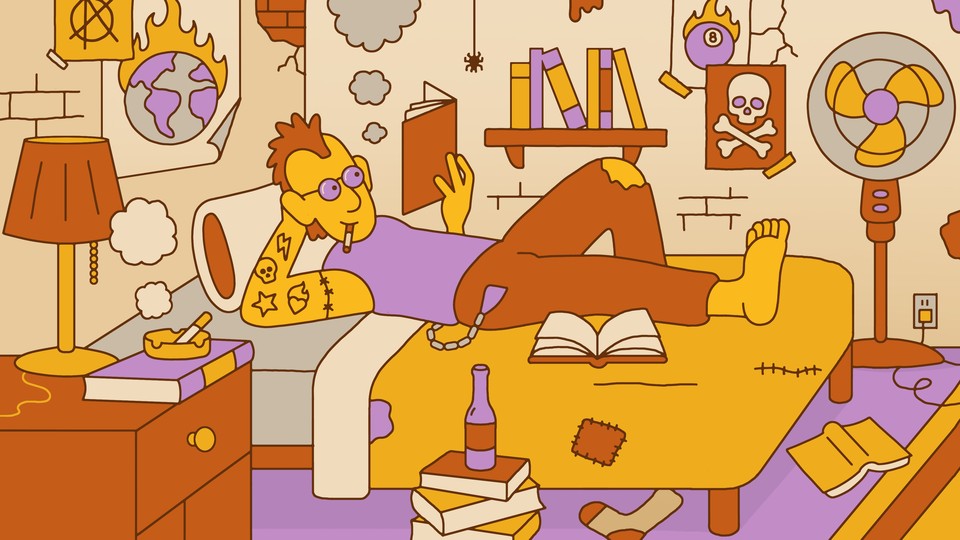
Being a reader means cultivating a relationship with the world that, by most standards, can seem pointless and counterproductive. Illustration by Jackson GibbsIf you read a book in 2025—just one book—you belong to an endangered species. Like honeybees and red wolves, the population of American readers, Lector americanus, has been declining for decades.The most recent Survey of Public Participation in the Arts, from 2022, found that less than half of Americans had read a single book in the previous 12 months; only 38 percent had read a novel or short story. A recent study from the University of Florida and University College London found that the number of Americans who engage in daily reading for pleasure fell 3 percent each year from 2003 to 2023.
This decline is only getting steeper. Over the past decade, American students’ reading abilities have plummeted, and their reading habits have followed suit. In 2023, just 14 percent of 13-year-olds read for fun almost every day, down from 27 percent a decade earlier. A growing share of high-school and even college students struggle to read a book cover to cover.
Educators and policy makers have been agonizing about this trend line for decades, but they haven’t managed to change it. Now some are trying a new tactic: If people won’t read books because they enjoy it, perhaps they can be persuaded to do it to save democracy. The International Publishers Association, which represents publishers in 84 countries, has spent the past year promoting the slogan “Democracy depends on reading, arguing that “ambitious, critical, reflective reading remains one of the few spaces where citizens can rehearse complexity, recover attention and cultivate the inner freedoms that public freedoms require.”
The problem with these kinds of arguments isn’t that they are wrong; it’s that they don’t actually persuade anyone to read more, because they misunderstand why people become readers in the first place. Telling someone to love literature because reading is good for society is like telling someone to believe in God because religion is good for society. It’s a utilitarian argument for what should be a personal passion.
It would be better to describe reading not as a public duty but as a private pleasure, sometimes even a vice. This would be a more effective way to attract young people, and it also happens to be true. When literature was considered transgressive, moralists couldn’t get people to stop buying and reading dangerous books. Now that books are considered virtuous and edifying, moralists can’t persuade anyone to pick one up.
One of my strongest early memories of reading comes from fifth grade, when I was so engrossed in a book that I read right through a spelling test without noticing it was happening. I remember this incident partly because I was afraid I would get in trouble. But I think the real reason it stays in my memory after 40 years was the feeling of uncanniness. The time that had passed in the classroom had not passed for me; in a real sense I was in another world, the world of the book.
Being a reader means cultivating a relationship with the world that, by most standards, can seem pointless and counterproductive. Reading is not profitable; it doesn’t teach you any transferable skills or offer any networking opportunities. On the contrary, it is an antisocial activity in the most concrete sense: To do it you have to be alone, or else pretend you’re alone by tuning out other people. Reading teaches you to be more interested in what’s going on inside your head than in the real world.
Anyone who was a bookish child could probably tell a similar story to mine. Marcel Proust tells one in Swann’s Way, the first volume of his epic novel In Search of Lost Time, when he writes about reading on summer afternoons in the country and not hearing the church bell.
Sometimes it would even happen that this precocious hour would sound two strokes more than the last; there must then have been an hour which I had not heard strike; something which had taken place had not taken place for me; the fascination of my book, a magic as potent as the deepest slumber, had stopped my enchanted ears and had obliterated the sound of that golden bell from the azure surface of the enveloping silence.
In this passage, the ability to fall so deeply under the spell of a book seems like a blessing. But as the novel goes on, Proust’s narrator shows that his sensitivity to books—and later to music and art—is an expression of the same qualities that make him unfit for life and relationships. He is so susceptible to the poetry of place names that when he visits the actual places, he is always disappointed. His hyperawareness of what is going on inside his mind makes him an egotist; other people exist for him as providers of emotional stimuli, not as real individuals with their own minds and desires.
As a rule, if you’re looking for evidence that reading makes you a better world citizen, the last place you’ll find it is the work of great writers. They know too much about literature to idealize it the way educators do. In fact, some of the greatest novels are about how reading ruins lives—starting with the book often considered the first modern novel, Don Quixote. Cervantes’s comic hero is addicted to “reading books of chivalry,” until “his fancy grew full of what he used to read about in his books, enchantments, quarrels, battles, challenges, wounds, wooings, loves, agonies, and all sorts of impossible nonsense.” Convinced that he is a character in a novel—which, of course, he is—he embarks on a series of knightly adventures that go laughably and pathetically wrong.
Centuries later, the heroine of Gustave Flaubert’s novel Madame Bovary makes the same mistake, with more tragic consequences. Emma Bovary is addicted to reading—Flaubert writes that, as a teenager, she “made her hands dirty with books from old lending libraries.” When she gets married and finds that she doesn’t love her husband the way novels had led her to expect, she turns to adultery “to find out what one meant exactly in life by the words felicity, passion, rapture, that had seemed to her so beautiful in books.” But what is beautiful in books turns out to be ugly in life, and Emma’s attempt to live like the heroine of a romance ends in ruin and suicide.
After Madame Bovary was published, in 1856, its frank depiction of sexual immorality got Flaubert prosecuted in Paris for obscenity. He was acquitted, and the attempt to censor the novel only made it more popular, just as would happen in the 20th century with Ulysses and Lady Chatterley’s Lover. Today, all of these books are considered classics, which means that most of us encounter them only in the classroom, as objects of dutiful study.
If we want to keep reading from going extinct, then the best thing we could do is tell young people what so many great writers readily admit: Literature doesn’t make you a better citizen or a more successful person. A passion for reading can even make life more difficult. And you don’t cultivate a passion for the sake of democracy. You do it for the thrill of staying up late to read under the covers by flashlight, unable to stop and hoping no one finds out.