Tayari Jones's novel 'Kin' explores class and fate through the lifelong friendship of Annie and Vernice, drawing parallels to Edith Wharton's social critiques. Jones uses traditional literary tropes to examine how socioeconomic backgrounds shape destinies in 1950s-60s America.
Key Takeaways
•Tayari Jones's work blends contemporary urgency with old-fashioned literary techniques, drawing inspiration from early-20th-century writers like Edith Wharton and Henry James.
•'Kin' presents class as an inescapable arbiter of fate rather than a circumstance to transcend, challenging American ideals of self-determination.
•The novel explores how different upbringings—Annie's working-class background versus Vernice's bourgeois aspirations—irrevocably shape the characters' lives and friendship.
•Jones maintains historical authenticity by portraying restrictive gender mores of the 1950s-60s without imposing anachronistic modern perspectives on her characters.
•Unlike many contemporary novels, 'Kin' embraces traditional novelistic elements like love triangles, class conflict, and inevitable tragedy rather than optimistic rebellion.
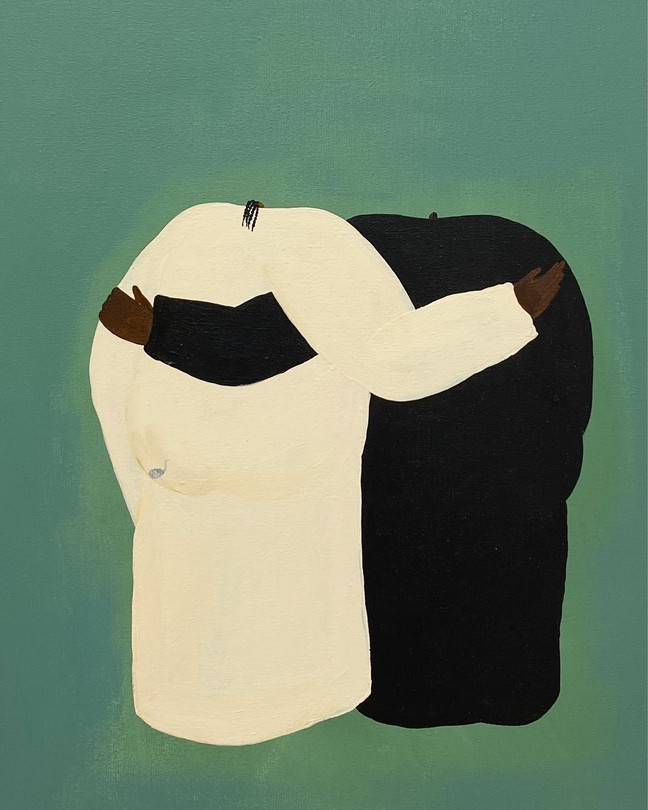
Tayari Jones’s new novel, Kin,is a steely portrait of friendship and fate. Painting by Bahati Simoens At the end of Edith Wharton’s The Age of Innocence, an aging Newland Archer, who as a young man broke his own heart by choosing propriety over love, tells himself that the mark of the modern era is that everyone is too busy to care about their neighbors’ standing. Archer, shaped by the hierarchies of the Gilded Age, is disoriented by this new egalitarianism. Wharton writes him wondering, “And of what account was anyone’s past, in the huge kaleidoscope where all the social atoms spun around on the same plane?” The Age of Innocence is set in the 1870s, which means that by Archer’s standards, the work of the writer Tayari Jones would already have been old-fashioned well over a century ago.
Jones, whose novel Kinhas just been released, is often described as a timely writer, but to concentrate only on the contemporary urgency of her books is to ignore her clear interest in the past and its conventions. As a stylist, she seems strongly influenced by early-20th-century literature, even when her subject matter comes from the news. Her debut, Leaving Atlanta, narrates the Atlanta child murders committed between 1979 and 1981—when Jones herself was growing up there—through the eyes of child protagonists whose mix of knowing and naivete would be at home in the work of Henry James. Jones’s fourth book, 2018’s An American Marriage, which made her nationally famous, is an especially forceful juxtaposition of old and new. Its titular marriage goes awry when Roy, the husband, is wrongly accused and convicted of rape. While he’s incarcerated, his wife, Celestial, falls for her childhood friend Andre—a storyline thatis at once a darkly modern love story and an old-school love triangle.
Jones’s novels derive much of their richness from her striking capacity to use literary and cultural tropes that may seem outmoded to new ends. Where many of her peers skirt or hint at emotion, she describes it head-on. She enjoys traditional sources of novelistic turmoil: not just love triangles but also orphanhood, separations bridgeable only by mailed correspondence, unrequited and star-crossed love. And like Wharton in Gilded Age Manhattan, Jones makes incisive and thoughtful use of even the tiniest details of socioeconomic status, and she cares very much about each of her characters’ pasts.
Such minute attention to class is rare in recent American novels not set among the literati or ultra-wealthy, and still rarer in books that aren’t comedies. Jones is a straightforward writer of drama, and her characters either come from or strive to get to southwest Atlanta, where she grew up. Celestial, who was raised in the same neighborhood as Jones, describes her upbringing as “what the rest of America thinks of as middle-middle class and what black America calls upper-middle class.” Jones wields a scalpel as sharp as Wharton’s to dissect the expectations and mores that, in the world she is describing, can make or break marriages, divert lifelong friendships, and, in Kin, circumscribe a person’s fate.
Kin starts in a small town in Jim Crow–era Louisiana, where its two protagonists, Annie and Vernice, are growing up without a mother. Although this shared absence connects them and renders them alike in others’ eyes, Jones is clear from the beginning that the girls’ situations, and their destinies, are not the same. Annie’s “trifling” mother, Hattie Lee, dumped her newborn with the girl’s grandmother and vanished, leaving Annie to dream of the day she would return. Vernice’s mother is dead, murdered by her father—who then died by suicide—when Vernice was six months old. Neither Annie’s grandmother nor Vernice’s Aunt Irene, who reluctantly gives up a new life in Ohio to take care of her, are tender toward their charges; at times, they are nakedly resentful. Both girls long for their mother, but their truest bond comes from the fact that they are each other’s only real source of attention and warmth.
But Irene instills expectations in Vernice that don’t occur to Annie’s exhausted grandmother, who “looked forward to climbing in the grave and pulling the dirt over her like a blanket.” Vernice grows up with every physical comfort that Irene can afford—along with the mandate to be well turned out at all times—and with the knowledge that her aunt is saving to get her to college. When, at 17, Vernice tries to persuade Annie to join her at Spelman College, in Atlanta, which Jones (and a couple of her earlier characters) attended, Annie says, “Miss Irene been training you to be a young lady since the day they told her that she had to raise you. My granny just wants me to be able to put food on my plate without laying on my back for it.”
Neither girl questions, let alone tries to shake, this distinction, which is one of class—and of class aspiration. Annie especially accepts the divide between herself and her friend, whom she calls Niecy. Only when the two are separated does she understand that she and Vernice aren’t total opposites. She’s always seen herself as tough and scrappy, but now she wonders if it’s just that no one “would for one second think to call me shy if I stood next to Niecy.” With Annie beside her, however, “nobody would ever call Niecy poor or homely. In that way,” Annie realizes, “we kept each other from being the thing we most didn’t want to be.”
Vernice’s bourgeois ambitions aren’t merely a product of her upbringing, though. She has a profound yearning, distinctly not inherited from Irene, “to grow a person within myself and love that little person so hard that it would bind her to me.” Annie, in contrast, wants only to be a daughter. Before graduating from high school, she runs away in search of Hattie Lee, a quest that leads her to wash sheets (not lay on her back) at a Mississippi brothel and work at bars in Memphis. Meanwhile, at Spelman, Vernice swiftly dives into a romance with her roommate, Joette, even as she gets set up with a wealthy alumna’s son, a lawyer eager to get married. Soon, she’s getting ready to become a southwest Atlanta housewife with her very own “throne room” in a freshly built house. She’s barely attracted to her husband-to-be, but she soothes herself with the conviction that “burning love” is not the “only type of love any more than the camellia is the only flower. There is the love that blooms from decency, and from that love, passion.”
If this sounds almost antiquated, it is, and consciously so. Jones does impressively delicate work highlighting the constrictive gender mores of the 1950s and ’60s without having Annie or Vernice notice or examine them to a degree that would be anachronistic. It seems clear that Jones would rather risk having a passage read as sexist to the 21st-century eye than violate her novel’s reality. She appears to have considered similar issues while writing An American Marriage:In an Auburn Avenue interview about that novel, Jones said, “Every time a woman doesn’t take care of someone, someone isn’t taken care of. There’s consequences to disrupting roles.”
It’s striking for a contemporary novelist, especially one who describes her work as feminist, to write stories that honestly explore rather than condemn these consequences. Kin does so twice over. For Annie, the absence of any expectation to be a lady means she can live with her boyfriend without getting married, but it does not free her from the assumption that she’ll cook and clean for him. Neither does it free her from his rather insidious conviction that he deserves more of her attention than her hunt for her mother does. Vernice, meanwhile, would love to challenge the limits of a lady’s role, but she’s afraid that would prevent her from becoming a mother, and thanks to Aunt Irene, she’s too much of a good girl to consider doing so out of wedlock.
Kin is similarly old-fashioned in its steely portrait of class as an arbiter of fate, not as a circumstance to transcend. Like Wharton and F. Scott Fitzgerald, Jones seems to reject the American promise of self-determination: Vernice and Annie can no more escape the defining differences between their upbringings than Jay Gatsby can escape the fact that he used to be James Gatz. In the prewar American novel, this is a relatively common attitude, but in the literature of the 1950s and beyond, the value—if also the risks—of individuality and rebellion emerges as a major theme. Jones considers Toni Morrison an influence, and Kin could be read alongside 1973’s Sula, also a tale of a profound female friendship. But although Sula is decades older, its structure, prose, and protagonist are all defiant in their modernity. It isn’t quite an optimistic novel, and yet is imbued with possibility. Kin, in contrast, bucks contemporary expectations by hewing to older ones. In doing so, Jones gives the novel the same sense of inevitable tragedy that animates Wharton’s books.
Jones’s emotional directness lends her prose a deep warmth that could trick the reader into believing she’ll allow her heroines a happy ending. Not the case. The gradations of class, in Jones’s rendering, are inescapable when Annie and Vernice are preparing to leave their hometown—but they’re truly immutable once Vernice is married. Her wealthy new family refuses to extend any of their access or connections to Annie; to them, friendship is nowhere near as important as propriety. Vernice’s mother-in-law tells her not to “transfer the squalor of your childhood to your new life,” then adds, “your goal, at all times, is to make sure there is a chasm between you and the mess.” She is being cruel, and Vernice breaks all of her conditioning to say so.
But unlike Annie, Vernice isn’t used to advocating for herself; she’s the one whose worst fear was to be seen as poor and homely. In the end, that terror takes over, and Jones writes its results with shattering simplicity. Deep into the novel, Annie thinks that an “‘I love you’that is out in the world unanswered bedevils a space, like the ghost of a whore in Mississippi.” If that’s true, then Vernice will be haunted for the rest of her life.