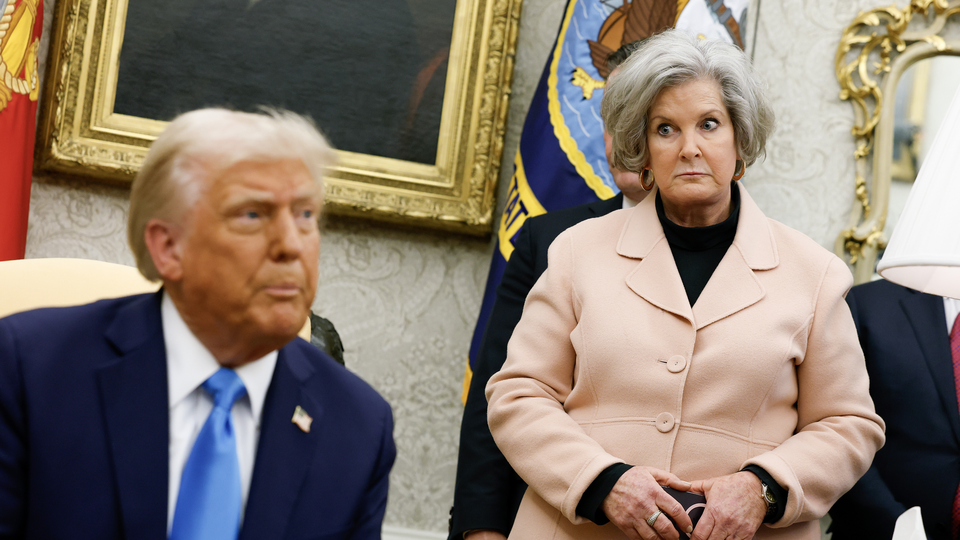
Despite making controversial on-record comments about Trump and staff in Vanity Fair, chief of staff Susie Wiles retains his support. Her blunt assessments caused a stir, but Trump and allies defended her, highlighting her indispensable role in bringing discipline to his administration.
Key Takeaways
•Susie Wiles made surprisingly candid on-record remarks about Trump and senior staff in Vanity Fair, calling Trump's personality akin to an alcoholic's and criticizing others like Elon Musk.
•Despite the controversy, Trump publicly supported Wiles, and cabinet members rallied to defend her, indicating her crucial role in his administration.
•Wiles has been credited with instilling discipline and professionalism in Trump's operations, helping secure legislative wins and reducing chaos compared to his first term.
•The incident underscores the tension between Trump's disdain for mainstream media and his desire for their coverage, as staffers participated in the Vanity Fair piece.
•While Wiles' job appears safe for now, the controversy adds to distractions for an administration facing electoral setbacks and internal challenges.
The president made clear he supports his chief of staff despite her Vanity Fair comments. Anna Moneymaker / Getty Susie Wiles styles herself as a White House chief of staff who avoids being in the headlines. When cameras come into the Oval Office, she tends to sit just out of frame. She rarely gives interviews. Unlike her predecessors, she seldom tries to curb President Donald Trump’s impulses. She has been lauded in Trump world for instilling a sense of discipline in a chaotic realm, and for providing steady leadership during both Trump’s historic political comeback and the steamrolling start to his second term.
Well then! That’s sure over now.
Wiles committed the cardinal sin for a White House staffer—particularly a staffer for this White House—by becoming the news herself with the publication today of a two-part Vanity Fair story in which she offered stunningly forthright assessments of the president and much of his senior staff. Her blunt candor (she said that Trump has an “alcoholic’s personality” and that Elon Musk is “an avowed ketamine” user) was especially surprising because Wiles has presided over a (relatively) on-message White House and is usually so careful herself. The timing is also far from ideal for a West Wing already dealing with a series of GOP electoral defeats, the fallout from Trump repeatedly declaring the nation’s affordability crisis a hoax, and then, yesterday, the president blaming the beloved filmmaker Rob Reiner for his own murder.
Steve Bannon got excommunicated from Trump world—at least for a while—during the president’s first term after his own frank on-the-record exchange with a journalist. But this time, there was no firing, no public meltdown. Instead, Trump shrugged it off. Cabinet members mobilized to defend Wiles. Her job seems safe, at least for now. To many in Trump’s orbit, the White House’s response is a telling reflection of how indispensable she is to the president.
“She was a loyal fighter for him from the moment she came on board,” Donald Trump Jr. posted on social media today. “When things were tough and other supposed friends left my dad like a bunch of rats, Susie stood by his side.”
Still, her words were bracing. Often, senior administration officials talk to reporters on background—offering quotes without their names attached—so that they can speak honestly without deviating from the official White House message or alienating the president. But Wiles spoke on the record, and she appeared to hold little back. She revealed that Trump is indeed hoping to use military strikes on alleged Venezuelan drug boats to force that country’s leader out of power. She said that Vice President J. D. Vance has been “a conspiracy theorist for a decade” and that Russell Vought, the budget director, is “a right-wing absolute zealot.” And she tore into Musk, the tech billionaire who spent months destroying the federal bureaucracy, as “an odd, odd duck.”
Wiles’s cooperation with the author Chris Whipple was no secret. She talked with Whipple 11 times over the past year and sat with him in the chief of staff’s office, which occupies a prized perch in the West Wing just steps from the Oval Office. Several other senior staffers—including Vance, Deputy Chief of Staff Stephen Miller, and Press Secretary Karoline Leavitt—also spoke with Whipple and posed for glossy photographs. (Vanity Fair ran several extreme-close-up shots, not all of them flattering.) A few Trump allies told us that they suspected that Wiles had let her guard down with Whipple, who’d written a definitive history on modern White House chiefs of staff, and that the Trump aides had joined the long list of Washington staffers over the years who had succumbed to the lure of a glamorous Vanity Fair photo shoot. Despite Trump’s constant bashing of legacy media, he has spent a lifetime longing for their coverage and approval.
Wiles’s comments were so unexpected—and so, um, honest—that the story sparked frenzied speculation across Washington: Did Wiles think she was off the record? Was she trying to record her version of events for the history books? Was she planning to resign? After the story broke, Wiles called around to her West Wing colleagues in an attempt at damage control, insisting that her quotes had been taken out of context, aides told us. She told The New York Times that she took issue with the quotes attributed to her about Musk’s drug use, saying, “That’s ridiculous” and “I wouldn’t have said it and I wouldn’t know.” But the newspaper reported that Whipple had played the recording of Wiles’s comments confirming that, yes, she had indeed said what he’d written. (Wiles also told Whipple that she didn’t have firsthand knowledge of Musk’s drug use; the tech billionaire had previously admitted to using ketamine.)
Trump, in making his support for Wiles clear, went so far as to confirm in an interview with the New York Post her assessment that he has “an alcoholic’s personality.” Wiles had told Vanity Fair that Trump operates with “a view that there’s nothing he can’t do,” like her own father, the NFL legend Pat Summerall, who had a drinking problem. Trump does not drink and looks down on those who do, but he claimed not to have been bothered by that comparison. If he did imbibe, he said, “I’d have a very good chance of being an alcoholic. I have said that many times about myself, I do. It’s a very possessive personality.” (When Trump first met Wiles, then a Florida political operative, he loved that she was Summerall’s daughter; many of the president’s favorite cultural touchstones date from the 1980s, the decade in which Summerall and John Madden teamed up to become the NFL’s signature TV-broadcast team.)
In a social-media statement posted soon after the story’s publication, Wiles called it “a disingenuously framed hit piece.” Leavitt did as well, writing that “President Trump has no greater or more loyal advisor than Susie.” And then she directed top Trump officials to fan out on social media to defend Wiles; agency heads such as Pete Hegseth, Robert F. Kennedy Jr., and Doug Burgum were among the nearly two dozen senior officials who posted praise for the chief of staff. The vice president, delivering a speech in Allentown, Pennsylvania, even laughingly acknowledged that he could, in fact, be a conspiracy theorist.
“We have our disagreements,” Vance said of Wiles. “We agree on much more than we disagree, but I’ve never seen her be disloyal to the president of the United States, and that makes you the best White House chief of staff that I think the president could ask for.”
The show of force underscored Wiles’s importance to Trump, who churned through four chiefs of staff during his first term. After Trump left office in disgrace in early 2021, Wiles agreed to coordinate his fundraising efforts and political activity. A year later, she took the helm of his reelection campaign, which, at the time, seemed like a long-shot bid. She, along with the GOP consultant Chris LaCivita, put together a far more professional operation than in any previous Trump campaign, and cut down on the staff infighting and leaking that defined his two earlier runs. She publicly claimed that she never tried to control Trump, but she did, on occasion, get him to back away from outlandish ideas. In a moment famous in Trump’s circles, Wiles stepped into the candidate’s line of sight during a particularly dark and rambling Pennsylvania rally in the campaign’s final week and simply glared at him. The unspoken message: Stop it, and move on. Trump eventually did. The president is deeply fond of her, staffers told us, and once praised her as the “most powerful person in the world” while also, oddly, at times calling her “Susie Trump.”
The circle of power in the West Wing is small—Vance, Miller, Secretary of State Marco Rubio, and a few others—and Wiles, in many ways, wields the most influence. She streamlined processes, cracked down on talking to the press, and demanded loyalty from the staff. Wiles largely reduced the chaos, dysfunction, and turnover that permeated Trump’s first term and was able to help secure passage of a sweeping tax bill and a dramatic expansion of executive power.
She revealed to Vanity Fair a number of occasions when Trump ignored her advice. She said that she’d tried to persuade him not to pardon the most violent January 6, 2021, rioters and urged him to hold off on announcing his sweeping tariffs plan. She openly criticized the way Musk slashed international-aid programs. She admitted that some of the prosecutions brought by the Department of Justice directly stemmed from Trump’s desire for revenge. And she said that Trump broke their “loose agreement” to end his “score settling” against political enemies that she’d feared would distract from his agenda after the first 90 days.
Now Wiles herself has become the latest in a string of distractions. The momentum that she helped engineer stalled out this summer when the GOP legislation proved unpopular and Jeffrey Epstein returned to the headlines. Since then, rising prices and a sense that Trump has overreached in expanding his executive power have led to a string of Democratic wins at the ballot box and a fear among Republicans that the president has lost touch with the promises that returned him to the White House. And yesterday, even some in the president’s own party denounced his assertion that Reiner was killed alongside his wife because he was a Trump critic. (Prosecutors have said that the couple’s son, who has spoken openly about his struggles with drug addiction, will be charged with their murder.)
Although Trump announced a speech to the nation tomorrow night that is meant to recap a year of accomplishments, some in the West Wing privately admit that a revised approach to governing—including possible staffing changes—could be on the horizon in the new year. Wiles has said that she told Trump that he needs to start campaigning again. And the vice president volunteered his own idea for a course correction.
“If any of us have learned a lesson from that Vanity Fair article,” Vance said in Pennsylvania, “I hope that the lesson is that we should be giving fewer interviews to mainstream-media outlets.”