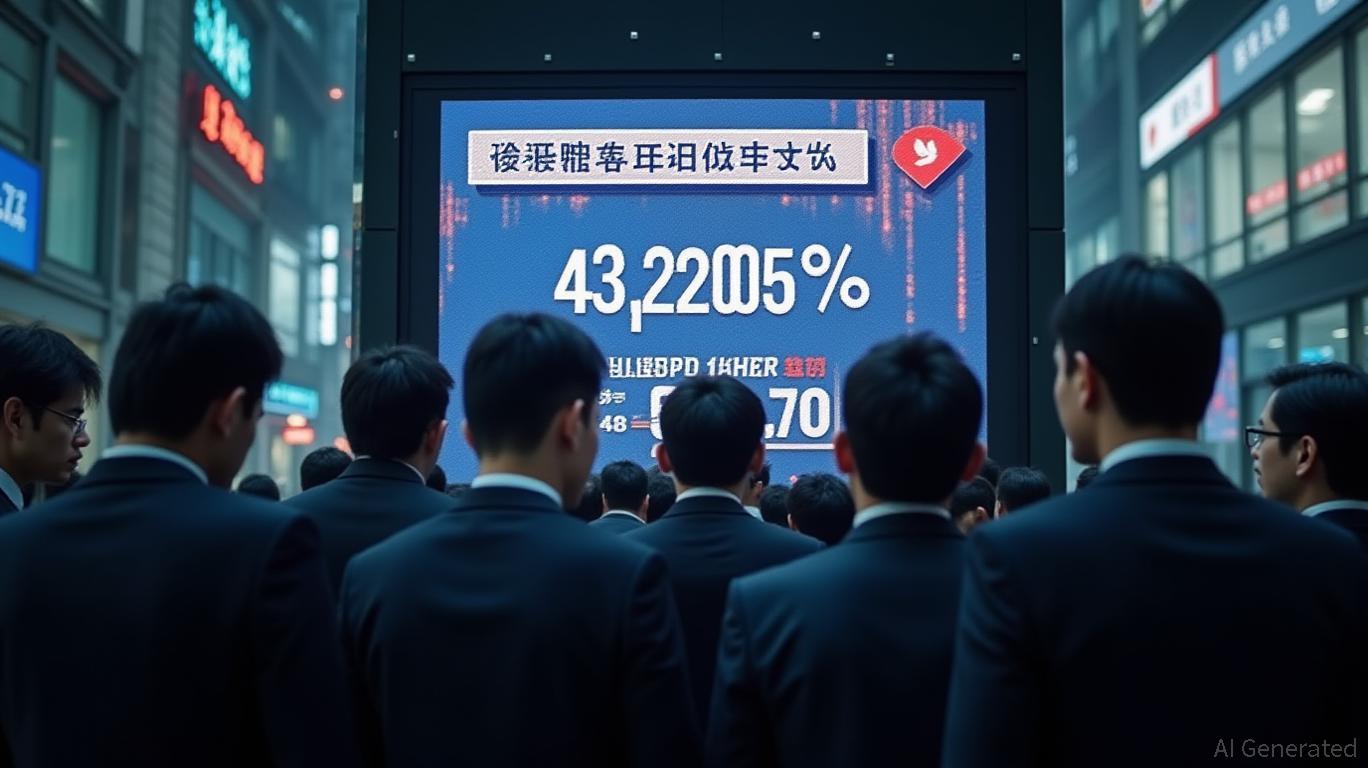
Japan treasury bill bids accepted at lowest price 43.2005%
TL;DR
Japan's Treasury bill auction on March 5, 2026, accepted bids at a lowest price of 4.5253%, reflecting fiscal pressures amid high debt and market volatility. Recent policies and political uncertainty raise concerns about sustainability and market stability.
Tags
Japan treasury bill bids accepted at lowest price 43.2005%
On March 5, 2026, the Japanese Ministry of Finance conducted an auction for Treasury discount bills, with bids accepted at a lowest price of 4.5253% per 100 yen, reflecting heightened fiscal pressures amid evolving economic and political dynamics according to auction results. The auction, part of Japan's ongoing efforts to manage its record debt-to-GDP ratio of approximately 240%, saw competitive bids totaling ¥[amount] billion, with ¥[amount] billion in accepted bids. This outcome aligns with broader volatility in Japanese government bond (JGB) markets, where 40-year yields recently surpassed 4% for the first time since 2007, and 30-year yields hit a record 3.9%.
Recent fiscal measures, including Prime Minister Sanae Takaichi's announcement of a snap election and a two-year suspension of the 8% consumption tax on food, have raised concerns about sustainability. These policies, projected to cost ¥5 trillion annually, have intensified scrutiny over Japan's ability to fund expanding deficits without triggering market instability. The Bank of Japan (BoJ) has maintained its headline interest rate at 0.75%, a 30-year high, while signaling growth forecasts of 0.9% for 2025 and 1% for the current fiscal year. However, analysts caution that reliance on bond purchases to suppress yields risks exacerbating long-term fiscal vulnerabilities.
Interdealer market liquidity remains a focal point, with buy-side traders expressing concerns about the capacity of secondary markets to absorb large-scale issuance during periods of stress according to Morgan Stanley MUFG Securities analysis. While electronic trading advancements have improved liquidity in recent years, manual processes in spot interdealer markets persist, raising parallels to the 2020 U.S. Treasury crisis and the 2022 UK gilt turmoil.
For investors, the auction results underscore the delicate balance between fiscal stimulus and market confidence. With political uncertainty and structural debt challenges persisting, Japan's ability to navigate its fiscal trajectory without triggering a crisis remains a critical concern for global markets.
Ministry of Finance Japan, Auction Results (February 20, 2026); Yahoo Finance, Japan's Central Bank Holds Rates Steady (February 2026): Ministry of Finance Japan, Auction Results (February 20, 2026); Yahoo Finance, Japan's Central Bank Holds Rates Steady (February 2026)
According to Morgan Stanley MUFG Securities analysis (October 2025): Morgan Stanley MUFG Securities analysis (October 2025)