Defense Secretary Pete Hegseth's press briefing raised concerns about the administration's handling of the Iran war, as his dismissive comments about the Strait of Hormuz closure inadvertently confirmed reports of strategic miscalculations. He focused on attacking media coverage rather than addressing the war's challenges.
Key Takeaways
•Hegseth's briefing suggested the administration underestimated Iran's actions in closing the Strait of Hormuz, despite his attempts to downplay it.
•His response to CNN's report was contradictory—calling it 'fake news' while confirming Iran's long-standing threats to shipping in the strait.
•Hegseth prioritized criticizing media coverage over outlining a clear plan for the war, indicating a focus on propaganda rather than strategy.
•He openly advocated for biased reporting at CNN under new ownership, reflecting the administration's desire to control the narrative.
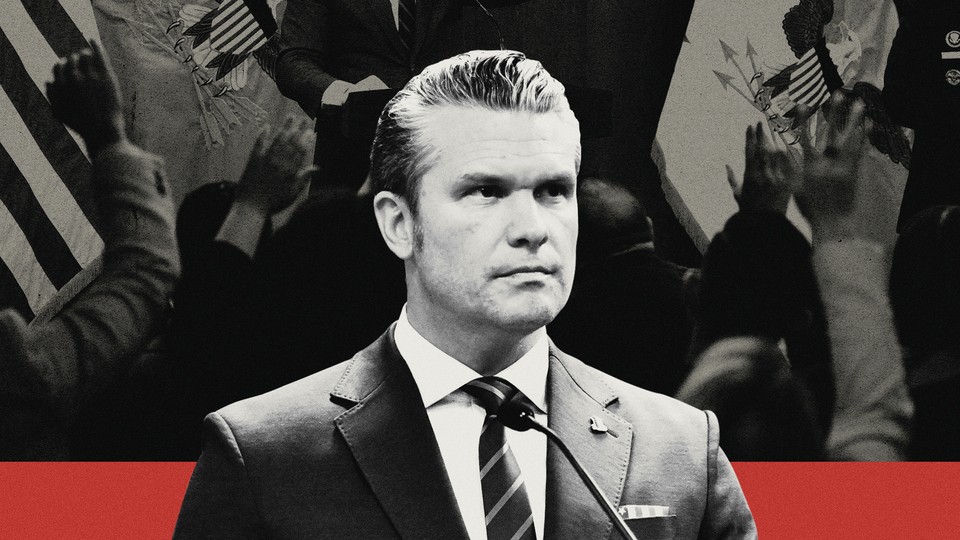
If you want to believe the Iran war is going as planned, don’t listen to the defense secretary. Illustration by Lucy Naland. Sources: Octavio Jones / AFP / Getty; Alex Wong / Getty. However well or poorly you think the excursion in Iran, as President Trump calls it, is going, you might want to lower your assessment after Pete Hegseth’s press conference today.
The defense secretary, who calls himself the “secretary of war” but might need to change his title to “excursion secretary,” addressed the public after CNN reported that the administration had erroneously assumed that Iran would keep the Strait of Hormuz open. Since the war began, Iran has mined the strait, fired on ships, choked off traffic, and caused the price of oil and other commodities to soar.
Hegseth’s response is that we shouldn’t worry our pretty little heads about a minor body of water. “They are exercising sheer desperation in the straits of Hormuz,” he said. “Something we’re dealing with. We have been dealing with it and don’t need to worry about it.”
Hegseth went on to call CNN’s report “patently ridiculous” and “fake news.” Yet when he elaborated, he seemed to inadvertently give it credence.
“For decades, Iran has threatened shipping in the Strait of Hormuz,” he said. “This is always what they do—hold the strait hostage.”
It’s true that Iran has long threatened to close the strait. The accusation is that the administration bungled by not believing that Iran would follow through on its threats. Hegseth’s blithe assurance that Iran is behaving no differently from before confirms the report that he is trying to discredit.
Hegseth’s presentation gave no remotely skeptical viewer any new reasons to trust that the administration expected the war to go as it has nor that there is a realistic plan to end it. Instead, his briefing suggests he believes that the administration’s only challenge in the Middle East is to prevent news organizations from reporting on anything but Iran’s desperation.
Hegseth is fond of the trick of using a dismissive tone while actually conceding skeptics’ main point. Returning to the topic of the strait, he casually insisted, “The only thing prohibiting transit in the straits right now is Iran shooting at shipping. It is open for transit should Iran not do that.”
Well, yes. Everybody understands why the strait is closed. Nobody is saying that the Strait of Hormuz is closed because Trump hates oil tankers. By pointing out that the enemy is to blame for doing the bad thing, he is reinforcing the suspicion that he didn’t expect the bad thing to happen.
Hegseth urged reporters to focus on more important developments, such as, “We know the new so-called not-so-supreme leader is wounded and likely disfigured.”
It’s understandable that a man who installed a makeup studio at the Pentagon and expelled photojournalists for shooting him at an unflattering angle would consider disfigurement an especially devastating strategic setback. But given that the administration has never listed making Iran’s mullahs less attractive as a primary war objective, this is a minor comfort.
Also, a small point on trash-talking: You can call him the “so-called supreme leader” or the “not-so-supreme leader,” but combining the two insults negates them both. He is not “the so-called not-so-supreme leader,” because he is not calling himself the not-so-supreme leader.
Hegseth mainly berated news outlets for failing to cover the war in the propagandistic fashion that he’d practiced as a Fox News talking head. He quoted a CNN chyron that read Mideast War Intensifies. A better chyron, he suggested, would have been Iran increasingly desperate.
In fact, a headline emphasizing Iran’s motives and state of mind would be less objective than one emphasizing what the parties to the war are actually doing. But objectivity is the opposite of Hegseth’s intent. “The sooner David Ellison takes over that network, the better,” he said, referring to the Trump ally who heads Paramount Skydance and will soon acquire CNN.
Trump seems to have used the threat of regulatory pressure to install his friends at CNN. Hegseth is openly asking the new ownership to crack down on reporting that casts an unflattering light on the administration’s behavior. Cracking down on reporting is definitely the kind of priority Trump and Hegseth would care about. But it does not seem like what they’d emphasize if the war were going smoothly.