Introducing LifeSciBench
Agentic AI systems are becoming increasingly capable of performing scientific tasks. However, their usefulness to life science researchers depends on how well they handle the complexity of real research. That work rarely looks like a single fact-recall question or a clean prediction problem. Researchers interpret incomplete evidence, reconcile conflicting results, design difficult experiments, troubleshoot assays, evaluate translational risk, and decide what to do next under uncertainty.
Current benchmarks do not fully capture these capabilities. Many life science evaluations focus on narrow domains or isolated skills, resulting in questions with structured question formats and clean reference answers. While valuable, they often fail to truly assess whether a model can contribute across the broader span of research-level work.
We designed LifeSciBench to help close this gap. Every task is grounded in the judgment of practicing life scientists with Ph.D.-level training and direct experience advancing drug discovery programs in biotech and pharmaceutical settings.
LifeSciBench includes 750 expert-authored tasks spanning seven workflows and seven biological domains.
1,062
Task artifacts
173
Scientist contributors
19,020
Rubric criteria
453
Expert reviewers
What LifeSciBench measures
LifeSciBench measures whether AI systems can support realistic life science research tasks, not just answer biology questions. To define the benchmark taxonomy, we surveyed practicing life scientists about the workflows they use most often in applied research settings. Then, we grouped their responses into seven recurring categories: evidence handling, analysis, design and optimization, scientific reasoning, validation and operations, translation, and scientific communication.
Each task is structured like a request a scientist might give to a knowledgeable collaborator: scientific prompt, any relevant context or artifacts, and a free-response answer. Expert-written rubrics evaluate whether a model can produce the right answer for a specific problem, with the right level of detail, justification, caveats, and formatting a scientist would expect.
Dataset construction
LifeSciBench evaluates scientific reasoning alongside the less well-defined, practical skills necessary for real-world scientific use. Its tasks ask models to work through realistic research problems: interpreting evidence, making domain-grounded judgments, and communicating conclusions that would be useful to expert reviewers. Many tasks also require models to handle uncertainty and reason over supporting data files rather than relying on prompt text alone.
The benchmark is designed to reflect the complexity of life science work. Overall, 79% of tasks require multiple reasoning or decision-making steps, with an average of four steps per task. LifeSciBench includes 1,062 attached artifacts spanning figures, PDFs, tables, sequence files, structure or chemical files, and web references. More than half of tasks (53%) require models to interpret or synthesize information from at least one artifact.
Tasks were created by 173 expert scientists across different life science disciplines. Each scientist had Ph.D.-level training and biotechnology or pharmaceutical industry experience. Tasks could undergo as many revision cycles as needed before acceptance, with no fixed cap on the number of rounds; accepted tasks averaged six self-directed automated review cycles and completed at least two rounds of expert reviews. Reviews were anchored in either a verifiable correct answer or strong expert consensus, with at least 90% agreement among reviewers in the relevant domain. This process helped ensure that accepted tasks were scientifically grounded, clear enough to grade, and representative of applied research.
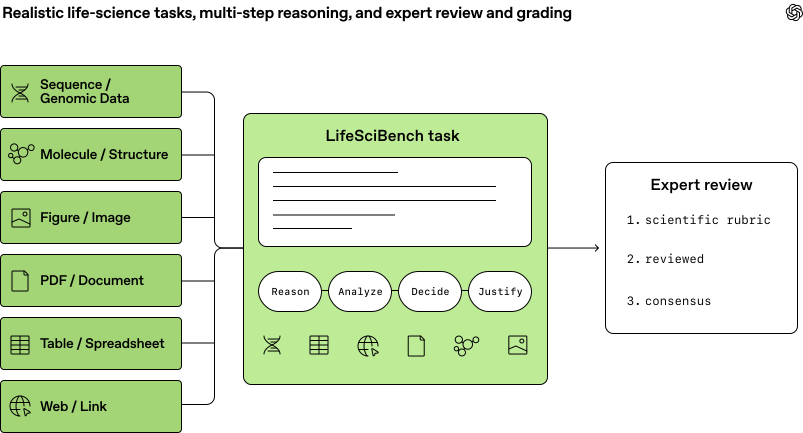
Grading and rubric breakdown
LifeSciBench tasks are graded with a detailed, task-specific rubric that breaks down the expected response into specific scientific claims, calculations, decisions, justifications, and so on. Across the benchmark, expert-developed rubrics include 19,020 criteria—an average of 25 per task—to assess both scientific correctness and usefulness for research decisions.
This design reflects how scientific work is evaluated in practice: many life science tasks cannot be graded by checking the final answer alone. A response may reach the correct high-level conclusion but still be judged incomplete if, for example, it overlooks a key assay limitation or fails to proactively bring up a highly consequential biological nuance. Conversely, a partial response may contain high-quality reasoning even if it does not fully solve the task.
The granular rubrics capture this nuance. LifeSciBench evaluates not only final-answer accuracy, but whether a model reaches its answer in a scientifically valid and operationally useful way.
Extracting, reconciling, and auditing scientific evidence from papers, figures, tables, and experimental records.
Eval Example
We’re preparing for a Type B FDA meeting on AAV9-microDys-X, an AAV9-based micro-dystrophin gene therapy for Duchenne muscular dystrophy that expresses a 138 kDa construct from an MCK promoter, and we want a hard-nosed critique of whether our current package really supports accelerated approval on micro-dystrophin expression as a surrogate endpoint reasonably likely to predict clinical benefit.
Study context: open-label Phase 1b/2 in 12 ambulatory boys age 4–7 with confirmed DMD and out-of-frame rod-domain deletions. The package is:
- Pre-treatment vastus lateralis biopsies: 0–3% of healthy-control dystrophin by quantitative Western blot using MANEX1A against the N-terminal actin-binding domain.
- 12-week post-treatment contralateral vastus lateralis biopsies: mean micro-dystrophin 38% of healthy control (range 18–61%) by the same Western blot, normalized to total protein by Coomassie staining.
- Post-treatment immunofluorescence: sarcolemmal signal in 75–95% of fibers using a polyclonal anti-dystrophin C-terminal antibody.
- 48-week function: mean NSAA change +1.4 points from baseline versus −0.6 in an external published natural-history registry cohort (p = 0.03 by unpaired t-test).
- Safety: transient transaminitis in 8/12 patients managed with steroid taper; one resolved myocarditis; no deaths.
- Biodistribution/persistence: AAV9 vector genomes detectable in muscle at 12 weeks at a mean of 2.3 vector genomes per nucleus.
- Eligibility: no baseline anti-AAV9 neutralizing antibodies (titer <1:400) and no exon-44 deletions.
Please pressure-test this package item by item: where would FDA or a skeptical reviewer say the evidence, as presented, fails to support our conclusion, and what additional data, analyses, or design changes would be needed to close those gaps if possible? For anything not specified, assume what is known from other clinical-grade 138 kDa micro-dystrophin programs and relevant clinical trials through December 31, 2025 also applies.
Candidate Response
Bottom line: As presented, this package is not strong enough to support accelerated approval on micro-dystrophin expression as a surrogate endpoint reasonably likely to predict clinical benefit. A skeptical FDA reviewer would likely view the biomarker, functional, durability, safety, and generalizability evidence as materially under-supported.
Package Item | Key Failure Mode | What Would Be Needed |
|---|---|---|
Western blot quantification | MANEX1A binds an N-terminal epitope shared by endogenous full-length dystrophin and the micro-dystrophin transgene, so the assay does not cleanly distinguish transgene from residual/revertant dystrophin. Quantifying a 138 kDa micro-dystrophin against a healthy full-length dystrophin standard is also invalid. | Use a recombinant micro-dystrophin standard and an orthogonal method that distinguishes transgene from endogenous dystrophin, such as targeted mass spectrometry or a transgene-specific/epitope-specific assay. |
Immunofluorescence | The C-terminal polyclonal antibody is poorly suited because the 138 kDa construct lacks the C-terminal domain. Many DMD patients have revertant fibers, and revertant dystrophin can retain C-terminal epitopes. Revertant fibers may expand clonally with age, biasing IF signal, especially in older boys. | Repeat IF with an antibody against an epitope present in the transgene but absent from revertant dystrophin. Quantify transgene-positive fibers separately from revertant fibers. |
Surrogate endpoint validity | The package conflates protein amount with clinical function. “38% of healthy-control protein mass” does not mean 38% of normal dystrophin function because micro-dystrophin is structurally truncated. | Empirically validate the relationship between micro-dystrophin mass-percent, sarcolemmal localization, downstream functional restoration, and clinical benefit before treating expression as a surrogate endpoint. |
Biopsy design | Pre- and post-treatment contralateral vastus lateralis biopsies introduce left-right and intramuscular spatial variability. Disease progression and fibro-fatty replacement can also change total-protein-normalized signal. | Standardize biopsy site using consistent anatomical landmarks, normalize to muscle-specific proteins, and measure fibro-fatty composition in parallel. |
NSAA comparator/statistics | An external natural-history cohort is not a randomized concurrent control. Trial eligibility, supportive care, participation effects, baseline NSAA, steroid regimen, age, and exon class can all bias the comparison. An unpaired t-test is not sufficient. Also, a +1.4 NSAA change is within test-retest variability for this age group. | Run a randomized concurrent placebo-controlled study, or at minimum use adjusted analyses accounting for baseline NSAA, age, steroid regimen, exon class, and other confounders. |
Age-window confounding | Boys age 4–7 are in a developmental window where untreated ambulatory DMD patients may gain motor function before decline dominates. A 48-week NSAA change mixes developmental gain, disease progression, and possible treatment effect. | Use a concurrent randomized control with age stratification to separate developmental trajectory from treatment effect. |
Prior clinical precedent | Open-label micro-dystrophin functional signals have not reliably predicted confirmatory benefit; published precedent includes micro-dystrophin gene therapy confirmatory trials failing to reproduce open-label NSAA improvements. | Do not rely on open-label NSAA change as decisive support. Require controlled functional evidence. |
Structural limits of the construct | The 138 kDa construct deletes spectrin repeats R16/17, which contain nNOS-binding sites. Loss of nNOS recruitment can impair functional sympatholysis and ischemia protection during exercise, creating a mechanistic ceiling on rescue independent of expression level. | Add mechanistic studies showing whether this specific construct restores relevant dystrophin-associated complex function, nNOS localization, exercise physiology, and muscle protection. |
AAV durability | Vector genomes at 12 weeks do not establish durable expression. AAV9 genomes are largely non-integrating episomes and may decline over time. Vector-genome persistence is not the same as persistent protein expression. | Measure longitudinal transgene protein expression and functional biomarker durability beyond 12 weeks. |
Immune/safety profile | Transaminitis in 8/12 patients is consistent with immune response to AAV-transduced cells, but the mechanism is not established. One myocarditis case is concerning given AAV9 cardiac tropism. | Provide deeper immune monitoring, liver/cardiac safety characterization, and intensified cardiac follow-up. |
Patient selection/generalizability | Excluding anti-AAV9 neutralizing-antibody-positive patients limits generalizability. Excluding exon-44 deletions limits applicability to that DMD subgroup. n=12 is too small to characterize safety and efficacy across the broader DMD population. | Broaden eligibility where possible or pre-specify stratified analyses by antibody status, genotype/exon class, age, and baseline function before using the result to support broad approval. |
Regulatory conclusion: The package may show biological activity, but it does not yet establish that the measured micro-dystrophin expression is a reliable surrogate reasonably likely to predict clinical benefit. The main gaps are assay specificity, invalid quantification standards, possible revertant-fiber confounding, lack of a randomized control, age-related NSAA confounding, uncertain durability, and unresolved safety/generalizability issues.
To close the gap, the program would need a controlled, age-stratified clinical design with transgene-specific expression assays, orthogonal protein quantification, tissue-composition controls, longitudinal durability data, mechanistic functional assays for the truncated construct, and stronger safety monitoring, especially hepatic and cardiac.
Rubric Criteria & Grades
Validating LifeSciBench
We validated LifeSciBench through an independent expert review. Feedback came from 453 reviewers who were not involved in writing the tasks. Of those reviewers, 97% held a Ph.D. or equivalent doctorate, with an average of 12 years of field experience and 14 peer-reviewed publications; 88% reported receiving at least one award or fellowship.
Reviewers scored whether each task reflected the qualities needed for a strong benchmark question: alignment with real-world research work, appropriate testing of scientific reasoning and domain expertise, grounding in evidence or expert consensus, and overall usefulness for assessing model performance. Agreement exceeded 96% in every category.
Real-world relevance
Does this task reflect realistic real-world life science work?
- Strong agree
- 90.4%
- Overall agree
- 98.3%
Scientific reasoning / domain skill
Does this task test and grade the right scientific reasoning and life science domain skills?
- Strong agree
- 86.4%
- Overall agree
- 98.1%
Scientific grounding
Is this task scientifically grounded, answerable, and anchored in appropriate evidence, data, artifacts, or expert consensus?
- Strong agree
- 77.1%
- Overall agree
- 96.5%