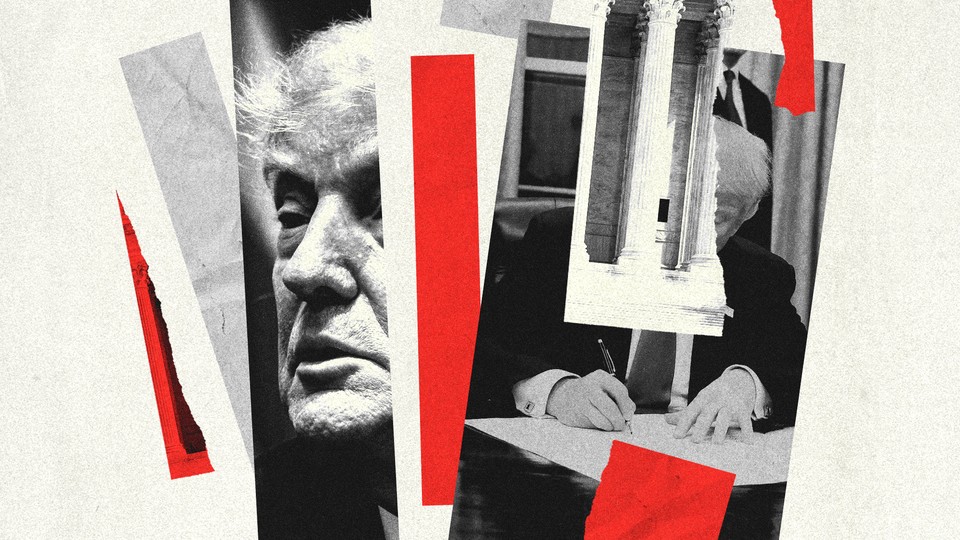
The president’s battle over presidential records is more serious than it looks. Illustration by Lucy Naland. Sources: Getty; Jim Watson / AFP / Getty; Samuel Corum / Sipa / Bloomberg / Getty. If Republicans lose control of either chamber of Congress in November, a constitutional crisis will erupt. A new Congress will ask questions about President Trump’s actions. The Trump administration will refuse to answer. The administration will argue that the Constitution grants Congress little power to order the executive to do much of anything. The executive, this administration insists, can do whatever isn’t explicitly forbidden; Congress can do only what is explicitly permitted. We know this will happen, because it’s already happening. The administration has lately been testing this “We can do anything” theory in the courts, including in the dusty domain of presidential recordkeeping.
Thanks to the 1978 Presidential Records Act, every president from Ronald Reagan onward has been required by law to preserve and protect their records during their time in office, then turn them over to the National Archives when they leave. There are some caveats and exemptions, but the mandate has long been clear: Protect records during a presidency; archive them afterward.
Few in 1978 or in the decades since have doubted Congress’s power to pass such a law, or questioned the law’s value. (On the day I finished my job as a speechwriter in George W. Bush’s White House, every piece of paper I had touched remained behind for the archivists to box and store. As a person who abhors filing above almost any other task, I personally experienced the PRA as a release and liberation.)
Presidential records were central to the political battles over Watergate. The Supreme Court ruled unanimously in United States v. Nixon in 1974 that Richard Nixon had to surrender subpoenaed tape recordings to the Watergate special prosecutor. The evidence exposed by this ruling led to Nixon’s resignation 16 days later. After he left office, Nixon alarmed Congress by claiming personal ownership of all of his records and recordings. He had already been caught once tampering with incriminating recordings (the famed “18.5-minute gap”). What would he do with the whole collection? Congress duly transferred control over the Nixon papers to the National Archives in late 1974. Nixon challenged the legality of this only to lose again at the Supreme Court in Nixon v. Administrator of General Services in 1977. That seemed to settle the matter.
Trump campaigned in 2016 as a fervent supporter of proper recordkeeping. The Democratic nominee Hillary Clinton had arguably violated federal recordkeeping laws by using a private email server to send and store messages. For this infraction, Trump led campaign-rally crowds in chants of “Lock her up!” When the rules of the Electoral College awarded Trump the presidency, he entered office with a clear mandate to uphold the highest standards of record management.
President Trump immediately betrayed the recordkeeping promises of candidate Trump. A 2017 investigation found that at least six senior Trump aides and officials—including his son-in-law Jared Kushner and his daughter Ivanka Trump—had used private accounts to transact government business. In Trump’s second term, the violations have become even more appalling. Last year, The Atlantic’s editor in chief, Jeffrey Goldberg, discovered that senior Trump officials were sharing military information of the utmost sensitivity on a private messaging app. That breach of federal-records law is unparalleled in its egregiousness. Other incidents of rule breaking keep coming to light.
Caught flouting records laws again and again, the second Trump administration is shifting to more confrontational tactics. In April, the Office of Legal Counsel in the Department of Justice issued guidance arguing that “the PRA is invalid in its entirety,” because Congress lacks the constitutional authority “to regulate or access the President’s records absent a valid legislative purpose, and no such purpose exists for the PRA.” If the Presidential Records Act is unconstitutional, the OLC guidance asserts, then the president can go ahead and ignore it.
The OLC’s guidance was signed by Assistant Attorney General T. Elliot Gaiser, a Trump loyalist who was among the lawyers who had assured the president in 2020 that Vice President Pence could block the election results from going into effect.
Gaiser’s “ignore the law” memorandum similarly broke precedent. The OLC’s job is to explain what the law is today, not to argue what the president wishes the law might become tomorrow. According to its own internal rules, the “OLC must provide advice based on its best understanding of what the law requires … even if that appraisal will constrain the Administration’s or an agency’s pursuit of desired practices or policy objectives.” If a president wishes to argue that a Supreme Court precedent should be overturned, the president can turn to his White House counsel and his solicitor general to plan a litigation strategy. But unless the president wins that case, governing law remains governing law, and the OLC is meant to offer guidance for how to obey it—except in a Trump administration, where the law is merely a suggestion.
Two nonprofit advocacy groups, American Oversight and the American Historical Association, challenged the OLC guidance in federal district court. They argued that the Trump administration should follow the law as it exists, not warp it to suit the president’s wishes. They won a partial and preliminary injunction on May 20. But this fight is just getting started.
In the Trump era, the Roberts Supreme Court has had to resolve various disputes over the norms that govern presidential behavior, triggered by a president who has rejected nearly all of them. During Trump’s first term, Congress wanted to investigate rumors of Trump tax evasion, money laundering, and business fraud. Rather than subpoena Trump himself, it sought records from his bankers and accountants, whom Trump then sued to stop them from cooperating. The Roberts Court did not resolve the issue on the merits. Instead, in Trump v. Mazarsin 2020, the Court created a complex new test to decide when and whether Congress could obtain records connected to a president. The practical effect was to set new limits on Congress’s investigative powers and to tilt the balance of power toward the president. The OLC memorandum on the Presidential Records Act duly cited Mazars some three dozen times, arguing that the ruling curbs Congress’s power to regulate executive recordkeeping.
The federal district court that ruled last month on the Presidential Records Act case ordered the White House to continue obeying the law as the law stands, pending litigation on the merits later. If and when this case reaches the Supreme Court, however, the justices may well accept the invitation to expand presidential power over White House records. The Roberts Court has already gone far to protect Trump from himself. In United States v. Trump in 2024, the Court invented a new doctrine of presidential impunity from criminal prosecution. Forbidding Congress to regulate executive paperwork hardly seems audacious for a Court that perceives a president so far beyond the reach of law.
Trump will have a lot riding on this case. A ruling in his favor would allow him to defy congressional demands for records, perhaps by not keeping any of them in the first place. He and his aides could do all their business on Signal or WhatsApp or some other private-sector device that sets messages to self-delete.
For a president who has spent much of his time in office enriching himself and his family, a Supreme Court decision that defeats the 1978 law would also be an enormous moneymaking opportunity. Trump has planned an unusual presidential library. In a complicated deal sanctioned by the Florida legislature, a Florida college has transferred downtown-Miami real estate worth at least tens of millions of dollars to the Donald J. Trump Presidential Library Foundation Inc.—for all of $10. As an educational institution, the library would be exempted from state and local property taxes, even though blueprints for it include a possible hotel and other profit-making elements. If the Supreme Court grants Trump private ownership of some or all of his records, then he will have the freedom to use them however he likes in his library. He will also be able to devise ways to monetize them—perhaps by selling access to some or suppressing or destroying others for the benefit of allies and donors.
Given just how doggedly Trump has converted public assets into private wealth throughout this term, no one should be surprised that he sees presidential records as a personal opportunity rather than a public responsibility. It will be up to the justices of a too-often-compliant Supreme Court to stop him and protect the people he—and they—theoretically serve.