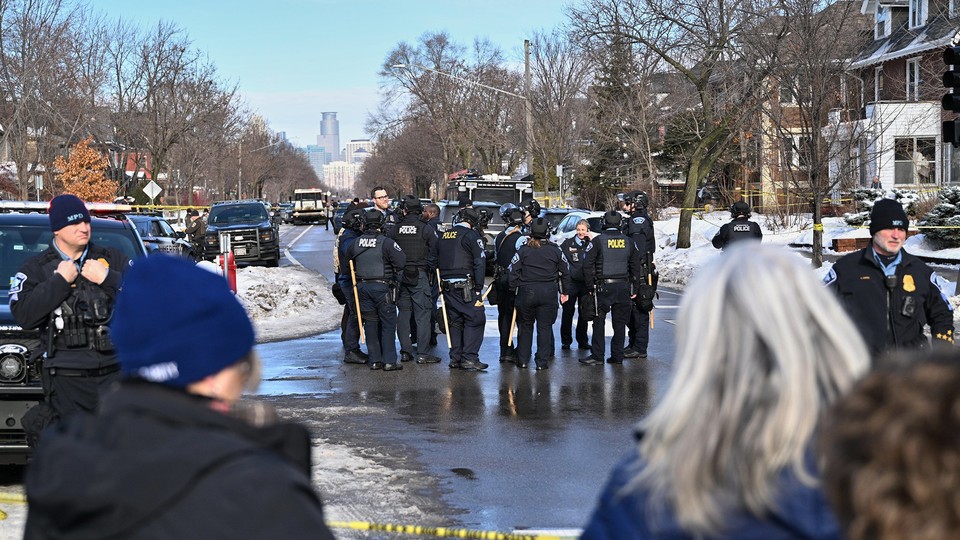
An ICE officer fatally shoots Renee Nicole Good during an immigration enforcement operation in Minneapolis, sparking controversy over use of force. The incident highlights escalating tensions under Trump's immigration crackdown and raises questions about federal agents' conduct.
Key Takeaways
•An ICE officer shot and killed Renee Nicole Good during a Minneapolis immigration operation, with videos showing her vehicle moving as officers approached.
•The shooting has intensified national divisions over immigration enforcement, with Minneapolis officials condemning ICE's actions.
•Trump administration officials defended the shooting as self-defense while labeling Good a 'domestic terrorist,' despite conflicting video evidence.
•The incident reflects broader patterns of aggressive immigration enforcement under Trump, with federal agents appearing increasingly quick to use force.
•Similar cases in other cities suggest a systemic issue with federal agents' mentality and training when deployed in urban immigration operations.
Trump’s immigration crackdown takes a dark turn in Minneapolis. Tom Baker / AP Aidan Perzana woke up to honking vehicles and looked out his window just as ICE officers surrounded an SUV. The 31-year-old data engineer told me he saw the officers moving to the side of the vehicle as the driver attempted to pull away. “There was not a thought in my mind that she was going to hit one of them,” he said. “I was surprised to hear the gunshots.”
Videos circulating on social media showed more of the confrontation. They start like so many of the chaotic clips from Chicago, Los Angeles, Charlotte, and other cities where President Donald Trump has ordered Border Patrol agents and ICE officers to ramp up arrests. Heavily armed federal agents in body armor and masks fill neighborhood streets and crowds gather; bystanders hold up cellphones; protesters blow whistles and honk car horns.
It’s not clear how Renee Nicole Good’s SUV ended up in the street between ICE vehicles—and many other details of what preceded the shooting remain unknown. In the video recordings, two ICE officers approach the 37-year-old’s car, and one attempts to open her driver’s-side door. She backs up and starts to pull away. It is in this sequence that controversy will undoubtedly flourish. A third officer, standing in front of the SUV, draws his weapon. As Good accelerates, one of the videos appears to show the vehicle clipping him. The officer shoots into her windshield and then at close range through the driver’s-side window. Good’s vehicle careens into a parked car.
Nearly six years after the killing of George Floyd in Minneapolis sparked riots and a movement for racial justice, today’s shooting, in the same city, seems like the latest chapter in the still-unfolding backlash. Trump and his aides have spent the first year of his presidency demonstrating their willingness to use force against those who opposed his policies—whether at home or abroad. Federal agents carrying out Trump’s immigration crackdown have appeared more and more jumpy, and quicker to point their weapons at protesters and cars. Trump has deployed border agents to cities deep within U.S. territory, and he has demanded that ICE officers boost their arrest and deportation numbers to levels they’ve never had to meet before. He has seemed to delight in every opportunity to escalate tensions between the federal forces he leads and some of the people he routinely casts as his enemies: blue-state and city leaders.
The shooting today orphaned Good’s 6-year-old son, whose father died in 2023, TheMinnesotaStar Tribune reported. It also appeared destined to aggravate the nation’s already-raw divisions over immigration enforcement. Jacob Frey, the Minneapolis mayor, erupted at ICE at a press conference hours after the shooting. “This was an agent recklessly using power that resulted in somebody dying,” Frey said, telling ICE to “get the fuck out of Minneapolis.”
Trump has ordered nearly 2,000 federal agents to Minnesota in recent weeks to make immigration arrests and hunt for cases of fraud involving immigrants. The investigations, which focus on Minneapolis’s Somali community, have upended state politics, prompting Governor Tim Walz this week to scrap his plans to run for reelection.
Within hours of today’s shooting, the FBI and Minnesota authorities announced a joint investigation. Former ICE officials and a few attorneys I spoke with said it was too early to say whether state officials will try to charge the ICE officer. They said such cases are rare when the incident involves an officer carrying out their federal duties. Minnesota Attorney General Keith Ellison, who is considered a possible candidate for governor, released a statement after the shooting, saying he would “continue to do everything in my power to oppose this brutality, ensure justice is served, and keep Minnesotans safe.” But he made no mention of the state’s role in the investigation, or of any possible criminal prosecution.
A 2023 DHS memo authorizes the use of deadly force on suspects who are fleeing if an officer “has a reasonable belief that the subject poses a significant risk of death or serious physical harm” to the officer or others. Under ICE’s rules of engagement, officers are allowed to use force if they reasonably believe their lives are in immediate danger from a weapon, including a vehicle trying to strike them.
Administration officials immediately began attacking Good, though many of their statements were at odds with what the bystander videos showed. Department of Homeland Security officials labeled her a “domestic terrorist,” and Trump said on social media that she “violently, willfully, and viciously ran over the ICE Officer” as she attempted to drive off. “The situation is being studied, in its entirety, but the reason these incidents are happening is because the Radical Left is threatening, assaulting, and targeting our Law Enforcement Officers and ICE Agents on a daily basis,” he said.
Addressing reporters this evening in Minneapolis, DHS Secretary Kristi Noem said the officer who shot Good was an experienced ICE veteran who “followed his training” and acted in self-defense. She said he and other officers were being harassed by “agitators,” including Good, who had been “stalking and impeding them.” (In Minneapolis, as in other cities where ICE activity has surged, pro-immigrant activists often drive around honking and blowing whistles to create a kind of rolling community alarm system.) Noem said the officer had been struck and dragged by a vehicle during a previous incident over the summer. She said he was treated today at a hospital for unspecified injuries from Good’s vehicle, then released.
Noem, in her remarks, made reference to the fury in Minneapolis after Floyd’s killing in order to take a swipe at Walz and Frey. “This city has burned before. And your governor and your mayor let it happen,” she said. “President Trump is not going to let that happen.”
One veteran ICE official I asked about the video, who was not authorized to speak with reporters, told me that because the officer was in front of Good when she began to drive toward him, “it would be authorized if he reasonably believed he might be hit.”
John Sandweg, an attorney who was acting ICE director during Barack Obama’s first term, told me the videos raise “serious questions about the reasonableness of the shooting.”
“As with every officer-involved shooting, but especially one like this, there has to be a comprehensive investigation,” he said. “Of course, given the lack of any investigation, the DHS rush to judgment is incredibly irresponsible and only fosters more distrust between the public and ICE.” That, he said, is ultimately “undermining the agency’s effectiveness.”
“I’m up for another round of fuck around and find out,” the Border Patrol agent Charles Exum told his buddies in a group chat on October 5, the day after he shot Marimar Martinez five times as she drove on a Chicago street. Martinez, a U.S. citizen, survived the bullets. But she was arrested and charged with attempting to ram Exum’s vehicle. DHS officials accused Martinez of trying to ambush agents conducting Trump’s Chicago immigration crackdown, Operation Midway Blitz, calling her a “domestic terrorist.”
Cellphone records and body-cam video began to puncture the government’s claims in the weeks that followed, and in November the Department of Justice dropped the charges against Martinez and walked away from the case. But the Trump administration’s combative approach to immigration enforcement continued unabated.
Chris Parente, a former federal prosecutor in Chicago who defended Martinez, told me the group-chat messages among Border Patrol agents that became evidence in her case were “an inside look into the mentality of those people that are now patrolling the streets of Minneapolis and will continue to go into other communities across the country.”
They are out of their element, asked to take on a mission for which they are ill-equipped. They are facing constant pressure from activists and protesters. And they’re being given crude encouragement by their leaders to treat those protesters as threats to their lives.