Japan 2-Year Bond Sale Passes Without Drama Amid BOJ Speculation
TL;DR
Japan's 2-year bond auction proceeded smoothly despite mixed signals on BOJ rate hikes. Demand was decent but weaker than previous auctions, with investors weighing hawkish BOJ comments against dovish political appointments.
Key Takeaways
- •Japan's 2-year bond auction passed without issues with a bid-to-cover ratio of 3.32, below the previous 3.88 but showing adequate demand.
- •Market sentiment remains divided on BOJ rate hike timing due to conflicting signals from Governor Ueda (hawkish) and Prime Minister Takaichi's appointments (dovish).
- •Shorter-dated bonds like 2-year notes attract diverse investors and are supported by surplus cash and BOJ collateral needs.
- •Tokyo inflation easing to a one-year low creates communication challenges for the BOJ as it considers further rate hikes.
- •Upcoming bond auctions and BOJ speeches will provide further clues on market sentiment and rate hike expectations.
Tags
Japan’s two-year government bond auction passed through smoothly as investors mull the Bank of Japan’s rate-hike path.
The bid-to-cover ratio at Friday’s sale was 3.32 versus 3.88 at the last auction and a 12-month average of 3.58. Japan’s bonds held gains after the sale.
Shorter-maturity bonds were sold while the yen strengthened Thursday after an interview with BOJ Governor Kazuo Ueda in the Yomiuri newspaper was seen as reiterating the central bank’s rate-hike path. That reversed moves seen on Wednesday after Prime Minister Sanae Takaichi nominated two new monetary policy board members who are seen as dovish.
“The auction had decent demand,” said Miki Den, a senior rates strategist at SMBC Nikko Securities. “While the next rate hike by the BOJ is seen as possible, there are growing views that another hike after that would be difficult under the Takaichi administration.”
Traders have been trying to gauge Takaichi’s stance on rate hikes after her historic election victory earlier this month — particularly after the Mainichi newspaper reported that she voiced apprehension over further monetary tightening in a meeting with Ueda.
“Regarding the BOJ’s rate hikes, views are mixed,” said Katsutoshi Inadome, a senior strategist at Sumitomo Mitsui Trust Asset Management. “Some see the timing as having been pushed back because Takaichi expressed reluctance toward rate hikes, while others point to Ueda’s comments supporting expectations of an earlier move.”
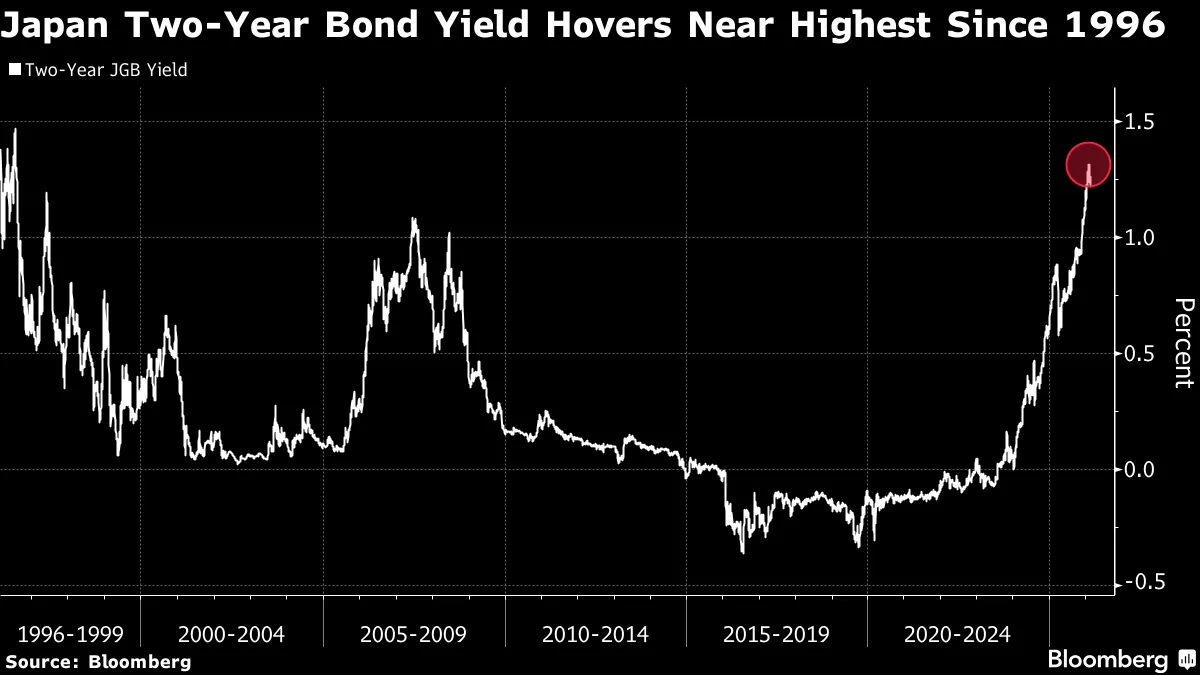
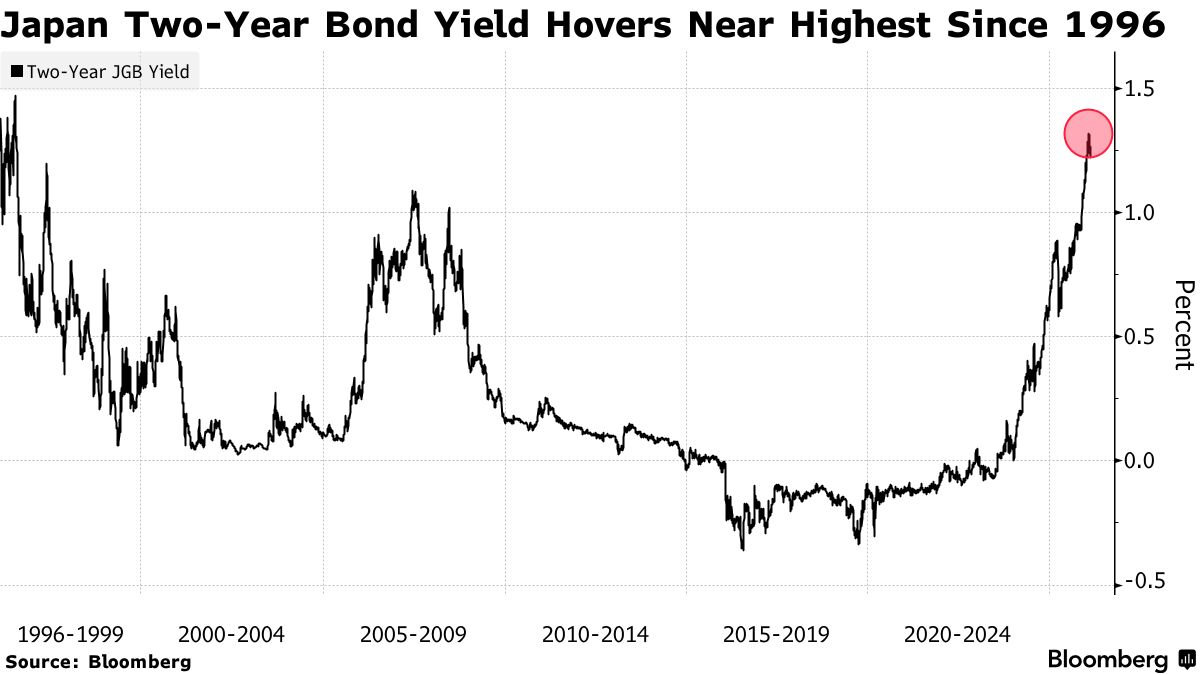
The two-year rate, which is sensitive to monetary policy expectations, is hovering around 1.23%, near its highest level since 1996 hit earlier this month. Shorter-dated bonds attract a wider range of investors, from regional banks to asset managers, and demand is underpinned by surplus cash and collateral needs for BOJ operations.
The swap market shows about a 70% chance of a rate hike by April. The BOJ’s most hawkish board member Hajime Takata renewed his call for raising the benchmark interest rate on Thursday, describing the nation’s once-frozen inflation trend as heated to the core.
What Bloomberg strategists say:
The demand for today’s 2-year auction is weaker than the previous month, but just enough to meet the passing grade. Given that Tokyo CPI core inflation was higher than estimated, it is a solid outcome.
With dollar-yen calming into a 154-to-157 range it will help to support bonds in the secondary market. Moreover, more than 33% of the bonds were bought by two big Japanese financial institutions.
— Mark Cranfield, Markets Live Strategist. Read more on MLIV.
Meanwhile, a Tokyo inflation gauge out Friday eased to the slowest pace in more than a year as Takaichi’s utility subsidies curbed household energy costs, posing a communication challenge for the BOJ as it looks to proceed with interest rate hikes.
Next week will provide more clues on sentiment with sales of 10- and 30-year government bonds. Ahead of the auctions, investors will be watching BOJ Deputy Governor Ryozo Himino’s speech on Monday for hints on the timing of the next rate increase.
“Communication between the Takaichi administration and the market has once again become strained,” said Sumitomo Mitsui’s Inadome. “From next week onward, there is a possibility that concerns over fiscal expansion could resurface in the bond market.”