The Iranian regime faces potential collapse as it meets five key conditions for revolution: severe fiscal crisis, divided elites, diverse opposition coalition, compelling resistance narrative, and unfavorable international environment. Widespread protests reflect deep economic despair and loss of regime legitimacy.
Key Takeaways
•Iran meets five critical conditions for revolution: fiscal crisis with hyperinflation, elite alienation, diverse opposition coalition, compelling nationalist narrative, and hostile international environment.
•The regime's legitimacy has eroded due to economic mismanagement, corruption, and ideological hypocrisy, alienating both the public and traditional elite supporters like bazaar merchants.
•While security forces remain loyal, the regime's survival depends on their continued support; their potential defection could trigger immediate collapse.
•The opposition movement has unified around nationalist sentiment rejecting the regime's regional adventurism in favor of domestic priorities and 'normal life'.
•International isolation and strategic defeats have left the regime vulnerable, with key allies weakened and the U.S. adopting a more confrontational stance.
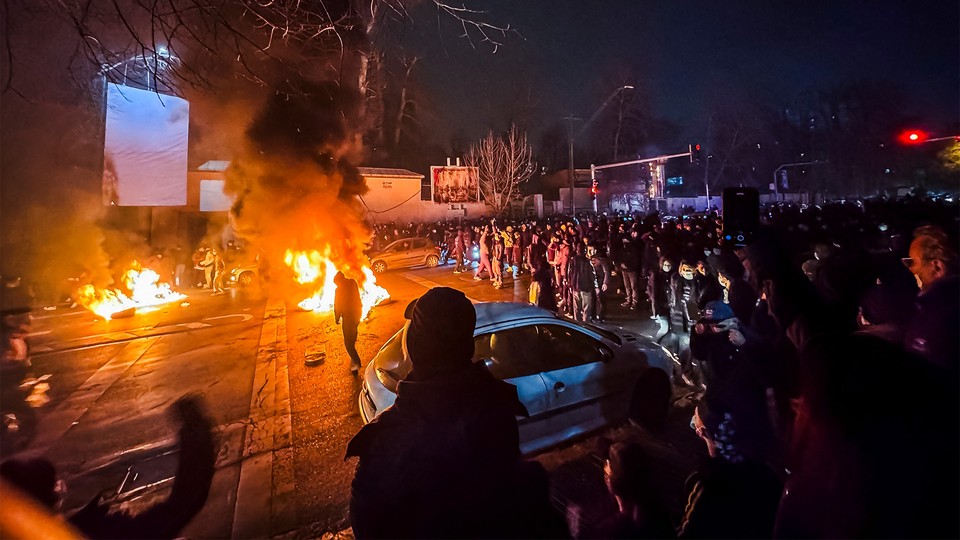
Five conditions determine whether revolutions succeed. For the first time since 1979, Iran meets nearly all of them. MAHSA / Middle East Images / AFP / Getty Forty-seven years ago, Iran had a revolution that replaced a U.S.-allied monarchy with an anti-American theocracy. Today, the Islamic Republic of Iran may be on the verge of a counterrevolution.
History suggests that regimes collapse not from single failures but from a fatal confluence of stressors. One of us, Jack, has written at length about the five specific conditions necessary for a revolution to succeed: a fiscal crisis, divided elites, a diverse oppositional coalition, a convincing narrative of resistance, and a favorable international environment. This winter, for the first time since 1979, Iran checks nearly all five boxes.
In the past week, protests have engulfed Iranian cities, their momentum growing daily. These began as a response to a fiscal crisis: a national currency in free fall, a state with empty coffers. In American politics, inflation rates of more than 3 percent tend to bring down administrations. Iran’s inflation rates—more than 50 percent across the board, 70 percent for food—are among the world’s highest. Over the past year, Iran’s currency has fallen more than 80 percent relative to the dollar. In 1979, a single U.S. dollar was worth 70 Iranian rials; today, it’s worth 1.47 million rials, a depreciation of more than 99 percent. Iranian currency has become less a medium of exchange than a daily index of national despair. And unlike past economic crises, this collapse has crossed all class lines, affecting bazaar merchants and the well-off as well as the poor.
Iran has 92 million inhabitants, perhaps the largest population in the world to have been isolated for decades from the global financial system. In addition to inflation, the country suffers from endemic corruption, mismanagement, and brain drain. Young Iranians contend with high rates of unemployment and underemployment; older generations have found their pension funds to be largely insolvent. Renewed global sanctions and the dwindling price of oil—down 20 percent in the past year—have forced Tehran to sell its oil to China at a backbreaking discount. Power outages and water rationing have become fixtures of daily life.
The second condition for state breakdown—the alienation of the elite—is also widely evident in Iran. What began in 1979 as a broad ideological coalition has, by 2026, contracted into a one-man party: the party of Ali Khamenei. Mir Hossein Mousavi, a founding father and the former prime minister of the Islamic Republic, is in his 15th year of house arrest. Every living former president has been silenced or sidelined: Mohammad Khatami is under a total media ban, Mahmoud Ahmadinejad is marginalized and monitored, Hassan Rouhani was barred from seeking a seat in the 88-member Assembly of Experts (the clerics who choose the next supreme leader).
The regime has been hollowed out by decades of negative selection—the result of rewarding mediocrity and prizing ideological loyalty over competence. The effect has been to alienate the professionals and technocrats who once provided the state with its administrative backbone. Replaced by sycophants and suffocated by the clergy’s interference in daily life, this class has long since lost faith in the system. It sees its wealth eroded by inflation, and the country ruined by incompetence—a failure now undeniable in the mismanagement of Tehran’s water supply.
Much like the Soviet Union of the 1980s, the Islamic Republic has mostly lost its convictions. Only a small percentage of its insiders remain true believers; the majority are motivated by wealth and privilege. One Tehran-based political-science professor we spoke with put a finer point on this: “At the beginning of the revolution, the regime was 80 percent ideologues and 20 percent charlatans. Today, it is the reverse.”
Bazaar merchants played a pivotal role in the 1979 revolution, serving for years as a core constituency and economic base for the Islamic Republic. But in recent decades, the regime has built the Islamic Revolutionary Guard Corps into a military-industrial complex from which networks of wealth and power flow. Siamak Namazi, an Iranian American businessman held hostage by the regime for eight years, compared the Iranian state to “a collection of competing mafias—dominated by the IRGC and its alumni—whose highest loyalty is not to nation, religion, or ideology, but to personal enrichment.” This system has not only weakened the regime’s ideological cohesion but also displaced the traditional merchant class, turning the bazaar from a pillar of support into a source of dissent.
Still, one group of elites remains united: the country’s security forces. Their solidity has, until now, prevented the Islamic Republic’s collapse. No senior IRGC commanders have defected as yet or voiced even mild public criticism of Ayatollah Khamenei, despite years of nationwide protests and the targeted Israeli assassination of nearly two dozen senior figures in their ranks. For many of these commanders, losing power would mean losing wealth and potentially their life. They would likely be the last leaders to turn against the regime. But if they did, the regime would not survive.
Iran clearly meets the third criterion: The Islamic Republic’s political, economic, and social authoritarianism has created a diverse oppositional coalition in response to perceived injustice. Over the past decade, intermittent mass protests have drawn participants from virtually every socioeconomic class, including ethnic minorities on the periphery of the country, labor movements, women, and bazaaris. These groups have rarely coordinated their efforts or protested in unison. But many of their reasons for outrage are broadly shared.
The Islamic Republic is a theocracy that claims to rule from a moral pedestal. For this reason, examples of its graft and hypocrisy are particularly galvanizing. IRGC commanders oversee the brutal enforcement of the veiling of women—but their daughters and mistresses are spotted overseas without hijab. The country is suffering from a severe water shortage—and many Iranians believe that a “water mafia” linked to the IRGC is diverting resources to their own industrial projects while entire villages are left to die of thirst. The children of thousands of senior officials advertise their lives in Western cities on Instagram and LinkedIn. Protesters in the city of Yasuj recently chanted, “Their children are in Canada! Our children are in prison!”
The opposition movement has shown that it can mobilize widespread fury, but to succeed, it will need to move beyond mobilization and forge links with disgruntled elites. Some of these technocrats and marginalized insiders feel alienated but are too afraid to act because of what may await them the day after. The opposition needs to offer a credible safe exit for these regime insiders, convincing them that the Islamic Republic is no longer their shield, but their shroud.
Revolutions arise when rulers become weak and isolated; when people believe themselves to be part of a numerous, united, and righteous group that can act to create change; and when political elites begin to attach themselves to the people, abandoning the government rather than defending it. In Iran, thus far, the last ingredient has been missing.
The fourth condition for state breakdown is a convincing shared narrative that bridges a nation’s socioeconomic, geographic, and ideological divides. In Iran today, the regime’s founding principle of pan-Islamic revolutionary ideology has been supplanted by a fierce, corrective nationalism. The state’s shopworn mantras of “Death to America” and “Death to Israel” are being drowned out by a demand for national self-interest: “Long live Iran.” This is not merely a change in tone, but a total rejection of the regime’s regional adventurism, punctuated by the now-ubiquitous protest chant: “No to Gaza; no to Lebanon; my life only for Iran.”
Beyond a surge in nationalism, Iranians have grown immune to the hollow ideological slogans and performative piety of a self-appointed “moral” state. A population largely born after the 1979 revolution seeks, above all, zendegi-e normal—a “normal life,” liberated from a regime that micromanages people’s attire, intimacy, and private choices. By delegitimizing the Islamic Republic as an occupying force—one that plunders national wealth to subsidize regional proxies—the opposition has effectively subverted the regime’s nationalist rhetoric.
Every successful revolution requires both inspirational and organizational leadership. Many of the protesters in Iran’s 2026 uprising have rallied behind former Crown Prince Reza Pahlavi, who has lived in exile since 1979. Leading an opposition from exile and restoring a deposed monarchy are both daunting, but neither is unprecedented. Vladimir Lenin in Russia, Ho Chi Minh in Vietnam, and Ayatollah Ruhollah Khomeini in Iran all spent more than 15 years in exile before returning to lead revolutions that toppled the regimes that had banished them. Several countries that once abolished their monarchies—including Spain, Cambodia, and Britain (under Oliver Cromwell)—later restored them as constitutional monarchies.
As Iranians know well from 1979, ruthless contests tend to define revolutions. Having spent nearly half a century abroad, Pahlavi has not yet organized the on-the-ground muscle needed to prevail in such a contest. He also faces a deeper question: What kind of order do Iran’s monarchists aspire to establish? Pahlavi has consistently said that his goal is to help Iran transition to democracy—and perhaps to serve as a constitutional monarch if chosen by the people. Yet many of his most passionate supporters are vocal about restoring an absolute autocracy. This tension has inhibited his ability to flip disaffected elites against the regime.
Yet ironically, among the broader population, this ambiguity could work in his favor. Revolutionary ideologies need not provide a precise future plan to unite and motivate their followers. On the contrary, what often works best are vague or utopian promises of deliverance, combined with an emotionally powerful depiction of the intolerable injustice and inescapable evils of the current regime.
The final and decisive catalyst for revolution is an international environment that helps sink the regime rather than bolster it. After North Korea, Iran may be the most strategically isolated country in the world. Over the past two years—since Hamas’s October 7, 2023, attack on Israel, which Ayatollah Khamenei alone among major world leaders openly endorsed—Iran’s regional proxies and global allies have been decimated or deposed.
For decades, Tehran projected strength through its so-called Axis of Resistance, a network of nearby proxies and autocratic allies. But following the devastating 12-day war in June, that deterrent has been degraded. With Hezbollah’s and Hamas’s leadership in disarray and Israeli jets maintaining a humiliating, virtually uncontested presence over Iranian airspace, the regime is strategically naked before its people—exposed by an empty treasury and an unprotected sky.
Syria’s Bashar al-Assad and Venezuela’s Nicolás Maduro are no longer in power. Vladimir Putin is consumed fighting a war in Ukraine. China—the destination for 90 percent of Iran’s oil exports—has proved to be a predatory partner. Donald Trump dropped 16 bunker-busting bombs atop Iran’s nuclear facilities, largely destroying an enterprise that—between sunk costs, sanctions, and lost oil revenue—had cost the nation more than half a trillion dollars. Moreover, in contrast to past U.S. presidents who were reluctant to enter Iran’s political fray, Trump has warned the Islamic Republic that if it massacres protesters, the United States is “locked and loaded” to respond.
Observers of the current protests ask: What is different this time? The answer is that the breadth of the economic collapse and the disastrous defeat in the 12-day war have shown all Iranians that the regime is no longer capable of providing them with basic economic or military security. Why tolerate a state that enriches itself but cannot fulfill the most elemental state functions?
When the five conditions coincide—economic strain, alienation and opposition among the elites, widespread popular anger at injustice, a convincing shared narrative of resistance, and favorable international relations—the normal social mechanisms that restore order in a crisis are unlikely to work. The society’s equilibrium has been profoundly disrupted and can easily tip into escalating popular revolts and open elite resistance, producing a revolution.
The Islamic Republic is today a zombie regime. Its legitimacy, ideology, economy, and top leaders are dead or dying. What keeps it alive is lethal force. The most important element still missing from a full revolutionary collapse is the repressive forces deciding that they, too, are no longer benefiting from, and hence no longer willing to kill for, the regime. Brutality can delay the regime’s funeral, but it’s unlikely to restore its pulse.