Jupiter from the Webb Space Telescope
AI Summary2 min read
TL;DR
Webb's infrared image of Jupiter reveals cloud differences, auroras, moons, and magnetic effects, with bright objects causing diffraction streaks. It's the largest space telescope, orbiting near Earth.
Tags
JupiterJames Webb Space Telescopeinfrared imagingastronomyNASA
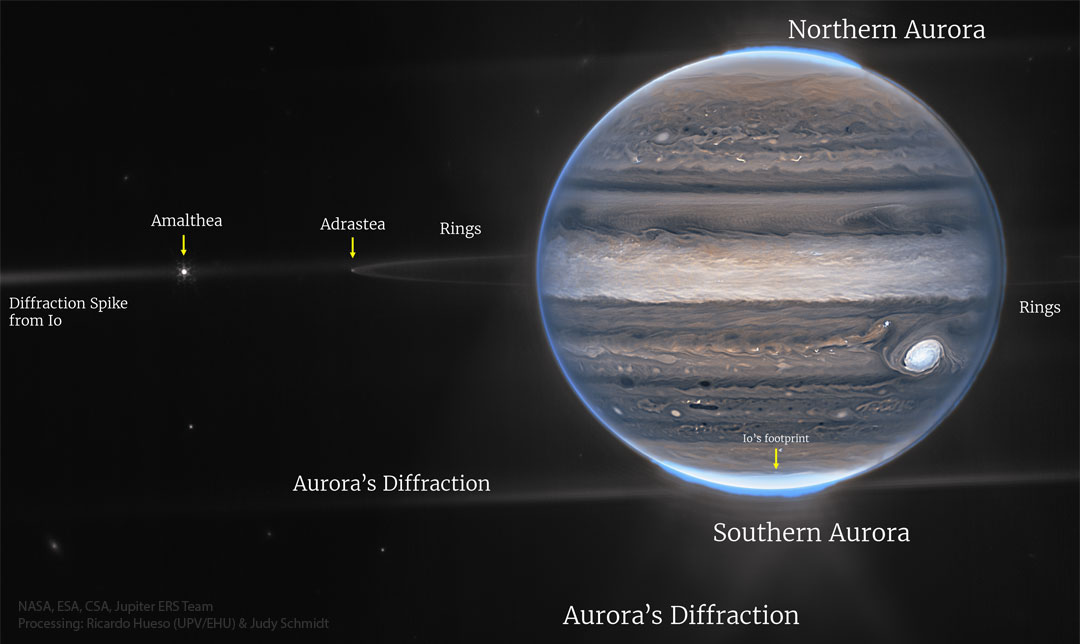
Jupiter from the Webb Space Telescope
Image Credit: NASA, ESA, CSA, Jupiter ERS Team; Processing: Ricardo Hueso (UPV/EHU) & Judy Schmidt
Explanation: This infrared view of Jupiter by Webb is illuminating. High-resolution infrared images of Jupiter from the James Webb Space Telescope (Webb) reveal, for example, differences between high-floating bright clouds -- including the Great Red Spot -- and low-lying dark clouds. Also clearly visible in the featured Webb image are Jupiter's dust ring, bright auroras at the poles, and Jupiter's moons Amalthea and Adrastea. The footprint of large volcanic moon Io's magnetic funneling of charged particles onto Jupiter is also visible in the southern aurora. Some objects are so bright that light noticeably diffracts around Webb's optics creating streaks. Webb, which orbits the Sun near the Earth, has a mirror over six meters across making it the largest astronomical telescope ever launched -- with over six times more light-collecting area than Hubble.