The Diplomats Who Carry Trump’s Grievances Abroad
TL;DR
Some of President Trump's ambassadors are causing diplomatic conflicts by prioritizing his personal grievances over professional diplomacy, leading to tensions with allies like France, Poland, and Israel.
Key Takeaways
- •Trump's ambassadors often engage in unprofessional behavior that damages U.S. relations with allies.
- •Appointments like Charles Kushner in Paris appear intentionally provocative, undermining traditional diplomacy.
- •Diplomatic incidents range from refusing summons to making inflammatory statements about host countries.
- •These actions reflect a broader pattern of using ambassadorships to insult or challenge allied nations.
- •The lack of qualified envoys risks America's global standing and alliance stability.
Tags
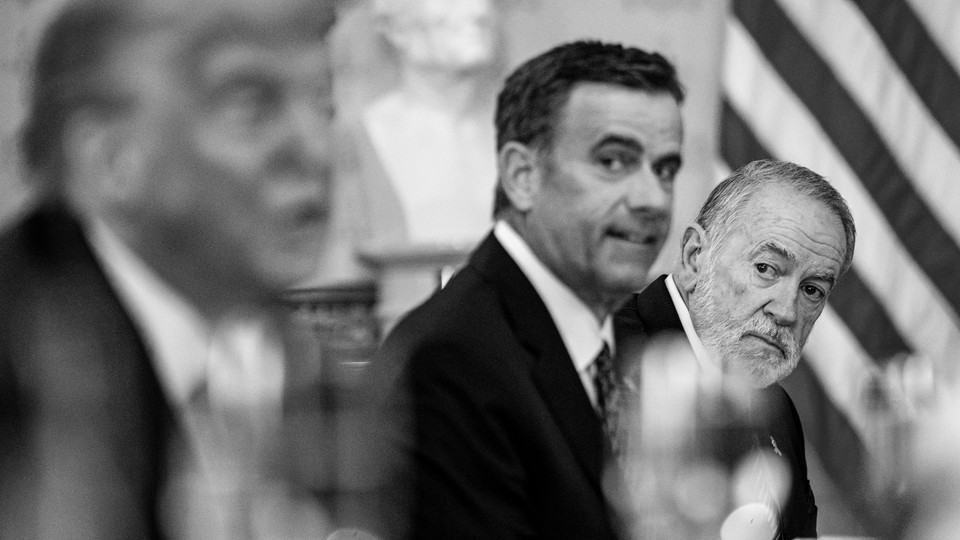
American diplomats are supposed to represent the nation, advocate for the interests and policies of the U.S. government, and stay on generally good terms with the country to which they’re assigned. Even when they are sent to places that have an adversarial relationship with the United States, they are expected to maintain decorum while conveying messages these regimes may not want to hear.
Some of President Trump’s ambassadors, however, are a different type: They seem to think that their job is to carry their boss’s boorishness and petty grievances abroad. Ambassadors are supposed to represent the president, but these incompetent emissaries take that concept to an extreme, and they have managed to get into needless conflicts with America’s friends in France, Poland, Iceland, and Chile, among others, along with pretty much the entire Middle East.
The most recent example is from Paris, where U.S. Ambassador Charles Kushner refused a summons this week from the French government. Summoning an ambassador is a standard diplomatic action; it usually happens when a host government wants clarification about, or to express displeasure over, something an ambassador’s nation has done or said. In this case, the State Department had injected itself into the aftermath of the far-right French activist Quentin Deranque’s murder by posting on X that he was killed by violent leftists. The French government regarded this as interference in its internal affairs and called in Kushner, who then refused to show up—the second time that he’s refused such a summons. This is a serious snub, especially among allies.
France then prohibited Kushner from meeting with any French government official, which escalated the feud far beyond the initial problem, and …
Wait. Charles Kushner is, in fact, Jared Kushner’s father, and he did time in federal prison for a slew of tax violations and other offenses (including an incident of witness retaliation in which he hired a prostitute to seduce his brother-in-law and then sent a video of the encounter to his own sister). So you might be asking an obvious question here: Why is this convicted felon and the father of the president’s son-in-law an ambassador to a major U.S. ally?
The choice is meant to be offensive—that’s why. As the professor and historian Ruth Ben-Ghiat, who studies authoritarianism, posted on X: Kushner “was put there as a (pardoned) felon to symbolize the death of democratic notions of diplomacy in the US. This thuggish individual was installed in Paris as an act of aggression towards democratic France.”
Meanwhile, America’s man in Warsaw, Ambassador Tom Rose, said earlier this month that he would have “no further dealings, contacts, or communications” with Włodzimierz Czarzasty, the speaker of the lower house of the Polish Parliament. Rose objected, in his words, to “outrageous and unprovoked insults directed against President Trump.”
What were these insults? Rose didn’t specify, but a few days earlier, Czarzasty had had the temerity to say that Trump did not deserve a Nobel Peace Prize. A Polish politician in his own country expressed an opinion, and the U.S. ambassador took it upon himself, like a scorned teenager blocking a phone number, to say that he and the Polish legislator were no longer on speaking terms with each other. Much like the French foreign minister reminding Kushner that he has an “apparent misunderstanding of the most basic expectations” of his job, Polish Prime Minister Donald Tusk gently noted on X: “Mr. Ambassador Rose, allies should respect, not lecture, each other.”
But insulting our allies is Trump’s brand of diplomacy. In Ottawa last year, Pete Hoekstra, a former representative who is now the U.S. envoy to Canada, delivered a Trumplike—and expletive-laced—tirade criticizing Canada and defending the president’s tariffs. Likewise, the American ambassador in Chile, a former Border Patrol agent named Brandon Judd, managed to annoy Chile’s president by taking umbrage at criticism of Trump and saying that such remarks “harm the Chilean people.” And over in Reykjavik, the former member of Congress Billy Long managed to irritate everyone with a dumb joke about making Iceland the 52nd state. (After Greenland—get it? Long later apologized.)
But the king of ambassadorial buffoonery is former Arkansas Governor Mike Huckabee, an evangelical Christian who is now America’s ambassador in Jerusalem. Last week, he gave a lengthy interview to Tucker Carlson. (The ambassador to Israel talking to Carlson, a man who platforms Holocaust deniers, is more evidence that ghastly anti-Semitic views are no longer unwelcome in the GOP.) During their discussion, Huckabee and Carlson somehow got onto the question of who owns the Middle East, and for once, an American ambassador didn’t insult his host country—he just enraged the hundreds of millions of people who live near the host nation.
Carlson asked whether Huckabee agrees that God, in the Bible, gave the region—“I think it says from the Nile to the Euphrates, which is, once again, basically the entire Middle East”—to the Jewish people. “You’re saying he did,” Carlson concludes.
Huckabee then hauled off this banger: “It would be fine if they took it all, but I don’t think that’s what we’re talking about here today.”
Matters did not improve when Carlson followed up, asking Huckabee whether he really meant that “it would be fine if the state of Israel took over all of it.” Huckabee missed the life preserver that Carlson tried to throw his way: “They don’t want to take it over,” he answered. “They’re not asking to take it over.”
Well, thanks for that clarification, ambassador. Of course, the region lit up with fury once an American diplomat—posted to Jerusalem, no less—said that he’d be just fine with giving the whole place to the Israelis. Huckabee tried to walk back what he admitted was a “hyperbolic” statement, and the U.S. embassy in Jerusalem quickly tried to clean up the mess. But all of this raises the question of why Trump is sending such unqualified and potentially dangerous people to important postings around the world.
In fairness to Trump, a lot of nations have sent plenty of scandalous embarrassments abroad as envoys—and Trump is not the first U.S. president to reward friends and supporters with these cushy gigs. But Trump has elevated diplomatic incompetence to an art. Aside from letting Huckabee loose in the Middle East, he sent an unqualified loyalist, Matthew Whitaker, to NATO. He also stashed his son’s ex-girlfriend Kimberly Guilfoyle in the embassy in Athens. And even in smaller and less complicated postings, Trump has made wince-inducing choices: America’s ambassador to the Bahamas is Herschel Walker, a former football player whose campaign for the U.S. Senate in Georgia imploded because of scandals and the candidate’s obvious incompetence. What’s Trump got against the Bahamians?
Of course, the insults are the point. Trump seems to have a special loathing for our allies. He has used some of these appointments as a middle finger to states and organizations that he does not understand. He likely views some of them as impediments to his plans and schemes—such as, say, Norway, which he thinks is responsible for shutting him out of the Nobel Prize competition. What better way to stick it to those uppity French than by sending a convicted felon? Why not saddle NATO with a guy who has no foreign-policy experience?
Trump and his supporters might think it’s a hoot to watch Europeans seethe while Ambassador Kim Guilfoyle eats baklava and strolls under the shadow of the Acropolis, but America needs competent representation in the world’s capitals, especially when contemplating risky policies. Last week, General Dan Caine reportedly expressed concern about going to war with Iran while the country’s alliances are not in order. He may have been thinking not only of the damage done by Trump’s approach to foreign relations but also about the crew of bumblers and hangers-on whom the president has sent to represent America around the world.
Related:
Evening Read
Boredom Is the Price We Pay for Meaning
By Daniel Smith
When my first child was born, I discovered, as many new parents do, that my love for her was more profound than I could have anticipated. I had friends and relatives for whom I was willing to die. For my daughter, so visceral was my love, so instantaneous and complete, I knew I would kill.
That I loved my daughter was never in doubt. My problem was that I didn’t much like being a father. This came as a shock. I’d wanted a baby because I had taken such pleasure in life that I’d felt driven to expand the scope of existence itself. Experience was too wonderful to hoard, so I had a child. The irony was painful in that, seemingly overnight, the very things that most enlivened and sustained me—reading, watching movies, seeing friends, making love, sitting quietly by myself—were crowded out by a child whose needs absorbed nearly all of my energy and time. From a life of freedom and agency I had entered a life of constriction and tension, of white-noise machines, parenting manuals, and fatigue.
Read the full article.More From The Atlantic
Explore. On Netflix’s hit dating show Love is Blind, stealth misogyny gets its big reveal, Megan Garber writes.
Reminisce. The editor Ann Godoff, who died this week, cared passionately about her writers—and much less about her own ego, Franklin Foer writes.
Play our daily crossword.
Rafaela Jinich contributed to this newsletter.
When you buy a book using a link in this newsletter, we receive a commission. Thank you for supporting The Atlantic.