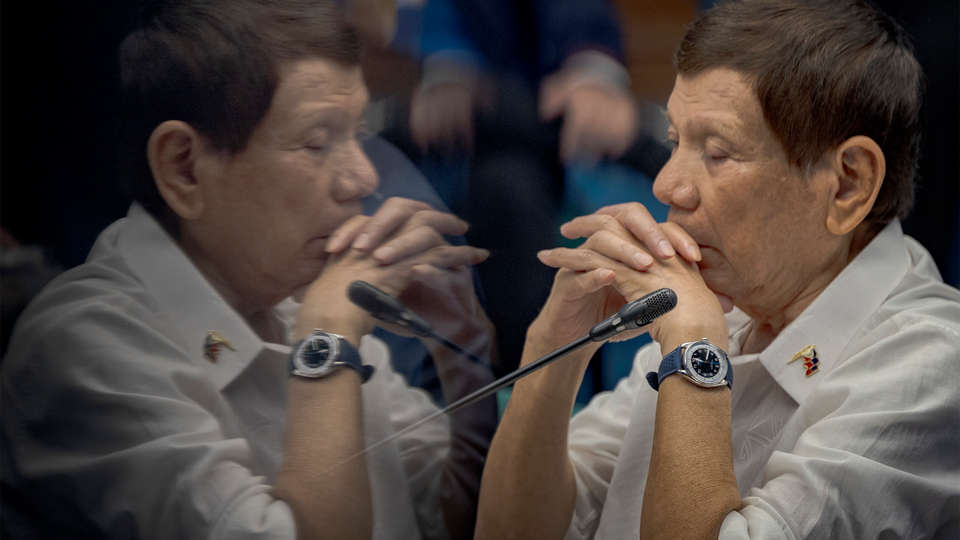
Rodrigo Duterte's violent drug war in the Philippines resulted in thousands of extrajudicial killings. Despite initial public support, grassroots efforts by clergy and activists documented atrocities and built a case for justice. Duterte now faces trial at the International Criminal Court for crimes against humanity.
Key Takeaways
•Duterte's drug war led to an estimated 6,000-30,000 extrajudicial killings, justified by moral rhetoric about drug users as threats to society.
•Clergy and activists formed underground networks to support victims' families, document killings, and gather evidence despite widespread public support for the violence.
•The International Criminal Court investigation gained momentum through victim testimonies and evidence collection, culminating in Duterte's arrest and transfer to The Hague.
•Political infighting between the Duterte and Marcos dynasties created an opportunity for the ICC to pursue accountability where domestic justice had failed.
•The case challenges the moral legitimacy of extrajudicial violence and represents a rare path to justice for mass atrocities committed with public acquiescence.
Rodrigo Duterte once seemed invincible. How did he end up on the verge of facing real justice? Ezra Acayan / Getty Rodrigo Duterte was elected president of the Philippines in 2016 on the promise that he would kill. He framed his war in moral terms: Drug users transgressed the laws of society, but the justice system was so broken and so corrupt that they evaded punishment. Due process stood in the way of keeping the innocent and the virtuous safe. He sneered at spineless elites unable to rein in drugs and crime and pledged to achieve swift justice instead.
Once in office, he made good on that promise, moving from rhetoric to action. He singled out crystal meth, the poor man’s narcotic, as a particular problem. Shabu, he said, shrinks users’ brains so that they “are no longer viable as human beings in this planet.” Users therefore deserved to die. Government tallies put the number of drug suspects killed during Duterte’s time in office at about 6,000. But human-rights groups claim that the number of extrajudicial killings may be as high as 30,000. Many of my fellow Filipinos thought that the carnage was justified. They saw Duterte as the slayer of the elite and the scourge of criminals. Others simply looked away.
Duterte left office in 2022. Four years later, he still commands a fanatic following in the Philippines and retains a grip on the public imagination. He is larger than life; his language is violent and profane. He projected such an aura of invincibility that many believe, even now, that he is beyond accountability.
But last month, Duterte sat in an austere cell in The Hague as prosecutors argued that he should be tried for crimes against humanity. His only companions were his lawyer, prison staff, and a handful of convicted war criminals. This is a story that traces the path to justice for mass atrocity in the face of public acquiescence.
When the killings started in 2016, clergy were the first responders, often called upon to say prayers for the dead and preside over funerals. Maria Juanita Daño, whom everyone calls Sister Nenet, is a nun who lived in a tenement in Manila’s packed San Andres district. She was alarmed when the casualties of the drug war started piling up in her neighborhood. Prayers, she thought, were not enough.
But what could a nun in a tenement do? All around the country, many among the clergy asked themselves a version of this question. They improvised answers. Sometimes they helped pay for funeral expenses. They gave milk and groceries to widowed mothers and shouldered the schooling of orphaned children. They recorded the killings and got counselors to help the grief-stricken. They contacted journalists and connected them with survivors. They helped file cases in court and set up drug-rehabilitation programs on the fly, hoping to convince police and local officials that those in the church’s care should be spared. Some housed terrorized residents in convents and rectories.
Those efforts were puny compared with what the communities were up against: a powerful killing machine with deep roots in Filipino society. Duterte, a democratically elected leader, tapped into a legacy of dictatorship: the shadow-policing system that had long carried out the extrajudicial executions of criminals, insurgents, and other threats to the social order. He cranked up the rusty killing machine of a former police state—its death squads, surveillance networks, and clandestine operators—and then unleashed it with stunning force and velocity.
The country’s human-rights community was used to documenting and exposing state-sanctioned abuses. But advocates could not keep up with so many atrocities committed in so short a time against victims targeted not for political activities but for alleged ties to the drug trade. Even among the clergy, many were wary of opposing an immensely popular president. Churches had long viewed drug use as a moral failure and supported draconian measures—beliefs that many of the faithful shared. Before Duterte became president, churches, along with law enforcement and the media—which portrayed shabu users as crazed criminals—had stoked the moral panic about drugs.
Polls showed overwhelming support for the drug war, and many Filipinos said that they felt safer. “There was so little sympathy for the dead,” a Protestant church activist told me. “Some even held parties to celebrate the killing of those they considered salot, a social plague. These places have been neglected for so long, they have not been given justice, and the killings are a form of justice for them.”
From the beginning, however, there were exceptions to the rule of apathy. In June 2017, I joined Ciriaco Santiago Jr., a missionary, on his late-night trips to condole with victims’ families. Sometimes, we were the only ones at the vigils for the dead—friends and kin were unsympathetic or afraid. Late one night in Payatas, a shantytown near a garbage dump in Manila’s outskirts, Santiago knocked on the door of a funeral office. This was little more than a wooden shack beside a convenience store and a karaoke parlor, all of them run by an enterprising resident who had already buried 200 people in the 12 months since Duterte had taken office, nearly all of them drug suspects. Three scavengers at the dump had been gunned down recently, and their families couldn’t afford to bury them.
Santiago had come to pay for their funerals. His religious order, the Redemptorist Fathers and Brothers, had paid for the burial of scores of the drug-war dead. Along with other groups, it provided temporary jobs and housing for those whose lives were at risk and tried various ways to help the survivors cope, eventually setting up a café run by drug-war widows and children. While visiting hard-hit communities as part of an investigation into the death toll of the drug war, I found many similar efforts. By demanding justice and dignity for the drug-war dead, were nuns, priests, pastors, and other sympathizers not protecting criminals? Cardinal Pablo Virgilio David, the bishop of Kalookan, in northern Manila, told me that he had voted for Duterte “because of the political will that I saw in him.” But the drug war had exacted a heavy toll in his diocese. The communities most affected, he realized, are “not only in the margins of society; they are also in the margins of the church.”
On the pulpit and on social media, David shared his epiphany: Drug use, he said, is at root a “health and poverty issue.” His diocese organized self-help and drug-rehabilitation programs. He also set up a sanctuary, led by a priest who’d come to the bishop in tears after one of his parishioners had been killed. The victim had feared for his life, but the priest gave him what later seemed like naive advice: that hiding would be seen as a sign of guilt.
David received death threats and was sued for sedition along with other priests. Despite that, he continued to preach that the most radical thing about faith was the stubborn belief in the possibility of redemption. This challenged the moral argument on which the legitimacy of the drug war rested. The public cheered when Duterte and his supporters insisted that drug dealers deserved execution, but David and others believed that the poor caught up in the drug trade deserved empathy.
Back in San Andres, Sister Nenet met with victims’ families regularly for prayers, Bible readings, and meditation. Eventually, the community provided evidence in a class-action lawsuit at the supreme court, pleading for protection from the police.
In another part of Manila, Flaviano Villanueva, too, was alarmed. A priest who ran a shelter for the homeless, he saw his flock at risk. “We needed to respond with something other than fear,” he told me, so he provided therapy as well as financial support. Many of the victims had been buried in concrete boxes leased for five years by poor families. Those leases were expiring, and the families could not afford to renew them, so Villanueva helped exhume the bodies, turning over the bones to a forensic pathologist who examined the remains and kept records for future use. Later, the victims’ ashes were interred in a modest columbarium that the priest had built in a Catholic cemetery.
It was there that Edgar Matobato, a confessed hit man for Duterte, went to pay his respects before he slipped out of the country to testify to the International Criminal Court. Matobato had been in hiding for years, sheltered by clergy and others who were convinced that he had atoned for his sins. At the cemetery, drug-war widows unleashed on him the full force of their anger and anguish. It was a rare moment of catharsis in a country that has yet to come to terms with the carnage of Duterte’s war.
During the darkest period of that war, connections were being made. Those who opposed the carnage were forming subterranean networks that allowed them to support victims’ families and collect evidence of atrocities in real time—records crucial for accountability. As I reported, I was introduced to a growing community of victim supporters. Apart from clergy, they were doctors, lawyers, psychologists, academics, artists, poets, feminists, businesspeople, journalists, students, actors, government officials, and, in one case, a hip-hop group.
They did not always see eye to eye, but they were moving in the same direction, with the same goal. They worked together to support the International Criminal Court investigation into potential crimes against humanity, which had launched in early 2018. They gathered victims’ testimonies for the ICC’s registry. Volunteer law students helped survivors with the paperwork. Women and children wept when telling their stories, recalls Nicolene Arcaina, a now-31-year-old lawyer who was named by the ICC as the case manager for the victims. The students and the paralegals cried with them; they had to take breaks and debrief with volunteer therapists.
“Because the streets flowed with blood,” one of the survivors told Arcaina, “we are now of one blood.”
For a long time, this resistance didn’t seem to matter. After Duterte’s presidency ended in 2022, his daughter Sara took office as vice president to the new head of state, Ferdinand Marcos Jr.—the son and namesake of the dictator who had ruled the country for 20 years before being ousted in a popular uprising in 1986. The election results nearly extinguished the already faint hopes of accountability. The country had yet to hold the first Marcos to account for plunder and human-rights abuses, and this election seemed an exoneration of both his and Rodrigo Duterte’s sins.
Then Duterte’s opposition enjoyed a stroke of political good fortune. The dynasts began to jostle, publicly and viciously, for power. Things came to a head in late 2024, when Sara Duterte publicly threatened to have Marcos and his family killed if anything happened to her. Marcos’s allies in the Congress of the Philippines voted to impeach her.
By then, ICC prosecutors had built their case and were ready to issue an arrest warrant. Their timing coincided perfectly with the political rift, making it convenient for the Marcos government to surrender Sara’s father to the ICC. Last March, police arrested the former president at the Manila international airport as he stepped off a plane after a foreign trip. Within hours, he was on a flight to The Hague.
The ICC has been described as a “dead man walking,” the victim of an eroding global consensus around international justice and human rights. The United States has issued sanctions against the court, and some countries have withdrawn from it—including the Philippines, in response to the investigation into Duterte. But because the allegations against him include killings that occurred while his country was still party to the court, he cannot escape its jurisdiction.
The prosecutors at The Hague were methodical. They laid out a case that dated back decades, to before Duterte’s presidency. As mayor of the southern city of Davao for more than 20 years, they said, Duterte had organized death squads targeting petty criminals. And then, as president, they said, he’d drawn up kill lists and unleashed police and masked hit men in shantytowns, where they’d gunned down drug peddlers and users. The prosecutors described a pyramid of murder and impunity with Duterte at the apex, police and civilian officials in the middle, and low-level policemen, police assets, and hit men at the bottom. Rewards, they said, were paid for the murders.
For now, the former president sits in his jail cell. During the day, loyal supporters display his cardboard likeness on a strip of grass they call Duterte Street. But at night, only the screeching of seagulls pierces the silence—loud, high-pitched cries, like widows and mothers wailing.