The truth left out from Elon Musk’s recent court filing
TL;DR
OpenAI counters Elon Musk's court claims, revealing he agreed to a for-profit structure in 2017 but negotiations failed over his demand for full control. They rejected merging with Tesla, he left, and OpenAI successfully structured as a non-profit with a public benefit corporation valued at $130B.
Key Takeaways
- •Elon Musk agreed in 2017 that OpenAI needed both non-profit and for-profit entities—the exact structure he's now suing over.
- •Negotiations broke down because Musk demanded full control and OpenAI refused to give it, leading to his departure.
- •OpenAI rejected Musk's proposal to merge OpenAI into Tesla and instead found independent funding paths.
- •Musk's current lawsuit is described as his fourth attempt at similar claims and part of a harassment strategy to slow OpenAI.
- •OpenAI's current structure includes a non-profit foundation controlling a public benefit corporation valued at approximately $130 billion.
In his latest court filing(opens in a new window), Elon cherry-picks and publishes snippets from Greg Brockman's private journal entries (obtained as part of legal discovery) which, when read with the surrounding context, tell a very different story from what Elon claims.
The truth is that we and Elon agreed in 2017 that a for-profit structure would be the next phase for OpenAI; negotiations ended when we refused to give him full control; we rejected his offer to merge OpenAI into Tesla; we tried to find another path to achieve the mission together; and then he quit OpenAI, encouraging us to find our own path to raising billions of dollars, without which he gave us a 0% chance of success.
We did find a path to advance the mission, with OpenAI now structured as two main entities: a public benefit corporation (“PBC”) and a controlling non-profit which owns equity in the PBC currently valued at approximately $130 billion.
Elon’s latest variant of this lawsuit is his fourth attempt(opens in a new window) at(opens in a new window) these(opens in a new window) particular(opens in a new window) claims, and part of a broader strategy of harassment aimed at slowing us down and advantaging his own AI company, xAI. He is now grossly misrepresenting the written record to further his harassment; this post shows just a few examples of the truth that Elon isn’t telling.
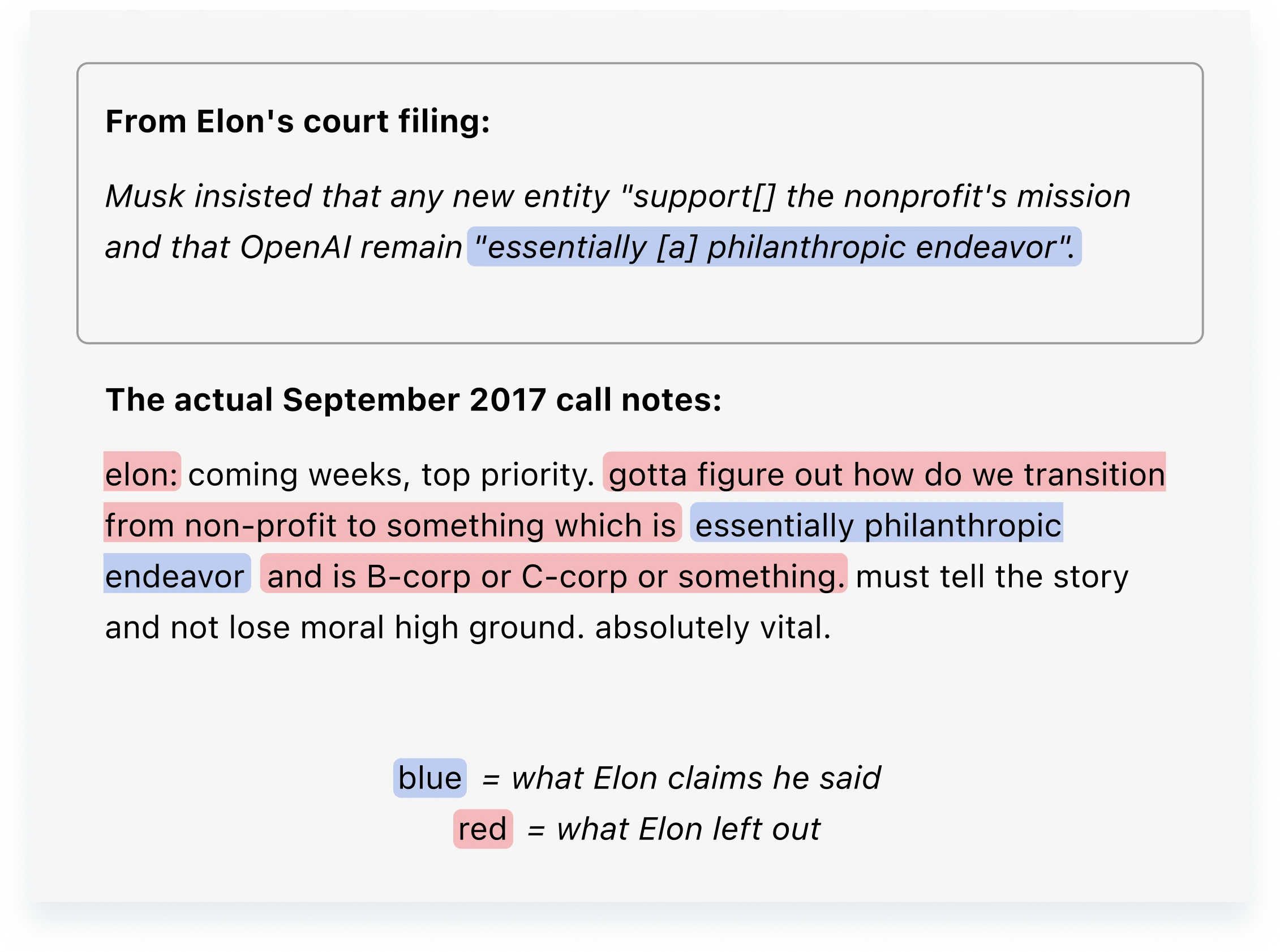
From Elon’s court filing
In 2017, OpenAI’s founders became concerned that developing artificial general intelligence would require more resources than a nonprofit could raise through charitable donations. Ex. 38. They discussed numerous ideas, including creating a for-profit arm for OpenAI, collaborating with an existing company, or restructuring in some other manner. Ex. 1 (Musk Tr.) at 70:6-72:15, 78:18- 79:14, 95:8-16. Musk insisted that any new entity “support[ ] the nonprofit’s mission” and that OpenAI remain “essentially [a] philanthropic endeavor.”
The actual September 2017 call notes:
gdb: over upcoming weeks, how much of your time should we plan for?
elon: coming weeks, top priority. gotta figure out how do we transition from non-profit to something which is essentially philanthropic endeavor and is B-corp or C-corp or something. must tell the story and not lose moral high ground. absolutely vital.
gdb: yep.
elon: need to understand B-corp situation.
ilya: i have *some* thoughts. one idea keep non-profit and have C-corp. but i find this approach less appealing because in some sense C-corp not beholden. one formulation: mission is to minimize ex risk by building friendly AGI. could be a way to go. like it more as a new entity beholden to the mission.
elon: agree, does sound better. never even heard of a B-corp until sam brought it up. it does sound like right move. would not shut down the non-profit, should still exist in some form.
ilya: no opinion, as long as the main entity has something fundamentally philanthropic.
elon: any prefs on name?
ilya: openai. continuity of the mission. it’s all the same.
elon: i agree, think that makes sense. well, i’m pretty excited about doing this with you.
ilya: all that’s left is the minor thing of actually doing it.
elon: alright cool. i’m gonna figure out the details of the whole B-corp thing tomorrow and get that process under way. and then let’s just stay in frequent touch. make this happen as quickly as possible.
blue = quote shown in Elon’s court filing
red = emphasis added
Commentary
Elon did not think that OpenAI needed to remain solely a non-profit. As the context shows, he agreed that OpenAI needed both a non-profit and a for-profit entity—the exact structure OpenAI has today, and that Elon is now suing OpenAI over. At the time, he said only that the non-profit should continue to exist “in some form.” Ilya, not Elon, suggested that the for-profit should have a connection to the OpenAI mission. Shortly after this call, Elon actually created an OpenAI PBC (or “B-corp”).
Despite his court filings glossing over the details of these negotiations, they were quite intense and involved deeply personal conversations. Elon said he wanted to accumulate $80B for a self-sustaining city on Mars, and that he needed and deserved majority equity. He said that he needed full control since he’d been burned by not having it in the past, and when we discussed succession he surprised us by talking about his children controlling AGI.
Discussions about OpenAI’s structure—and Elon’s proposal that he lead and control it—progressed to the point that Elon asked us to check references with people who had worked closely with him. One pointed out the parallel to Elon’s Mars ambitions, which had started as a philanthropic project(opens in a new window) and grew into a commercial one, and mentioned that Elon tends to vilify people who quit his companies.
Even before negotiations over OpenAI’s structure began, Elon leveraged OpenAI for the benefit of his for-profit ventures. For example, in early 2017, he asked OpenAI to send a team to help fix Tesla’s self-driving program, Autopilot. Scott Gray, Ilya, Greg, and Andrej Karpathy ended up devoting significant time to improving Autopilot, which led to Elon recruiting Andrej to join Tesla fulltime. Elon never truly treated OpenAI as an independent non-profit.
From Elon’s court filing
But Musk’s co-founders secretly had other plans. On November 6, 2017, following a meeting with Sutskever, Brockman admitted in his private diary that their “conclusion is we truly want the [for-profit] b-corp.”
The actual November 6, 2017 notes:
- sam: say, we wanna do openai, if you wanna do inside tesla it’s ok. if weirdly competitive should revisit.
- ilya: was thinking, what we need.
- sam: depends how strategically dependent we would be, could imagine a way that works.
- ilya: earlier more concerned. don’t want only strategy to be tesla. wouldn’t wanna be locked into something that only tesla
- gdb: why be ok with similar effort in tesla?
- sam: won’t work, how little
- sam: would like E to stay on board, not go to war. don’t think will work, tell him that. maybe he’ll get the hardware built inside of tesla.
- ilya: if i’m truly honest, my prefs here are not set in stone, some pref for b-corp. can be made happy in the non-profit world.
- sam: what involvement?
- sam: would prefer to have him involved,
- sam: much more interested in you two being motivated + non-distracted. normally have one thing. that’s moved around a lot. thing i care about the most optimum output. if you guys are not gonna be happy with the non-profit, let’s figure out the b-corp. If you don’t want e involved,
- do have weakly held views, but pale in comparison to making you guys fully happy.
** ilya and me breakfast
- conclusion is we truly want the b-corp. honestly we also want to get back to work. but it’s not super clear how we get there.
blue = quote shown in Elon’s court filing
red = emphasis added
Commentary
While Greg and Ilya preferred the B-corp, they were open to pursuing the mission within the standalone non-profit—if it could raise enough funding. Their preference was not a secret; the thinking was shared with Elon and his key staff.
Negotiations over an OpenAI for-profit with Elon fell through in September 2017 because we wouldn’t give him absolute control. In early October, Shivon Zilis (at the time Elon’s liaison to OpenAI) told Greg and Ilya that Elon wanted them to “commit” to the non-profit by giving him two more board seats, agreeing not to quit for some period of time, and signing a non-solicit. Greg and Ilya considered this proposal but never agreed to it given their concerns about the non-profit’s ability to raise enough capital and Elon’s ability to start a competitor without consequence. They discussed with Shivon whether a B-corp with Elon was still possible; she said Elon had told her it could be but not for the next 6-9 months—enough time to get some distance from these intense negotiations and for Elon to focus on Tesla’s Model 3 ramp-up.
A few weeks later, Elon told us that it was a happy accident that the for-profit hadn’t materialized as it never could have obtained enough funding. Instead, he began trying to convince us that merging OpenAI into Tesla was the only path to the mission, and it seemed that he would pursue an AGI competitor within Tesla regardless.
By early November, we were trying to figure out a path forward that didn’t involve ending up at Tesla. The November 6, 2017 entry goes through more thinking (e.g. “the answer is that we would have preferred the b-corp, but we prefer the non-profit to tesla.”) and eventually comes to an ordered list of options for how to move forward: “[1] b-corp w/ appropriate control structure [2] non-profit w/ lots of funding [3] us quitting and doing our own thing”.
From Elon’s court filing
Brockman privately fretted about concealing their plans from Musk. “[C]annot say that we are committed to the non-profit. don’t wanna say that we’re committed. if three months later we’re doing b-corp then it was a lie.” Ex. 43 at 2. “[Musk’s] story will correctly be that we weren’t honest with him in the end about still wanting to do the for profit.” Id. at 3. “[I]t’d be wrong to steal the non-profit from [Musk]. to convert to a b-corp without him. that’d be pretty morally bankrupt.”
The actual November 6, 2017 notes:
if he starts the competitor going to be less
cannot say that we are committed to the non-profit. don’t wanna say that we’re committed. if three months later we’re doing b-corp then it was a lie.
statement must be, right now we have these concerns, we want to see the fundraising landscape. hypothesis: after robot hand and 5v5, totally diff world. we need, upper bound, $150M for 2018. and right now more dollars wouldn’t make us move faster.
and so... what does this all mean. we are really unsure if he starts a competitor that it’s going to end in a good place. btw right now we have this great position of power. but it can of course all go away very quickly.
- policy gradients
ok, so not feeling so great about all of this. the true answer is that we want him out.
ok, so talking to shivon: she’s like how are you gonna raise the billions in the non-profit? of course E isn’t going to put personal money on the line, not going to give up on mars.
if he really thinks that AGI is gonna happen first and be the craziest thing and change everything, then why not?
can’t see us turning this into a for-profit without a very nasty fight. i’m just thinking about the office and we’re in the office. and his story will correctly be that we weren’t honest with him in the end about still wanting to do the for profit just without him.
[...]
he was like, ok. fundraising is super hard. i’ve worked hard on gates and he didn’t even stop by office. dustin donated but doesn’t even show up personally. that’s how much these people care about this. didn’t expect to be 70% of the cash contributions. thought I’d be one piece. there are all these names on the website and they haven’t contributed. reality check, no one’s gonna give you this amount of money, when they see the $10B they’re going to run to the hills.
one of the two of us is not based in reality.
but he was super supportive of us trying, and said, go ahead, I’m happy with anyone (even people who just want to get access to me), happy to give them any fancy title, diminish my own title, etc.. if you can do it then i want to learn from you. I’m very good at getting people to part with their money, i could raise $lb for tesla in a week and have you seen that company’s financials?
anyway, definitely the best this meeting could have gone. we now have a focus, a goal, and if we accomplish it, then we’ll really have shown him that we can outperform him even at something he’s great at. if we fail, well, we’ll deal with it then.
btw another realization from this is that it’d be wrong to steal the non-profit from him. to convert to a b-corp without him. that’d be pretty morally bankrupt. and he’s really not an idiot.
purple = Greg’s notes on what Elon said
blue = quote shown in Elon’s court filing
red = emphasis added
Commentary
In this entry, Greg and Ilya were still considering Elon’s demand that they “commit” to the non-profit by accepting his terms—something that, again, never happened. There was a chance that Elon would resume funding if they agreed to his conditions; there was a chance he’d resign to go create an AGI competitor within Tesla. Greg and Ilya felt that it’d be deceptive to accept Elon’s terms and then later create a for-profit without his approval. So they were nervous that, by accepting, they’d get stuck in a structure that was unable to raise sufficient capital while Elon left to pursue his own AGI project at Tesla. That’s why they decided not to accept his proposal. No one ever lied to Elon; no one ever told him they’d accepted his terms when they hadn’t.
In early November, we privately considered removing Elon from our board. We didn’t want to merge OpenAI into Tesla as he’d suggested, and he seemed intent on starting a competitor there regardless of what we did. Elon’s departure from OpenAI would have made it easier to figure out some structure for raising capital because it would have removed the impasse caused by his need for absolute control.
Still, though we felt Elon’s departure would have facilitated pursuit of the mission, we didn’t remove him. We kept trying to find a path forward with him because we thought that was the moral thing to do (per the same journal entry: “Ilya feeling like we morally should not be kicking elon out, and should be trying to make the non-profit work and convince him to stay”). We decided to try fundraising in the non-profit for a time to see what was achievable. We said that we’d need to eventually raise $10B, which Elon said seemed totally impossible. It was clear we’d need a long-term solution other than remaining solely a non-profit indefinitely.
What happened next
Over the next few months, we worked on fundraising and brainstorming ideas to obtain the next level of funding necessary to pursue and achieve the mission. In mid-January 2018, Elon congratulated us on a successful fundraise, agreed we should do an initial coin offering (“ICO”) to raise $10B—which would involve a for-profit subsidiary—and told us that we'd solved the long-term funding problem. By the end of January, however, he told us he no longer supported the ICO (which we’d soured on too by then) and that OpenAI was “on a path of certain failure relative to Google.”
By February 2018, Elon had decided that OpenAI would not be able to raise sufficient funding. That month, he quit even though we told him that we’d “been working on a fundraising structure that does not rely on a public offering, and we will be curious to hear your feedback.” On Elon’s way out, he said that he supported us pursuing the path we saw to raising billions of dollars—he just didn’t think we could succeed and he would instead focus on building AGI at Tesla for that reason.
For a time, the split with Elon seemed amicable. Shivon Zilis joined our board and helped us navigate Elon’s moods when, on occasion, he lashed out. But then Elon prepared to launch xAI and Shivon stepped off our board. Elon began the campaign of harassment that he’s waging now, with relentless public attacks and various lawsuits, as he’s tried to gain competitive ground for xAI.
While there’s a long way to go, we’ve made much more progress than Elon thought possible—including getting the OpenAI non-profit, now called the OpenAI Foundation, on track to become the best resourced non-profit in history. We’re grateful for the many users and partners who work with us to collectively advance our mission of ensuring AGI benefits all of humanity.