Bari Weiss halting a 60 Minutes report on El Salvador's CECOT prison exposes free-speech hypocrisy. Conservatives restrict speech they dislike while framing liberal censorship as equivalent to state censorship, revealing their true aim: controlling acceptable discourse.
Key Takeaways
•Bari Weiss's decision to stop a CBS News report on migrant torture in El Salvador illustrates how free-speech advocates often support censorship when it aligns with their political interests.
•The incident highlights a broader pattern where conservatives condemn 'cancel culture' while engaging in state-level censorship, book bans, and suppression of dissenting views.
•Many self-proclaimed free-speech champions defend only their right to speak, not others' right to respond, aiming to control what constitutes acceptable public discourse.
•Media consolidation under pro-Trump ownership creates single pressure points for potential government coercion over news content, threatening editorial independence.
•The 'free-speech panic' of the past decade was largely about ensuring right-wing control over public narratives, not protecting universal speech rights.
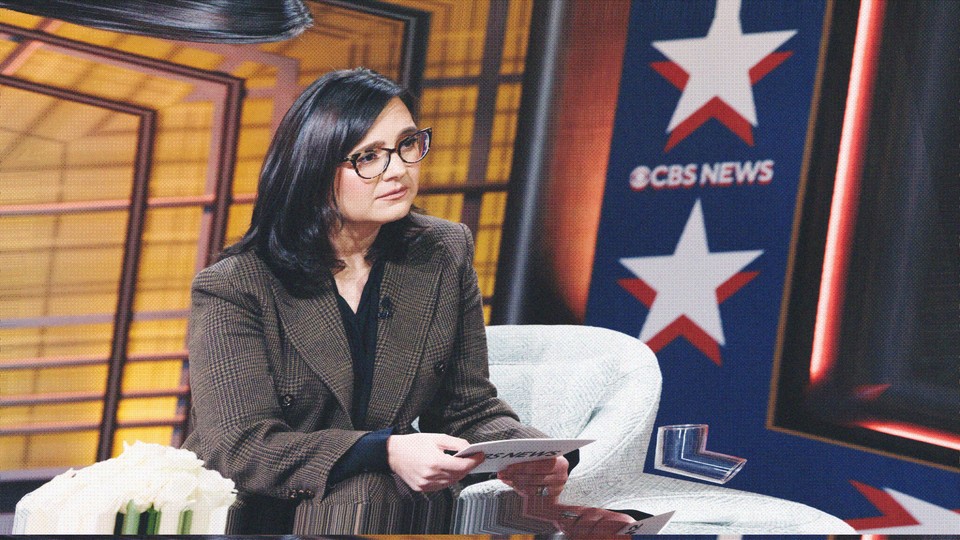
How we got to a place where free speech means whatever conservatives want to say. Illustration by The Atlantic. Source: Michele Crowe / CBS / Getty. On Sunday night Bari Weiss, the editor of The Free Press and the new head of CBS News, abruptly stopped a forthcoming 60 Minutes report on the torture endured by migrants in the brutal El Salvadoran prison CECOT, where the Trump administration has sent more than 280 men.
Trump supporters praised the decision from Weiss, who, notwithstanding her description of conditions at CECOT as “horrific,” had previously praised El Salvadoran leader Nayib Bukele for making El Salvador safer. More broadly, the whole affair neatly encapsulates the bizarre anti-free-speech free-speech discourse of the past decade, the purpose of which has been to justify restricting any speech that conservatives disapprove of while framing liberal censoriousness as equivalent to state censorship.
According to Sharyn Alfonsi, the correspondent who reported the segment, the story had already been reviewed by CBS News’s legal and standards departments before it was pulled.
“Our story was screened five times and cleared by both CBS attorneys and Standards and Practices. It is factually correct,” Alfonsi wrote in an email that was leaked to The New York Times and other outlets. “In my view, pulling it now, after every rigorous internal check has been met, is not an editorial decision, it is a political one.” The reason this whole saga is disturbing is that many observers—Alfonsi among them—interpreted it as an instance of state censorship by proxy: the head of a news organization putting the brakes on a story the government would rather not air. Weiss was recently installed at the head of CBS News by Paramount’s new owner, the pro-Trump billionaire David Ellison, which illustrates the risks of media consolidation, creating a single pressure point for an authoritarian government to coerce obedience if it so chooses.
Editors, of course, hold or spike stories all the time, for many legitimate reasons. And although many newsrooms require review by legal and standards departments for the most complicated stories, editorial independence dictates that the editor makes the final call on whether a story should move forward. But Alfonsi’s account calls Weiss’s reasoning into question. By Monday night, the unpublished segment was circulating like samizdat on social media, yet another example of regular people demonstrating a greater commitment to democratic principles than America’s leaders.
Weiss has long been a vocal supporter of a curiously narrow definition of free speech. That hypocrisy, shared by many, brought us to where we are today: Nasty tweets were a harbinger of incipient totalitarianism, but now the Trump administration is trying to imprison and deport people for pro-Palestinian advocacy, and it’s fine. The “PC Police” were trying to “outlaw make-believe,” but when Republican states ban books from schools and public libraries, it’s fine. These dumb lefties believe that words are violence, but when the federal government says left-wing speech is violence worthy of firing or prosecution, it’s fine. Protests on college campuses were a national crisis, but now that the federal government wants to ensure that entire universities comply with right-wing ideology when it comes to whom they hire, what they teach, and whom they admit, it’s fine.
Social-media companies implementing moderation policies is censorship, but when those moderation policies favor right-wing speech and outright bigotry, it’s fine. The “illiberal left” was leading an “epidemic of self-censorship,” but now that the owners of entire corporations compel their workers to shape content in order to win the favor of the right-wing president, it’s fine. Liberal snowflakes on campus were trying to censor academic inquiry, but now the Trump administration is slashing funding for research it deems “DEI” and censoring museums and federal historical sites for being insufficiently jingoistic, and it’s fine. We are rapidly approaching a system where the government uses its authority to decide which forms of speech are acceptable to publish or broadcast. And, of course, that’s fine.
Why is any of this okay with so many of those who once claimed to be free-speech champions or absolutists? Because, quite obviously, they were not. Many cannot even claim to be less censorious than the progressives they criticized, given the clamorous demand for firing people for remarks about the assassination of Charlie Kirk or demanding a boycott of Netflix for its LGBTQ content.
The campaign against so-called cancel culture had an appeal to the chattering classes—myself included—because many of us found left-wing nastiness annoying, exhausting, and in some cases threatening. (Recent MAGA defectors have learned what the rest of us already knew: This is not a distinctly left-wing issue at all.) And there were certainly those who sincerely believed (mistakenly, I think) that censoriousness could be as dangerous as state censorship. But I argued at the time that the campaign was largely a pretext for placing left-wing speech beyond the protection of the First Amendment in order to justify state suppression—and events have borne that out.
The reason so many of yesterday’s free-speech champions transitioned so easily into today’s pro-Trump censors is that their definition of free speech never included the right of others to talk back. They were not defending a universal right to freedom of speech; they were defending a right to monologue. They could say what they want, and you could shut up and like it. The cynicism of the effort can be known by its fruits: an administration that issues executive orders “protecting” free speech while engaging in the most sweeping campaign of state censorship since the Red Scare.
To the extent that there is or was something distinct called “cancel culture” (harsh, even violent censoriousness has a long history in America), its contemporary iteration is largely a creation of the perverse incentives of social media. Highlighting extreme and nasty behavior is the easiest way to keep people scrolling, posting, and interacting. That’s a structural, not an ideological, problem, and it’s not something that can be solved by purging or censoring one point of view.
Every society that has ever existed has had views that are mainstream and views that are fringe. The free-speech frauds who captured the discourse over the past decade understood this, but their true objection was that they did not unilaterally have the power to define which was which. For example, in a 2018 Times column, Weiss complained that “leftists” were engaged in a “concerted attempt to significantly redraw the bounds of acceptable thought and speech.” This was meant to sound sinister, menacing. In fact, this is politics. Every faction is always trying to “redraw the bounds of acceptable thought and speech.” In a free society, the government allows people to have those arguments. Such disputes are not a threat to free speech; they are free speech.
When I say that CBS News’s Bari Weiss understood this, you needn’t take my word for it. In November, shortly after being given the reins to one of the oldest broadcast-news organizations in the country, Weiss used identical language to describe her own project: “I think it’s about redrawing the lines of what falls in the 40-yard lines of acceptable debate and acceptable American politics and culture,” Weiss said at the Jewish Leadership Conference. “And I don’t mean that in, like, a censorious, gatekeeping way.”
What’s the difference between her “redrawing the lines” of acceptable speech and other people doing it? What makes one “censorious” and “gatekeeping” and the other not? Well, because she gets to decide. That’s what so much of the free-speech panic was ever about: making sure the right people were in charge of what you see, hear, and read. Notably, this has very little to do with reporting the news, which is supposed to be what CBS News does. But if the point of installing Weiss was to ensure that she would gatekeep on behalf of right-wing interests, that is precisely what she appears to be doing.
In that 2018 column, Weiss complained that so many people seemed to believe that “the real cause for concern are the secret authoritarians passing as liberals and conservatives in our midst.” Seems like they were right to be concerned. Upon reflection, her conclusion that misguided leftists were focusing on minor issues when there were true threats to freedom of speech was prescient. It applies neatly to the campus PC obsession that helped elevate Weiss to a position where she could block the publication of a story about the United States government rendering men to an overseas gulag without trial.