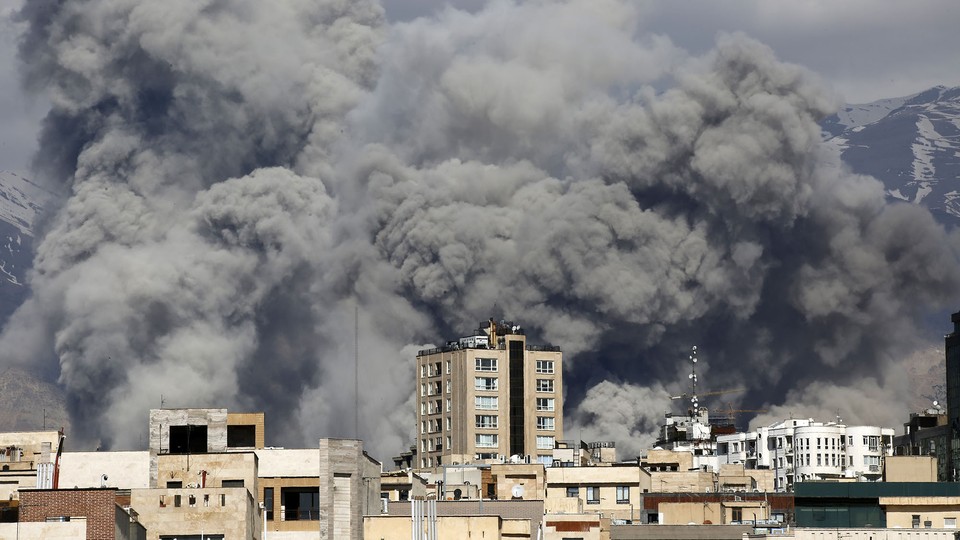
Israel has proven to be a crucial and capable military partner to the U.S. in the war against Iran, operating at a scale unmatched by European allies. The conflict involves extensive air campaigns, covert operations, and a clear objective of regime change in Iran.
Key Takeaways
•Israel operates as a peer military partner to the U.S. in the Iran war, with capabilities surpassing traditional European allies.
•The anti-Iran coalition has expanded due to Iran's aggressive actions against neighboring Arab states.
•The war includes a significant covert dimension involving intelligence, assassinations, and special operations aimed at regime change.
•Iran has responded with increased missile and drone attacks, though these are expected to diminish under coalition pressure.
•The conflict highlights the value of sophisticated, bold allies like Israel who can operate effectively at large scale.
Having sophisticated, creative, and bold partners that can operate at scale is invaluable to the United States. Fatemeh Bahrami / Anadolu / Getty The majority of wars are coalition wars, but some of the partners in these wars are barely seen or invisible. So it is with the current Iran war. Most of the Western commentary is focused on the United States and, inevitably, Donald Trump and his decision to pursue war—and indeed, it was his decision to launch it. But in the conduct of actual operations, the Israelis have been much closer to peers than minor partners.
According to an Israeli air-force spokesperson, in the opening wave, some 200 Israeli jets hit more than 500 targets in the first day, quite apart from any attacks by drones or special-operations forces. U.S. Central Command has yet to release its number of strikes from the first day, but they will likely be on the same order of magnitude, although conducted from a wider variety of platforms, including from the sea.
This is a remarkable level of allied effort. During the Gulf War, for example, when Great Britain was still a major power, it deployed barely 60 strike aircraft to deliver munitions—some of which, such as the runway-denial weapon JP-233, were both unnecessary and dangerous for the pilots—in a much larger American air campaign. Today, however, the Israeli air force is equipped with the latest American aircraft and its own and American munitions, and is operating on a scale that no U.S. European ally could match in this theater.
That is an astonishing thing. It was made much easier by the sensible decision of the first Trump administration to put Israel in the Central Command area of responsibility, rather than leaving it, as it had been for 40 years, for the European Command. It was facilitated as well by the American military’s realization that here was a first-class fighting force with whom it could readily work.
The anti-Iran coalition is larger yet. There have been reports that Saudi Arabia, standoffish in public, privately urged Trump to order the attack on Iran. By lashing out against its Arab neighbors, including attacks on Dubai, Abu Dhabi, Saudi Arabia, Qatar, Jordan, and even Iraq (it attacked Irbil, in the north), Iran has expanded the coalition fighting against it. Why it has done so is baffling—perhaps its leadership figured that these states would put pressure on Trump to end the war. But Iranian strikes are more likely to make it easier to conduct American combat missions from bases in surrounding countries.
The current attacks—the American Operation Epic Fury and Israel’s Roaring Lion—constitute just one campaign in a much larger war. That conflict began with the birth of the Islamic Republic, in 1979, and intensified in the 2000s with the sabotage of Iranian centrifuges, assassinations of Iranian nuclear scientists, the 2018 Mossad heist of the Iranian nuclear archive, and then two particularly intense phases of long-range war involving Israeli air attacks and Iranian ballistic-missile barrages. The October 2024 Israeli air attacks completed earlier work in destroying Iranian air defenses and some nuclear targets. The 12-day campaign in June 2025 was much more extensive, although on a daily basis not quite as intense as the opening phase of the current campaign.
Behind the sounds of jets and explosions lies another dimension of this war, and one in which the Israelis, who have been preparing for this for decades, are equal partners with the United States. It is a campaign in the shadows, composed of intelligence gathering, assassination, covert action, and special operations.
The killing of Iran’s supreme leader may have resulted from a CIA or Israeli intelligence assessment that he was meeting aboveground with key advisers—or, as likely, from a cooperative venture. Other senior Iranian officials have been killed, including the head of the Islamic Revolutionary Guard Corps and the minister of defense. More such operations are no doubt under way, of which the most interesting probably involve various forms of outreach to leaders of a coup or popular movements.
The objectives of previous campaigns were limited: damaging the air-defense system, setting back the nuclear program, or mere humiliation. This time, the aim is clearly regime change. That can happen only through an internal putsch or an organized popular uprising. The former requires identifying conspirators who have a chance. The latter probably entails smuggling weapons, explosives, and communications equipment into Iran to support any insurgents, and providing some training and direction. All of these moves would remain opaque to the outside world throughout the war and conceivably well beyond it. But that does not mean they are not already taking place.
In any war, the other side has choices as well. The Iranian regime has prepared its arsenal of drones and missiles to punish any such attack. During the 12-day war in 2025, the Iranians were initially paralyzed, only firing barrages of roughly 50 missiles 18 hours after the initial strikes. During the entire conflict, they launched more than 500 ballistic missiles and twice as many drones.
In the current fighting, Iran has been able to increase the pace. It initially fired a barrage of 200 missiles at Israel and has continued with attacks that have hit a number of targets, including a bomb shelter in Beit Shemesh, the U.S. naval base in Bahrain; a luxury hotel in Dubai; and bases in other countries. It even fired two missiles that fell into the sea before reaching the British base on Cyprus. But under the pressure of coalition attacks that are even larger than in 2025, when the U.S. entered the war for only one day, these will diminish in short order.
For the student of contemporary conflicts, the Middle East continues to offer lessons—about the routinization of assassination of top leaders as an operational tool of war, about the consumption of advanced munitions even in a war against a much weaker enemy, and about the increased power of clandestine warfare and cyberattacks integrated into conventional operations. The success of these measures in the current case will not guarantee the end of the deeply institutionalized Iranian regime or eliminate the possibilities of metastasizing violence or painful acts of revenge from the Islamic Republic. But if there is one lesson that stands out, it is that having sophisticated, creative, and bold allies, such as Israel, that can operate at scale is an extraordinary asset that the United States still retains and should prize.