Trump Administration Flips the Food Pyramid With New Dietary Guidelines
TL;DR
The Trump administration released new Dietary Guidelines for Americans, replacing MyPlate with a food pyramid that emphasizes 'real food' like proteins and healthy fats while limiting ultra-processed foods and added sugars. The guidelines aim to improve metabolic health and reduce chronic diseases, sparking polarized reactions over affordability and scientific alignment.
Key Takeaways
- •The new Dietary Guidelines replace MyPlate with a food pyramid, prioritizing proteins, dairy, healthy fats, vegetables, and fruits while marginalizing refined carbs and ultra-processed foods.
- •Key recommendations include higher protein intake (1.2-1.6 g/kg/day), full-fat dairy, caps on added sugars (≤2% of daily calories), and daily servings of vegetables (3) and fruits (2).
- •The guidelines focus on metabolic health over calorie-counting, aiming to address chronic diseases like obesity and diabetes through flexible, culturally adaptable whole-food choices.
- •Implementation will roll out in phases over two years, affecting federal programs such as school lunches and nutrition assistance, amid debates over affordability and scientific consistency.
- •Reactions are polarized, with supporters praising the emphasis on whole foods and critics questioning accessibility and potential conflicts with long-standing nutrition advice.
Tags

The Trump administration on Tuesday released a sweeping revision of the federal government’s nutrition advice, recasting the Dietary Guidelines for Americans around what officials describe as “real food” and a sharper rejection of ultra-processed products.
The Dietary Guidelines for Americans, 2025–2030, issued jointly by the U.S. Department of Health and Human Services and the U.S. Department of Agriculture, will shape everything from school lunches and military rations to nutrition assistance programs. The update matters because federal guidelines influence how food is produced, marketed and subsidized—and because roughly three-quarters of U.S. adults now live with at least one chronic condition linked to diet, according to the agencies.
"Our message is clear: Eat real foods," said Health and Human Services Secretary Robert F. Kennedy Jr.
At the center of the overhaul is a visual and philosophical break with the past. The familiar MyPlate icon has been replaced with a redesigned food pyramid that elevates proteins, dairy, healthy fats, vegetables, and fruits, while pushing refined carbohydrates and ultra-processed foods to the margins. Officials said the flip-flop reflects a growing focus on metabolic health rather than calorie-counting alone.
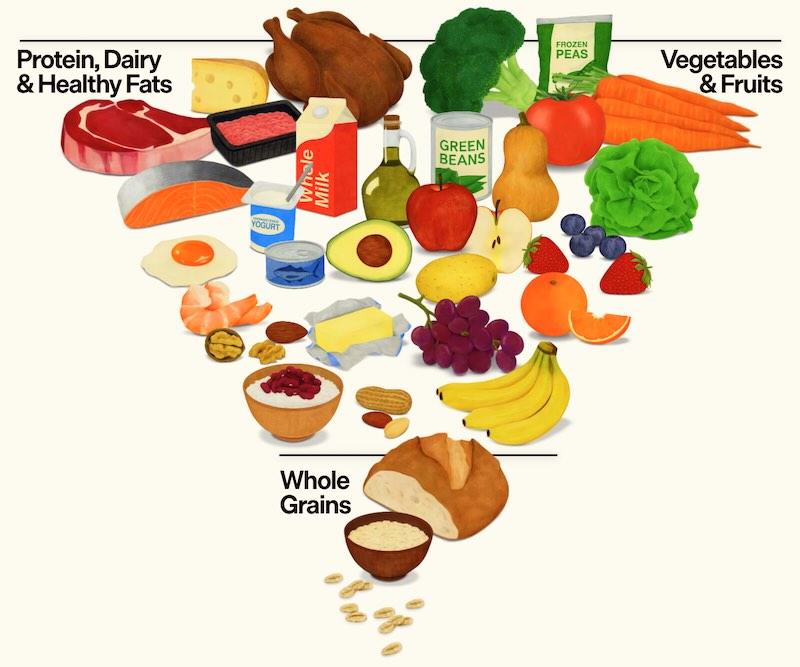
The guidelines call for higher protein intake—between 1.2 and 1.6 grams per kilogram of body weight per day—from a wide range of sources, including red meat, poultry, seafood, eggs, beans, nuts, and seeds. They also encourage full-fat dairy products such as whole milk, yogurt, and cheese, along with fats like olive oil, butter, and tallow.
Vegetables and fruits are given daily targets of three and two servings, respectively, with an emphasis on nutrient-dense, minimally processed options. Added sugars are capped at no more than 2% of total daily calories, a sharp tightening from prior guidance, and ultra-processed foods are explicitly discouraged. Limits on saturated fat remain unchanged at less than 10% of daily calories, while whole grains are recommended at two to four servings per day, prioritizing fiber-rich varieties.
Administration officials said the guidelines are intended to be flexible and culturally adaptable, allowing Americans to tailor choices to budgets, traditions, and preferences while still emphasizing whole foods most of the time. Implementation across federal programs is expected to roll out in phases over the next two years.
The update was led by Kennedy and Agriculture Secretary Brooke Rollins, and aligns with the administration’s “Make America Healthy Again” initiative, which targets rising rates of obesity, diabetes and related chronic diseases. The agencies cited evidence linking higher-protein diets to reduced diabetes risk, among other findings.
Reaction to the announcement was swift and polarized. A post from the White House announcing the guidelines drew tens of thousands of likes and more than a thousand replies within hours. Supporters praised the emphasis on whole foods and the de-emphasis of sugar and processed products, while critics questioned affordability and warned that “real food” remains out of reach for many households facing higher grocery prices.
Medical and nutrition experts also offered mixed assessments. Some praised the guidelines for taking a harder line on ultra-processed foods and added sugars. The American Medical Association highlighted those elements as positive steps. Others raised concerns ahead of the release that certain recommendations—particularly around saturated fat—could conflict with long-standing, science-based advice.
The debate underscores the stakes of federal nutrition policy, which has increasingly become a proxy for broader fights over public health, regulation, and personal choice. Whether the new guidelines reshape American eating habits—or deepen existing divides—will become clearer as they move from paper into cafeterias, kitchens and grocery aisles.