An ICE agent shot and killed American citizen Renee Nicole Good during a chaotic encounter in Minneapolis. The Trump administration defended the agent's actions as self-defense, signaling unconditional support for ICE's aggressive tactics. This incident reflects escalating tensions between immigration enforcement and the public, with similar violent confrontations likely to continue.
Key Takeaways
•ICE agents shot and killed 37-year-old American citizen Renee Nicole Good during a confusing traffic stop in Minneapolis.
•The Trump administration immediately defended the agent, claiming self-defense and granting 'absolute immunity,' despite contradictory video evidence.
•The administration framed Good's actions as 'domestic terrorism' and part of a 'sinister left-wing movement,' justifying lethal force against perceived threats.
•The incident has sparked nationwide protests against ICE's violent tactics and the administration's support for them.
•Similar shootings have already occurred elsewhere, indicating a pattern of escalating violence by immigration enforcement agencies under this administration.
The conditions that claimed Renee Nicole Good’s life will claim the lives of others. Mostafa Bassim / Anadolu / GettyOn an unseasonably warm Wednesday in Minneapolis, an Immigration and Customs Enforcement agent shot a woman in the face. The many eyes of our everyday panopticon recorded the event from multiple angles. Renee Nicole Good, a 37-year-old mom of three, had stopped her maroon SUV on a snowy street crawling with ICE officials. According to eyewitness reports, multiple men in masks shouted conflicting orders at her: At least one apparently demanded that she exit her vehicle and tried to open her door; another told her to drive away. Good seems to have moved slowly as she tried to maneuver around the agents surrounding her car. After appearing to first wave for someone to move, she reversed slightly and turned away from the agents to continue down the street. An ICE agent who appears to have been knocked back by her front bumper responded by shooting into her vehicle, and shot again as the SUV, suddenly without a conscious driver, careered into a parked car ahead.
Chaos erupted. A man announcing himself as a physician ran toward the scene to attempt to render first aid, but an ICE agent commanded him to step back. When emergency medical workers finally arrived on foot 15 minutes later, they clumsily pulled Good’s body from the driver’s seat, leaving behind a blood-soaked airbag. Onlookers immediately rose up in anger and outrage, screaming at the agents and shouting profanities. One man howled “Murderer! Murderer!” over and over again. Good’s partner, who was near the SUV, can be heard saying through sobs that Good was her wife, that their 6-year-old was at school, and that they were new in town, didn’t know anybody, had no one to call for help.
The alarm was warranted. Everyone on the scene had witnessed the crossing of a crucial line in Donald Trump’s mass-deportation project: ICE had just killed an American citizen on American soil.
The administration has since declared that the agent “is protected by absolute immunity,” whatever that means, a signal of unconditional support for an agency bloated with thousands of new, heavily armed, and minimally trained recruits, deployed around the country to help achieve Trump’s goal of deporting 1 million immigrants a year. Events such as Good’s death set the stage for yet more lethal confrontations, which the administration can be trusted to defend with the same specious pretext. What is now overt, in a way that it hadn’t been Wednesday morning, is that these agents are at war with the public, and have been for some time.
Good’s killing was the culmination of months of roiling tensions between the Department of Homeland Security and the communities it routinely invades to round up people for summary deportation. Having more than doubled ICE’s workforce in a matter of months, DHS has been fretting theatrically about how these agents are risking “their lives to remove the worst of the worst.” In retrospect, those concerns now seem like threats—a preemptive excuse for maximum violence.
The Trump administration instantly characterized Good’s killing as a matter of self-defense on the part of the ICE agent, whom The Minnesota Star Tribune has identified as Jonathan Ross, a 10-year agency veteran and member of its Special Response Team. Faced with footage of the incident Wednesday night, Trump offered the MAGA gloss on what took place: “She ran him over.” In fact, videos show that Ross remained upright.
In a press conference, DHS Secretary Kristi Noem claimed that Good had been killed because she had been “stalking and impeding” ICE agents all day, and that she had tried to “weaponize her vehicle” in an act of “domestic terrorism.” By Thursday, when White House Spokesperson Karoline Leavitt presented the administration’s official line, the story had grown more baroque. Leavitt maintained that Good was part of a “larger, sinister, left-wing movement that has spread across our country, where our brave men and women of federal law enforcement are under organized attack.” Thus Ross, as a target of a dangerous conspiracy, had merely been operating in self-defense.
In the administration’s closest brush with acknowledging wrongdoing, J. D. Vance mentioned to reporters Thursday that Ross had been involved in an incident with a vehicle several months ago, during which he was dragged for 100 yards and subsequently required numerous stitches: “So you think maybe he’s a little bit sensitive about somebody ramming him with an automobile?” These remarks could reasonably be taken to imply that Ross’s decision to shoot Good was an emotional overreaction based on past trauma, but then Vance pivoted: Ross “deserves a debt of gratitude.” In other words, even if Ross did act in error, Good’s death still bears the administration’s stamp of approval.
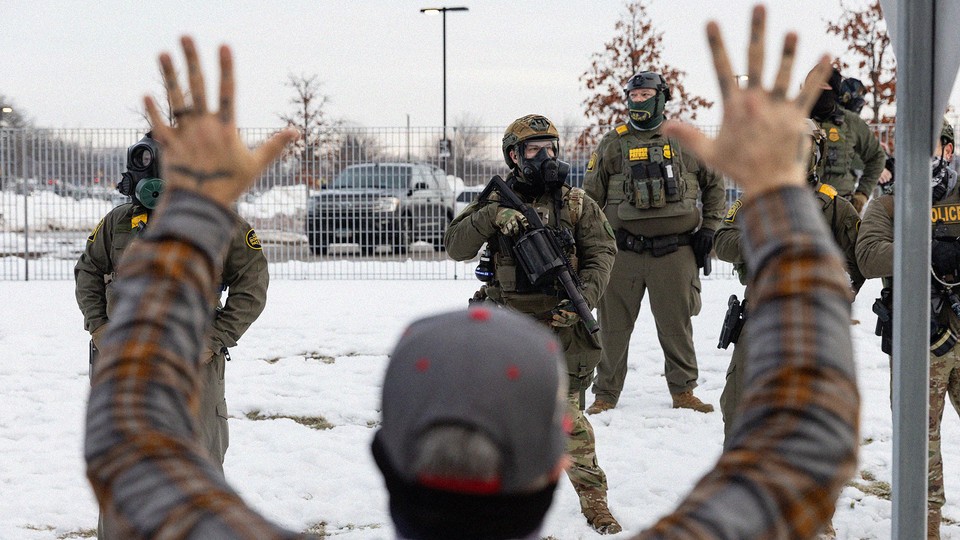
Protesters in Minneapolis have since flooded the streets in the thousands, and ICE agents have responded by apprehending some, shoving others to the ground, and spraying chemical irritants in their faces.
These incidents have ignited mass demonstrations nationwide, in which protesters have wailed “Shame”and “Murder,”banged drums, screeched from metal whistles, and hoisted signs declaring what is no longer deniable: ICE kills.
It therefore felt grimly inevitable when the Department of Homeland Security issued a statement Thursday night confirming that Border Patrol officers shot at two people in a targeted traffic stop in Portland, Oregon. “When agents identified themselves to the vehicle occupants,” the post on X read, “the driver weaponized his vehicle and attempted to run over the law enforcement agents.” There is nothing to stop the echoes of this rationale, and we should expect to hear it again and again. There may come a time when the administration dispenses with offering an explanation at all.