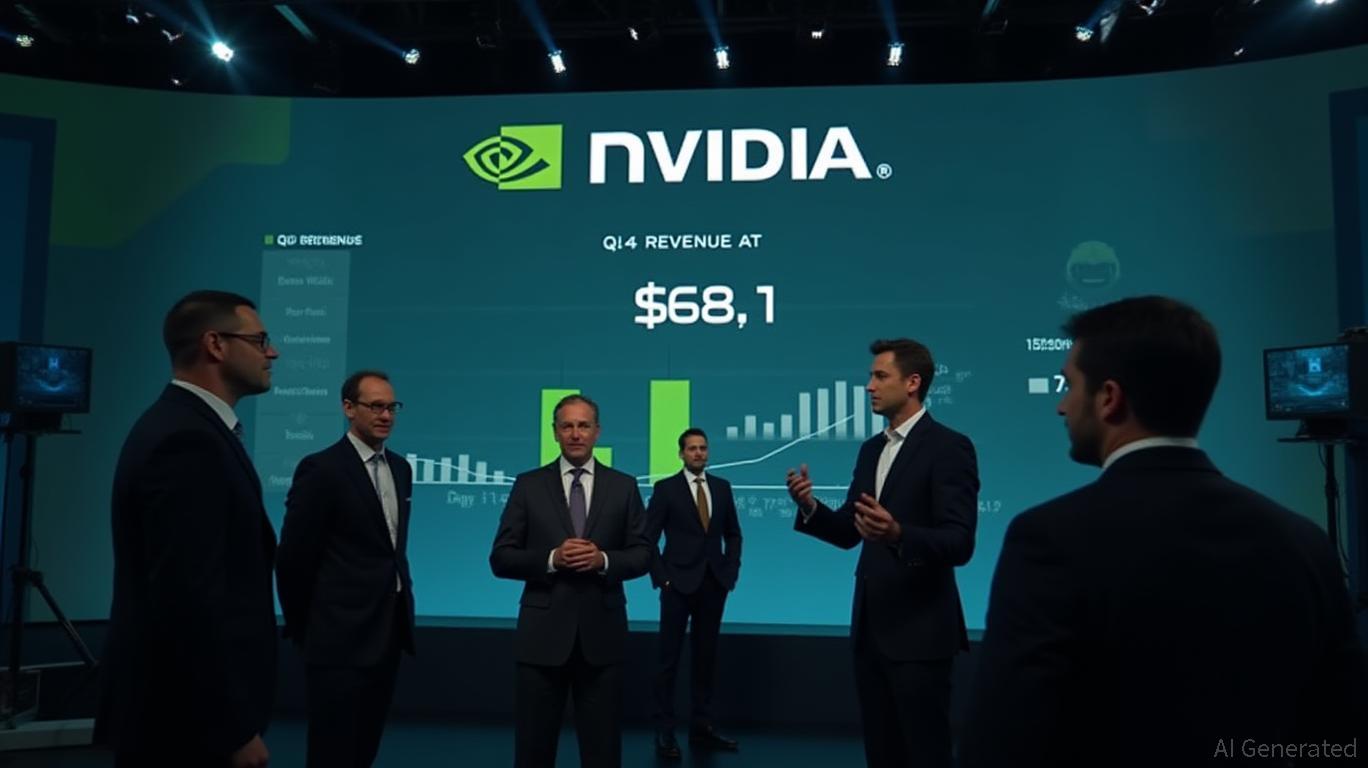
Nvidia shares turn negative after hours, previously up 4%; Q4 revenue at $68.1 billion, up 73% year-over-year.
TL;DR
Nvidia reported record Q4 revenue of $68.1 billion, up 73% year-over-year, but shares turned negative after hours despite initial gains. Strong demand for AI chips drove results, with upbeat guidance for Q1 2027, though investors expressed caution over sustainability of AI spending.
Tags
Nvidia shares turn negative after hours, previously up 4%; Q4 revenue at $68.1 billion, up 73% year-over-year.
Nvidia Shares Dip After Hours Despite Record Q4 Revenue
Nvidia (NVDA) reported record quarterly revenue of $68.1 billion for Q4 fiscal 2026, a 73% year-over-year increase, yet shares turned negative in after-hours trading, reversing earlier gains according to earnings reports. The results, which exceeded guidance by $3 billion, reflect sustained demand for AI infrastructure as cloud providers accelerate investments in computing capacity as data shows.
CEO Jensen Huang emphasized the structural shift toward agentic AI, stating, "Compute is revenues. Without compute, there's no way to generate tokens," "Without tokens, there's no way to grow revenues." The company's GAAP gross margin rose to 75%, surpassing guidance and up from 73.4% in Q3, while non-GAAP gross margin reached 75.2% according to financial results. Full-year fiscal 2026 revenue totaled $215.9 billion, a 65% increase from 2025 as reported.
Nvidia also provided upbeat guidance for Q1 2027, forecasting $78 billion in revenue, driven by continued demand for its Blackwell and Rubin AI chips according to company guidance. Total supply-related commitments surged to $95.2 billion at quarter-end, up from $50.3 billion in Q3, as the company secures inventory to meet multi-quarter demand as financial data indicates.
Despite the strong performance, investors remained cautious. Nvidia's stock initially rose 4% post-earnings but fell below breakeven in after-hours trading, reflecting concerns about the sustainability of AI-driven capital expenditures. Analysts noted that hyperscalers like Amazon, Microsoft, and Alphabet are projected to spend nearly $700 billion annually on AI and data centers, though risks such as over-investment and margin compression persist according to industry analysis.
CFO Colette Kress reaffirmed confidence in maintaining gross margins "in the mid-70s" for fiscal 2027 as stated in earnings. Meanwhile, Morgan Stanley and Bank of America reiterated "buy" ratings, citing long-term growth potential despite near-term volatility according to financial reports.
The results underscore Nvidia's central role in the AI industrial revolution, but market participants will closely watch execution risks, including Rubin's accelerated timeline and capital expenditure efficiency, to determine if the growth trajectory remains intact as industry observers note.