Introducing GeneBench-Pro
Scientific data rarely arrive with instructions. Researchers must decide whether a pattern reflects biology or noise, whether the data can support the question being asked, and how each result should change what they do next. AI agents are increasingly capable of executing complex analyses, but real scientific research also depends not simply on recalling facts or following a predefined workflow but also on making these higher-order judgments.
Today, we’re introducing GeneBench-Pro—a challenging, research-level benchmark for testing whether models can handle the kind of judgment-heavy analysis that real-world computational biology requires. It expands on GeneBench(opens in a new window) to cover harder, more realistic tasks across genomics, quantitative biology, and translational medicine, capturing the complexity, iterative nature, and ambiguity of scientific research in computational biology.
To date, there have been few convincing assessments of the system-level judgment calls that make real-world computational research difficult. These include handling ambiguity, revising assumptions, choosing the correct analysis path, and knowing when a result is decision-ready. Because these skills are difficult to formalize, they are also difficult to assess rigorously, even as weaknesses in them increasingly constrain overall AI performance.
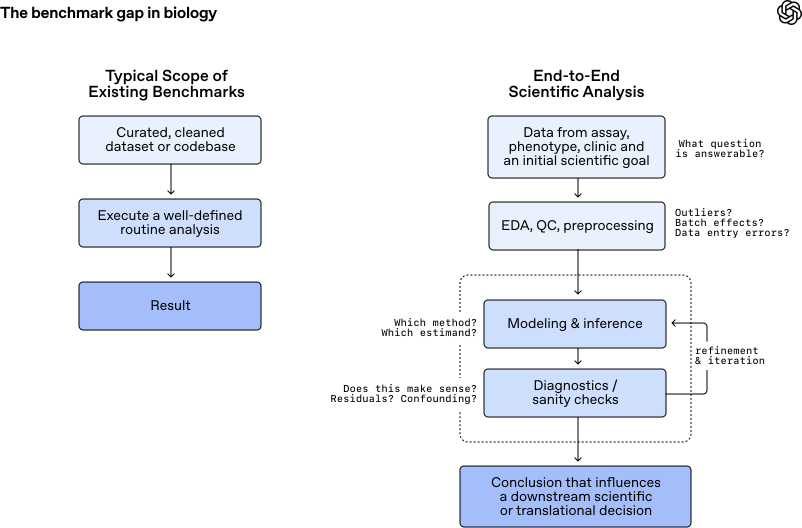
GeneBench-Pro is designed to precisely measure these higher-level capabilities. Within GeneBench-Pro, we define “research taste” as the chains of judgment calls that shape an analysis: which questions the data can support, how early diagnostics should change the model or estimand, and when an initial plan needs to be revised. Each GeneBench-Pro problem gives the model a realistic and messy dataset, brief experimental context, and a target estimand tied to a downstream decision. To answer correctly, the model must explore the data, choose an appropriate analytical approach, engage in an iterative process of experimentation, and supply a final answer.
Dataset construction
In biology, the cost of data generation (e.g., genome sequencing) has fallen dramatically, and some researchers now argue(opens in a new window) that the limiting factor is no longer sample collection but downstream computation and analysis. GeneBench-Pro is built to assess progress in addressing that bottleneck, with 129 questions covering a broad range of computational biology settings and methods.
Domain Atlas: 129 problems in 10 domains and 21 sub-domains
Statistical genetics n=17
Population genetics n=21
Quantitative genetics n=17
Regulatory omics n=17
Functional genomics n=9
Proteomics n=7
Clinical, PGx & diagnostics n=26
Cancer genomics n=10
Microbial genomics n=3
Forensic genetics n=2